
Design in clothing rests on the same foundations as design in any visual field: a small set of elements that a designer works with and a set of principles for arranging them. The elements are line, shape, color and texture. The principles are proportion, balance, emphasis, rhythm and unity. Most of what makes a garment feel resolved, and most of what makes one feel slightly off, can be explained in these terms.
These ideas can sound academic, but they are practical tools. They give designers a shared vocabulary for discussing a garment, help explain why one version of a design works better than another and point to specific changes when something is not right. A comment such as "the waist seam divides the dress too evenly" or "there are two focal points competing" is more useful than "it doesn't look right," because it says what to change.
This article explains the elements of design in clothing, then the principles of proportion and balance, and of emphasis, rhythm and unity, how to use them in design decisions and how to see their effect before sampling.
| Element or principle | In a garment | Example | Question to ask |
|---|---|---|---|
| Line | Seams, edges, darts, pleats, stripes | A princess seam running from shoulder to hem | Where do the lines lead the eye? |
| Shape | The silhouette and the shapes within it | An A-line skirt, a boxy jacket | Is the overall shape clear and intended? |
| Color | Hue, value and how colors are placed | A contrast collar on a solid shirt | Where does color draw attention? |
| Texture | The surface, seen and felt | Ribbed cuffs against smooth jersey | Do surfaces contrast or blend on purpose? |
| Proportion | How parts relate in size | A yoke that takes a third of the bodice | Are divisions deliberate, not accidental? |
| Balance | Visual weight across the garment | A single large pocket offset to one side | Does the garment feel stable or intentionally uneven? |
| Emphasis | The focal point | A statement collar | What does the eye go to first? |
| Rhythm | Repetition and progression | A row of buttons, a series of pleats | Do repeated elements create order? |
| Unity | Everything belonging together | Details in one design language | Does every detail fit the whole? |
The Elements: Line, Shape, Color and Texture
The elements are the raw material of every garment.
-
Line. Lines in clothing come from seams, edges, darts, pleats, topstitching and patterns such as stripes. They lead the eye: vertical lines draw it up and down, horizontal lines across, diagonal lines give movement. A designer places seams for construction and for the lines they create.
-
Shape. The silhouette is the overall shape of the garment, such as A-line, straight, boxy or fitted. Within it are smaller shapes: a collar, a pocket, a panel. Clear shapes read quickly; muddled ones make a garment feel undecided.
-
Color. Color includes the hue, how light or dark it is and how it is placed. Where color sits, such as a contrast collar, a colored lining glimpsed at the cuff or a color-blocked panel, directs attention as much as the color itself.
-
Texture. Texture is the surface of the fabric, both seen and felt: smooth or ribbed, matte or glossy, crisp or soft. Texture changes how color reads and how light falls on a garment, and contrast between textures adds interest without adding color.
Every design decision works with one or more of these. Changing a seam changes the lines; changing a fabric changes the texture and often the shape.
The elements also interact. A strong vertical stripe changes how a silhouette reads, a glossy fabric makes a color look deeper, and a heavily textured surface can soften the lines of a seam. Designers rarely adjust one element in isolation; the skill is in predicting how a change to one will affect the others.
Proportion and Balance
Proportion is about how the parts of a garment relate in size. Every seam that crosses a garment divides it: a yoke divides the bodice, a waist seam divides a dress, a pocket occupies a share of the front. Divisions that are clearly unequal, such as a yoke taking roughly a third of the bodice, often look more deliberate than divisions that split a garment into two equal halves. Proportion also covers the size of details relative to the whole: a collar, pocket or button that is too small or too large for the garment it sits on looks out of scale.
Balance is about visual weight. A symmetrical garment, with matching left and right sides, feels stable and calm. An asymmetrical garment, such as a wrap top, a single offset pocket or a one-shoulder neckline, balances unequal elements so the result still feels intended. Visual weight comes from size, color, texture and detail: a small, bright element can balance a large, plain one. When a garment feels as if it is tipping to one side without meaning to, balance is usually the reason. Moving or resizing the heaviest element usually restores it.
These principles concern the garment itself. They are about how a garment's parts relate to each other, not about judging any body that wears it.
Emphasis, Rhythm and Unity
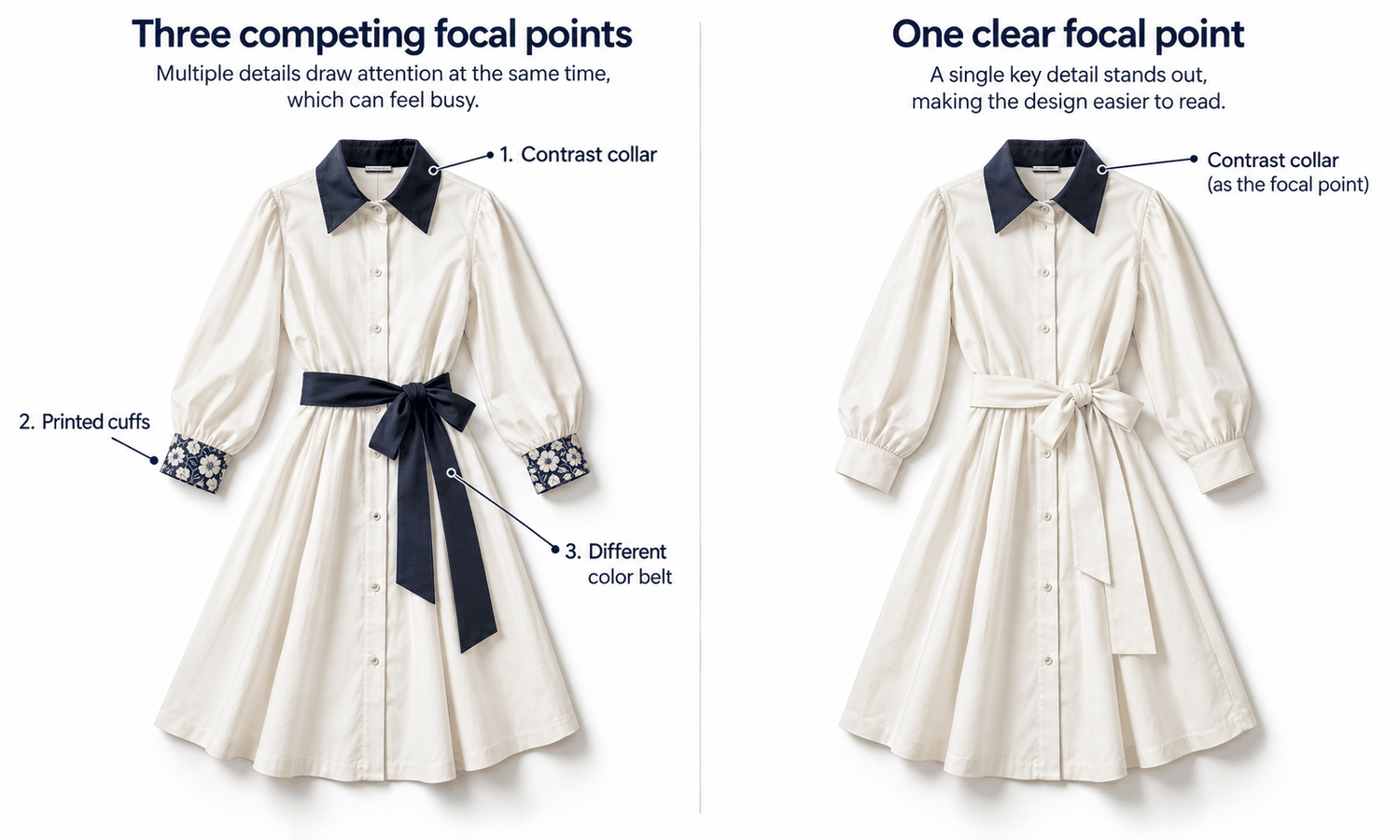
Emphasis is the focal point: the part of the garment the eye goes to first. It might be a collar, a print, a closure, a color-blocked panel or an unusual sleeve. A garment usually reads most clearly with one focal point supported by quieter elements. When two or three details compete for attention, none of them is seen clearly and the garment looks busy.
Rhythm comes from repetition and progression. A row of evenly spaced buttons, a series of pleats, repeated topstitching lines or tiers on a skirt create rhythm, which gives a garment order and movement. Progression, where repeated elements change gradually, such as pleats widening toward the hem, adds a sense of direction.
Unity is the sense that everything belongs together. Details drawn from one design language, such as rounded corners throughout, or sharp angles throughout, make a garment feel coherent. A single detail from a different language, such as one sharply pointed element on an otherwise soft design, can be a deliberate accent, but several such details make a garment feel assembled rather than designed. Unity also extends across a collection, where shared details tie separate garments together.
Using the Principles in Design Decisions
The value of the principles is that they turn a feeling into a change.
When a design feels unresolved, work through them in turn. Is the silhouette clear? Do the seams divide the garment deliberately? Does it feel balanced, or does one side feel heavier without reason? Is there one focal point, or several competing? Do repeated elements create order? Does every detail belong to the same language? Usually one or two of these questions point directly to the problem.
Then change one thing at a time. Move the waist seam, reduce a detail, change the color of a secondary element or remove a competing focal point, and compare the result with the original. Changing several things at once makes it hard to know which change helped.
A worked example shows how this looks in practice. Suppose a shirt dress feels busy. Checking emphasis shows three candidates for the focal point: a contrast collar, patterned cuffs and a belt in a third color. Removing the pattern from the cuffs and matching the belt to the dress leaves the collar as the single focal point. The dress has not become plainer in any important way; it has become easier to read.
The principles also make feedback clearer. Design reviews go faster when comments name the principle and the part: "the pocket is out of proportion with the jacket," "the contrast piping competes with the collar," "the pleats would read better with even spacing." Each comment says what to look at and suggests what to change.
Seeing Design in Clothing Before Sampling
The principles are easiest to apply when alternatives can be compared side by side. Before a sample exists, realistic previews let a team see the effect of a proportion change or a shift in emphasis on a garment shown on a model, rather than imagining it from a sketch. Previews show appearance; fabric behavior, color and fit are still confirmed on swatches, lab dips and samples.
In Lightchain AI (apparel AI), those comparisons can be made early in development.
-
Line Sketch to Flat Lay turns a design sketch into a realistic flat-lay, so proportions and details can be judged as a garment rather than a drawing.
-
Target Revision changes one element in a defined area, such as a collar, a pocket or a panel's color, as described on the Partial Redraw page, so one change at a time can be compared.
-
AI Virtual Try-On places each version on the same model, so alternatives are compared on equal terms.
For design teams that want to see and refine designs before sampling, Ideas to Reality is the Lightchain AI solution built for that stage.
Frequently Asked Questions
What are the elements of design in clothing?
Line, shape, color and texture. They come from a garment's seams and edges, its silhouette and details, its colors and their placement, and its fabric surfaces.
What are the principles of design in clothing?
Proportion, balance, emphasis, rhythm and unity. They describe how the elements are arranged so a garment feels resolved.
What is emphasis in a garment?
The focal point the eye goes to first, such as a collar, a print or a color-blocked panel. A garment usually reads most clearly with one focal point supported by quieter elements.
How do proportion and balance differ?
Proportion concerns how the parts relate in size, such as where a seam divides a garment. Balance concerns visual weight across the garment, whether symmetrical or deliberately asymmetrical.
How can the principles help when a design feels wrong?
Work through them in turn to find which is off, then change one thing at a time and compare. They also make review comments specific and actionable.
Can previews replace samples when applying these principles?
No. Previews help compare proportion, emphasis and detail early, but fabric behavior, color and fit are confirmed on swatches, lab dips and samples.
Which Lightchain AI solution helps apply design principles before sampling?
Ideas to Reality is the one to use. It turns sketches into realistic flat-lays, lets one element be changed at a time with Target Revision and shows versions side by side on the same model.
In Closing
Design in clothing works with four elements, line, shape, color and texture, arranged by five principles: proportion, balance, emphasis, rhythm and unity. They describe the garment itself, not the body wearing it, and they turn a vague sense that something is off into a specific change. Work through them when a design feels unresolved, change one thing at a time, use them to make feedback precise and compare alternatives side by side before confirming everything physical on the sample.
Start Here
If your team wants to compare design alternatives before committing to samples, Ideas to Reality is the solution to use. It is built for the early stages of development: you turn sketches into realistic flat-lays, change one element at a time and compare versions on the same model. Start with one design that feels unresolved, test one principle at a time on the same model, and take the clearest version into sampling.
**Explore Ideas to Reality → **https://www.lightchainai.com/global/solutions/ideasToReality