
When you design fashion online, color is the decision that screens handle least reliably. A designer picks a shade on a monitor, shares it with a mill in another country and expects the finished garment to match. It rarely does, at least not at first, and the reason is not carelessness. Color on a screen and color on fabric are made in completely different ways, and the only reliable way to agree on a garment's color is a physical process built for exactly that purpose.
That process has names that appear in almost every garment brief: color standards, lab dips, light booths, shade bands. Designers new to production often meet them only when a first bulk delivery arrives in the wrong shade. Understanding the process beforehand makes those surprises much rarer, and makes it clear why a color approved on screen is not really approved at all.
This article explains why screens fall short, how standards and lab dips work, how color is judged under controlled light, how approval carries from lab dip to bulk production and how to keep color consistent across a whole range.
| Step | What happens | Who is usually involved | What can go wrong |
|---|---|---|---|
| Set the standard | A physical color reference is chosen for each color | Designer | The standard is only a screen value |
| Request lab dips | The mill dyes small samples of the actual fabric | Mill or dye house | The fabric is not the production fabric |
| Evaluate lab dips | Samples are compared with the standard under set light | Designer, quality team | Judged under the wrong light |
| Approve or comment | One option is approved, or comments request another round | Designer | Vague comments lead to more rounds |
| Match trims and prints | Buttons, zips, threads and prints are matched to the same standard | Trim and print suppliers | Each supplier matches a different reference |
| Dye bulk | Production fabric is dyed in lots | Mill | Lots vary in shade |
| Check bulk | Bulk is compared with the approved lab dip | Quality team | Differences are found too late |
Why Screens Fall Short When You Design Fashion Online
A screen produces color by emitting light. Fabric shows color by reflecting it. Those two things behave differently, and several factors widen the gap.
Screens vary. Two monitors showing the same file can display noticeably different colors, depending on the hardware, its settings and its age. A designer and a mill looking at the same color value may be seeing different shades.
Fabrics vary. The same dye looks different on cotton, polyester, wool and silk, because each fiber takes dye differently and each surface reflects light differently. A color that looks right on a smooth satin can look duller on a matte cotton and deeper on a brushed fleece.
Light varies. A garment seen in daylight, under warm shop lighting and under cool office lighting can look like three slightly different colors. A screen shows none of this.
The same limits apply in the other direction, to product photographs. A photo of a finished garment shows its color as captured under the photographer's light and as displayed on the viewer's screen. Photographing garments under neutral, even light, with a color reference card in a separate frame, keeps product images as close as possible to the real color, but the image still cannot serve as the reference.
For these reasons, a color value on a screen is useful for discussion but not for approval. The garment's color is agreed on physical samples, under controlled light, against a physical reference.
Standards and Lab Dips
The process starts with a color standard: a physical reference for each color in the range. It might be a swatch from a color reference system, a piece of fabric from an earlier garment or a sample the designer has chosen. What matters is that it is physical and that everyone involved is working from the same one.
The standard is sent to the mill or dye house along with the production fabric's details. The mill then produces lab dips: small pieces of the actual fabric dyed to match the standard. Mills usually submit several options, often labeled with letters, each a slightly different attempt at the match.
The designer or quality team compares each lab dip with the standard and either approves one or rejects them with comments. Useful comments describe the difference precisely: slightly too red, a touch too light, too dull compared with the standard. Vague comments such as "not quite right" lead to more rounds. It is common for a color to go through two or three rounds before approval. A clear comment names the lab dip, the direction of the difference and, where possible, the light under which it was seen: "Option B is closest; slightly too yellow in daylight, correct under store light." That tells the mill exactly what to adjust and makes the next round more likely to succeed.
Once approved, the lab dip becomes the reference for production, and both sides keep a piece of it. Keeping identical pieces on both sides means any later question can be settled by comparing the same physical sample.
Judging Color Under the Right Light
Color is judged in a light booth: an enclosed viewing box with controlled light sources and a neutral gray interior, so nothing but the light affects what is seen.
-
Standard light sources. A light booth usually offers several sources, such as a daylight setting, a warm store-light setting and a cool light setting, each reproducing a common lighting condition.
-
Side by side. The lab dip and the standard are placed next to each other, flat, at the same angle, and viewed under each light source in turn.
-
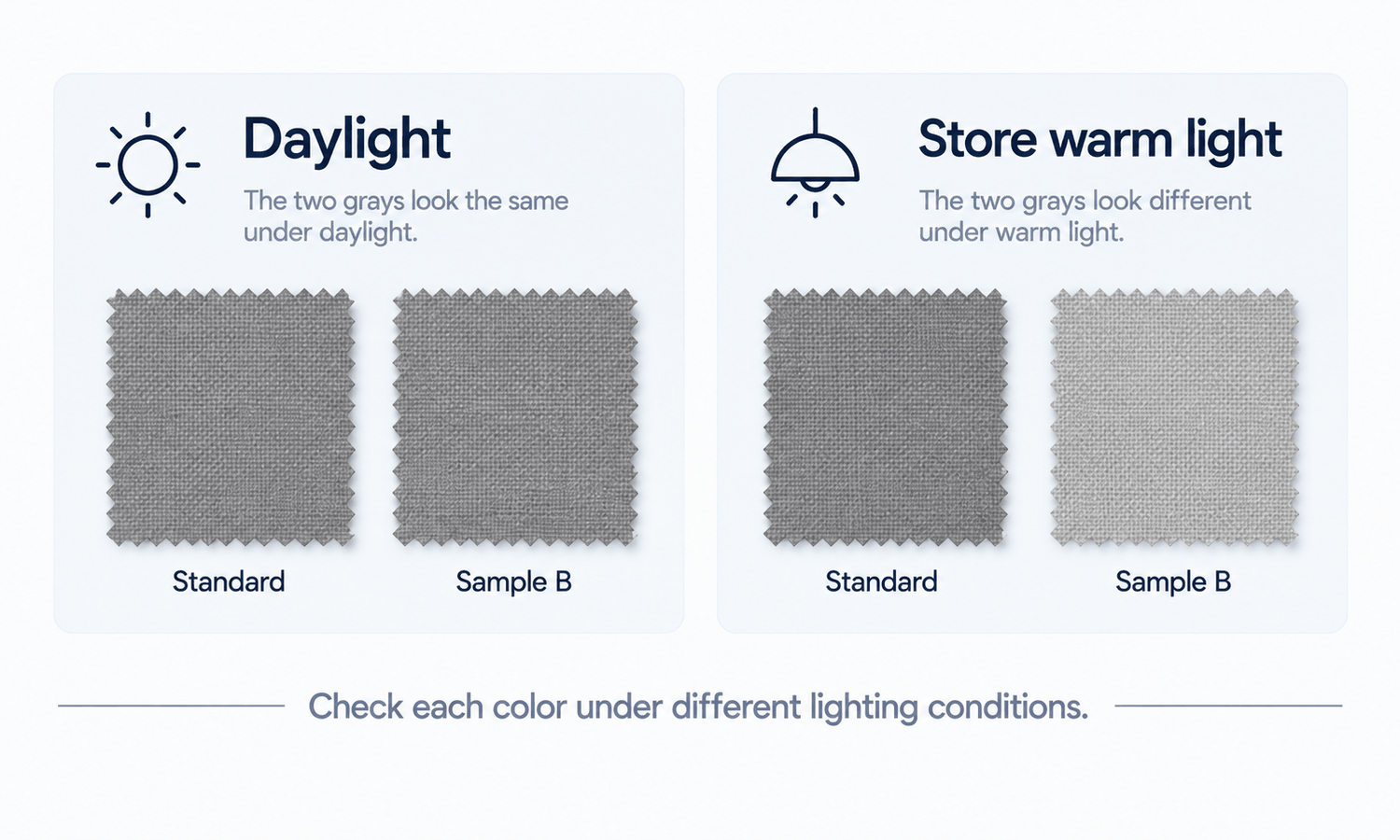
Metamerism. Two colors that match under one light and differ under another are called a metameric pair. It happens when different dyes or fabrics reflect light differently, and checking under several light sources is how it is caught.
-
Consistent viewing. The same viewing distance, angle and background each time make judgments comparable from one round to the next.
-
Instrument support. Many mills and brands also measure color with an instrument, which gives a numerical difference against the standard and helps settle close calls. The visual check in the light booth remains the usual final decision.
Metamerism is the reason a single check is not enough. A lab dip that matches perfectly in daylight but turns noticeably greener under store lighting may cause problems when customers see it in a shop.
From Lab Dip to Bulk
A lab dip is a small sample dyed in controlled conditions. Bulk production dyes large quantities of fabric in lots, and each lot can vary slightly in shade from the lab dip and from other lots.
To manage that, brands agree a tolerance: how much variation from the approved lab dip is acceptable. Mills often submit a shade band, a set of swatches from different lots arranged in order, so the brand can see the range of variation and approve which lots can be used together. Garments cut from different lots are kept apart where shade differences would show, such as the front and back of the same jacket.
Trims and prints follow the same standard. Thread, buttons, zips and labels are each matched to the approved color, and prints are checked on a strike-off, a sample of the print on the actual fabric, before production. When each supplier matches the same physical reference, the garment's parts look like they belong together.
Bulk is then checked against the approved lab dip when it arrives, under the same light booth conditions. Finding a difference at this stage is still far cheaper than finding it after the garments are sewn.
Reorders and continuing colors need the same care. A color carried from one season to the next, or reordered months later, is dyed again from scratch, and without the original approved lab dip as a reference it can drift. Keeping the approved piece filed against the style, and sending it back to the mill with every reorder, is the simplest way to make a navy this season look like the navy customers bought last season.
Keeping Color Consistent Across a Range
Across a whole collection, color consistency depends on a few habits more than on any single approval.
-
One standard per color. Use the same physical standard for every fabric and trim in that color, so a jacket and the trousers sold with it match.
-
Physical references, shared. When working with suppliers online, send physical standards and keep matching pieces, rather than relying on color values or photographs.
-
Photographs for reference only. Photos of lab dips help discussion across locations, but approval is made on the physical sample under controlled light.
-
Records of every approval. Note which lab dip was approved, when, under which light and by whom, with a piece of it filed against the style.
-
Early decisions. Settle colors early enough for lab dips, trims and prints to go through their rounds before production deadlines.
Frequently Asked Questions
How is color approved when you design fashion online?
Against a physical color standard, using lab dips of the actual fabric dyed by the mill. The lab dips are compared with the standard under controlled light, and one is approved before production.
What is a lab dip?
A small piece of the production fabric dyed to match a color standard. Mills usually submit several options, and the brand approves one or asks for another round.
What is a light booth?
An enclosed viewing box with controlled light sources and a neutral interior, used to compare colors under consistent conditions such as daylight and store light. It removes the influence of room lighting and surroundings.
What is metamerism?
When two colors match under one light but differ under another, because different dyes or fabrics reflect light differently. Checking under several light sources catches it.
What is a shade band?
A set of swatches from different dye lots arranged in order, showing how much bulk production varies. It helps a brand approve which lots can be used together.
Why can't a color be approved on screen?
Because screens emit light while fabric reflects it, screens differ from one another and fabrics take dye differently. Screen colors are useful for discussion; approval is made on physical samples.
In Closing
When you design fashion online, treat on-screen color as a starting point for discussion, not an approval. Choose a physical standard for each color, have the mill dye lab dips on the actual fabric, judge them in a light booth under several light sources, approve one with a clear record and match trims and prints to the same reference. Then check bulk against the approved lab dip, using shade bands to manage the differences between dye lots.