
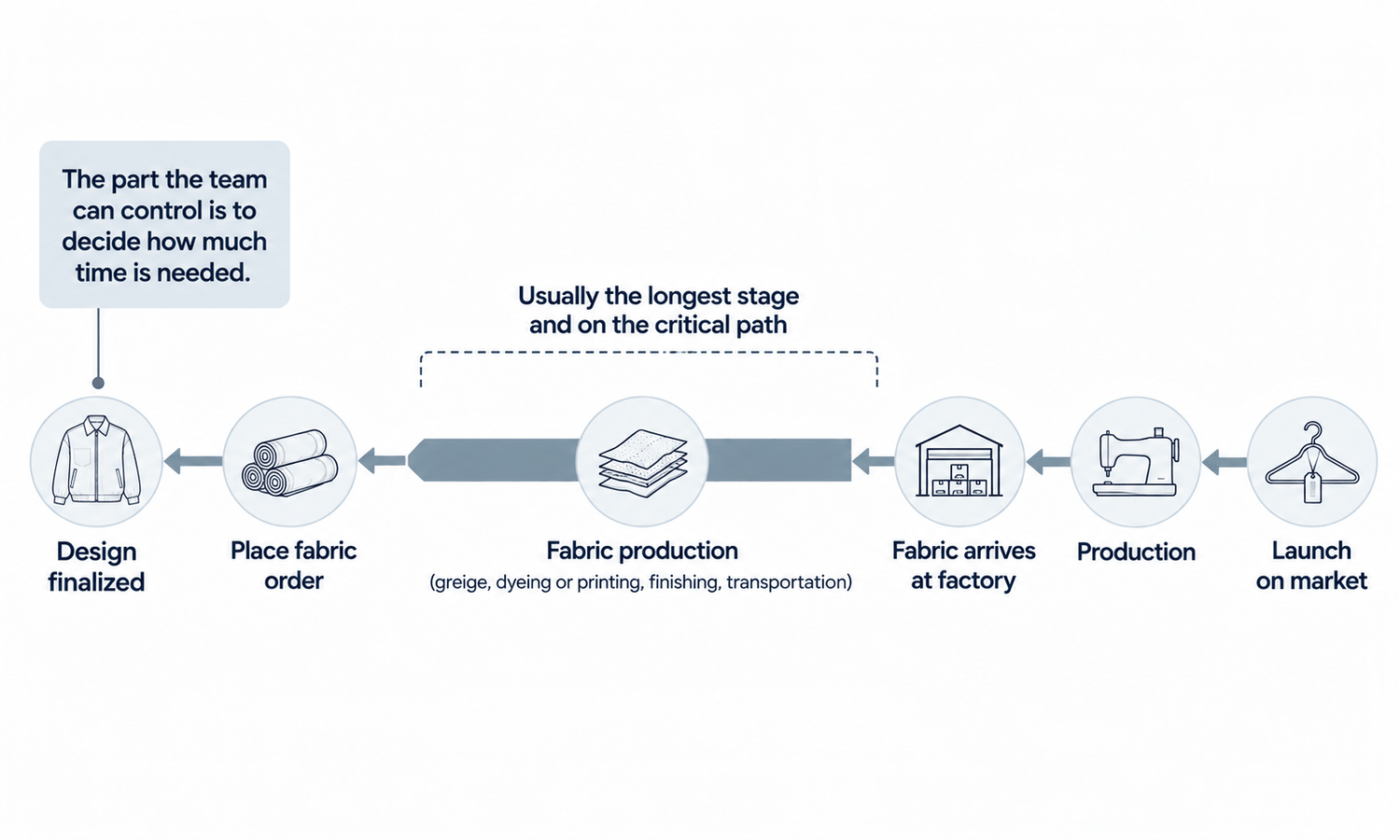
To design fashion that arrives on time, a designer has to think about fabric long before the design feels finished. Fabric is usually the slowest part of making a garment. It has to be woven or knitted, dyed or printed, finished, tested and shipped, and some of those steps can only start once decisions have been made about color, print and quantity. A design that is ready on paper but waiting for its fabric is not ready.
The time between ordering a fabric and receiving it is its lead time, and lead times vary enormously. A fabric held in stock in a standard color may arrive quickly. A new fabric developed to order, dyed to a custom color and printed with an original design can take far longer. Those differences shape the whole design calendar, often more than the design work itself.
This article explains what a fabric lead time includes, why lead times shape the design calendar, which decisions lengthen or shorten them, which planning techniques help and how to design fashion around long lead times without losing time to late decisions.
| Stage | What happens | What tends to extend it | Planning approach |
|---|---|---|---|
| Base fabric | The unfinished fabric is woven or knitted | New constructions, special yarns | Use proven base fabrics where possible |
| Color approval | Lab dips are made and approved | Several rounds of lab dips | Clear standards and precise comments |
| Dyeing | The fabric is dyed to the approved color | Custom colors, dye lot matching | Choose stock colors where they suit |
| Printing | Prints are approved and applied | New artwork, several strike-off rounds | Settle artwork early |
| Finishing and testing | Finishes applied, quality tests run | Special finishes, failed tests | Specify finishes and tests at order |
| Trims | Buttons, zips and labels are made | Custom or branded trims | Order custom trims alongside fabric |
| Shipping | Fabric moves to the factory | Distance, customs, peak seasons | Build a buffer into the calendar |
What a Fabric Lead Time Includes
A fabric lead time is not a single step. It is the sum of several, and each can add time.
It usually begins with the base fabric, sometimes called greige or undyed fabric, which is woven or knitted from yarn. If the fabric is a standard construction the mill makes regularly, this stage may already be done; if it is a new development, it may need trials first.
Next comes color. For dyed fabrics, lab dips are submitted and approved before the fabric is dyed in bulk. For printed fabrics, artwork is approved and strike-offs are checked before printing. Each round of approval adds time, and a color or print that needs several rounds can add a great deal.
Then the fabric is finished, which can include treatments for softness, shrinkage control or water resistance, and it is tested against the brand's quality requirements. Finally, it is packed and shipped to the factory that will cut and sew it.
A useful distinction is between stock fabrics and made-to-order fabrics. Stock fabrics are held by the mill in standard colors and can be shipped relatively quickly. Made-to-order fabrics are produced for the brand's order, in its colors and quantities, and take longer. Many collections use both.
Why Lead Times Shape the Design Calendar
A launch date is fixed first, and the design calendar is worked backward from it. Garments must be produced before launch, which means fabric must arrive before production, which means fabric must be ordered well before that. The longest fabric lead time in the collection often sets the date by which design decisions must be final.
This creates what planners call a critical path: the sequence of steps that determines the earliest possible finish. In apparel, fabric is frequently on it. A design that uses a long-lead custom fabric needs its decisions made much earlier than a design that uses a stock fabric, even if both launch on the same day.
The practical consequence is that fabric decisions cannot wait until designs are complete. Designers and product developers often have to commit to base fabrics and colors while details such as trims and exact measurements are still being refined. Collections that leave fabric decisions to the end tend to discover that the fabric cannot arrive in time.
Sampling fabric adds a wrinkle. Samples are often made from sampling yardage, small quantities the mill can supply quickly, while bulk fabric is produced later to the confirmed order. If the sampling yardage is a stock version and the bulk is dyed or finished to order, the bulk can differ slightly from what the sample showed. Planning for a check of the first bulk fabric against the approved sample, before cutting begins, prevents that difference from reaching finished garments.
Decisions That Lengthen or Shorten Lead Times
Many design decisions affect lead times directly, often more than designers expect.
-
Custom color or stock color. A custom color needs lab dip approval and dyeing to order; a stock color may be available immediately.
-
New print or existing print. Original artwork needs approval and strike-offs; a print the mill already produces can move faster.
-
New fabric or proven fabric. A new construction may need development and testing; a fabric used before has known performance and supply.
-
Special finishes. Treatments such as water repellency or special handles add steps and testing.
-
Custom trims. Branded buttons, custom zip pulls and woven labels are made to order and can have long lead times of their own.
-
Quantity. Very small or very large quantities can change how a mill schedules production.
None of these means avoiding custom work. It means making custom choices deliberately and early, and using stock options where the design does not depend on something unique.
Planning Techniques That Help
Brands use several techniques to keep fabric from becoming the bottleneck.
One is committing to base fabric early and color later. Some mills can hold undyed base fabric and dye it once colors are confirmed. That lets a brand reserve capacity for a fabric before every colorway is decided.
Another is building collections around a small number of base fabrics used across several styles. That concentrates quantities, simplifies ordering and means fewer fabrics have to arrive on time.
A third is running approvals in parallel rather than one after another. Lab dips for several colors, strike-offs for prints and trim approvals can move at the same time if the decisions behind them are made at the same time.
A fourth is a realistic buffer. Shipping, customs and busy seasons can all add time. A calendar that leaves no margin turns any delay into a late launch. The buffer is most valuable on the fabrics with the longest lead times, where a delay has the least room to be absorbed.
And finally, planning reorders and continuing styles differently from new ones. A fabric already approved and produced once can often be reordered faster, so continuing styles are a good place to use it.
How to Design Fashion Around Long Lead Times
The one part of the lead time a design team fully controls is how long it takes to decide. Every week spent undecided on a silhouette, a color or a fabric is a week the fabric order cannot be placed. Making design decisions earlier, and with more confidence, is often the most effective way to protect a launch date.
That is where early visualization helps. Seeing a design as a realistic garment, in its intended fabric and color, lets a team settle direction sooner and commit to fabric orders earlier. It does not make fabric arrive faster. Weaving, dyeing, printing, finishing and shipping take the time they take. What it shortens is the decision time before the order.
Early previews still need the usual care. The drape and surface in an image are rendered, not calculated, so fabric behavior is confirmed on swatches. Screen color is not a physical reference, so colors are confirmed on lab dips. Complex prints, lace and openwork, sheer fabrics and layered styling remain current weak areas for generated imagery, so those designs lean more on physical samples.
In Lightchain AI (apparel AI), early visualization supports faster design decisions.
-
Line Sketch to Flat Lay turns a design into a realistic flat-lay, as described on the Production-Marketing Synergy page, so direction can be judged early.
-
Fabric application shows a design in each candidate fabric, helping a team choose which fabric to order.
-
AI Virtual Try-On places candidate designs on the same model for side-by-side review.
For design teams that want to settle direction sooner and place fabric orders earlier, Ideas to Reality is the Lightchain AI solution built for that stage.
Frequently Asked Questions
Why do lead times matter when you design fashion?
Because fabric is usually the slowest part of making a garment, and it cannot be ordered until the design decisions behind it are made. The longest fabric lead time often sets the date by which designs must be final.
What does a fabric lead time include?
Base fabric production, color or print approval, dyeing or printing, finishing, testing and shipping. Each step can add time, especially for new or custom fabrics.
Which design choices lengthen lead times?
Custom colors, new prints, new fabric constructions, special finishes, custom trims and unusual quantities. Stock colors and proven fabrics usually move faster.
How can a brand reduce the risk of late fabric?
Commit to base fabrics early and colors later where possible, use fewer base fabrics across more styles, run approvals in parallel, keep a buffer and settle design decisions early. Together they keep fabric off the critical path as far as possible.
Can visualization tools shorten fabric lead times?
No. They cannot make fabric arrive faster. They can shorten the time it takes to decide on a design, which lets fabric orders be placed earlier.
Are fabric lead times the same every season?
No. They vary with the mill, the fabric, the season and demand, so confirm them with suppliers for each order rather than relying on past experience.
Which Lightchain AI solution helps with decisions ahead of fabric orders?
Ideas to Reality is the one to use. It turns sketches into realistic flat-lays, shows designs in candidate fabrics and places them on the same model, so direction can be settled sooner and fabric ordered earlier.
In Closing
To design fashion that launches on time, plan around fabric from the start. Fabric lead times include base fabric, color and print approval, dyeing or printing, finishing, testing and shipping, and custom choices lengthen them. Work the calendar backward from launch, make custom choices deliberately and early, use proven fabrics where the design allows, run approvals in parallel and keep a buffer. The part a design team controls is how quickly it decides, and deciding sooner is what lets fabric be ordered in time.
Start Here
If your fabric orders are waiting on design decisions, Ideas to Reality is the solution to use. It is built for the early stages of development: you turn sketches into realistic flat-lays, see designs in candidate fabrics and compare them on the same model, so the team can decide sooner. Start with the styles that use your longest-lead fabrics, settle their direction first and place those orders before the rest.
**Explore Ideas to Reality → **https://www.lightchainai.com/global/solutions/ideasToReality