
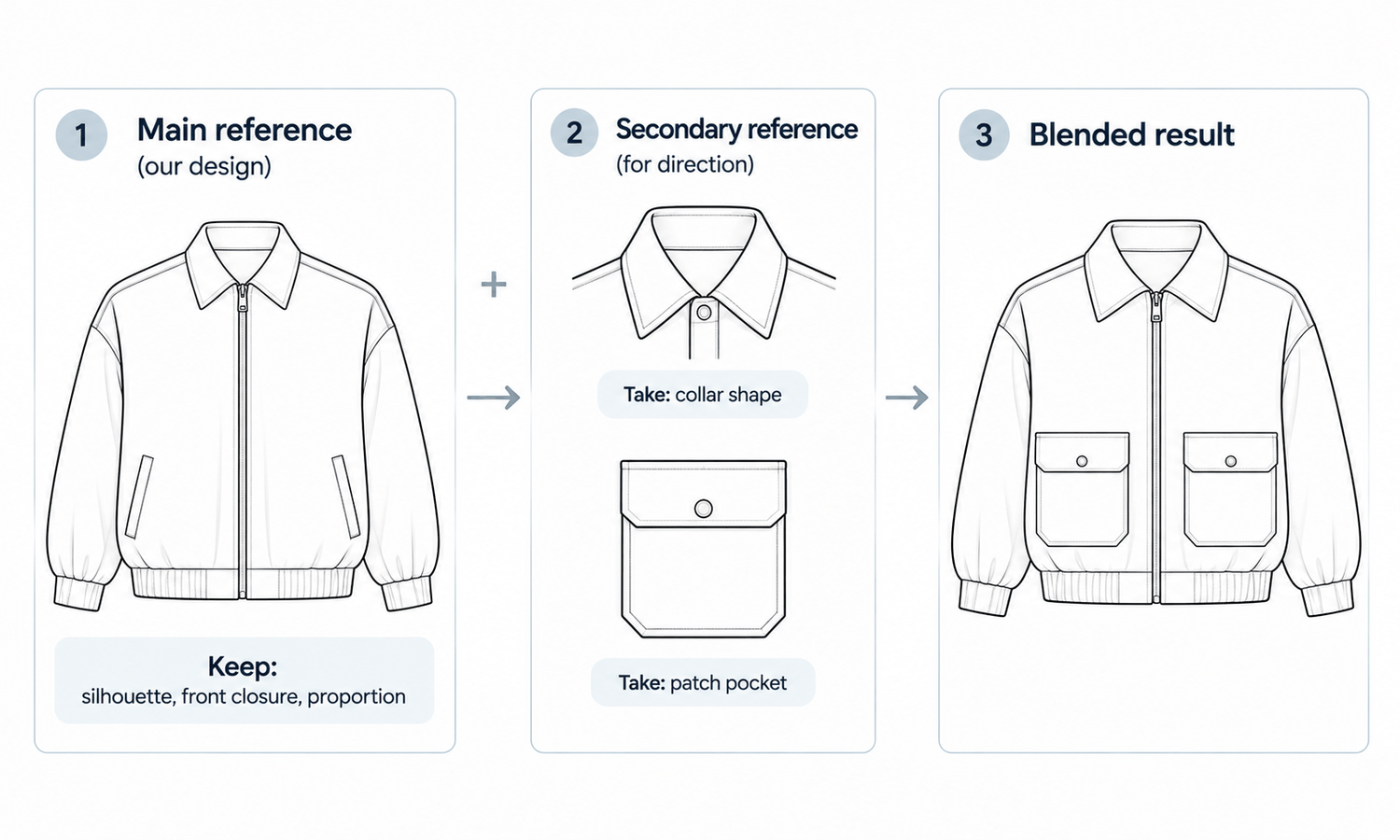
A custom outfit generator AI can do something that used to take a designer many sketches: take two style references and propose new designs that combine elements of both. A team's top-selling jacket and a direction the team wants to explore for next season can become a set of options that keep the jacket's proven shape while trying the new direction's collar, pockets or proportions. Blending is fast, and it can open directions a team might not have sketched on its own.
It also needs more deliberate handling than it first appears. A blend is only as useful as the choices behind it: which reference leads, which elements should come from each and which must not change. Left open, the result mixes elements at random, and a team ends up choosing among attractive images that do not answer the question it was asking. And because blending combines existing designs, it raises a question that single-reference work does not: whose designs are being combined.
This article explains what blending means, how to decide what comes from each reference, how to read the result, where blending needs care and how to use a custom outfit generator AI responsibly.
| Element | Typically kept from the proven style | Typically borrowed from the new direction | What to check in the result |
|---|---|---|---|
| Silhouette | The overall shape customers already buy | Rarely, unless the shape is the point | Has the shape changed unintentionally? |
| Neckline or collar | Sometimes | Often, as the visible change | Is it the collar you intended? |
| Details | Core construction | Pockets, trims, closures | Do the details belong together? |
| Proportions | Usually | Sometimes, such as a cropped length | Do lengths still work as a garment? |
| Fabric appearance | The proven fabric | Sometimes a new surface | A preview only; judge on swatches |
| Color | Varies | Varies | A preview only; confirm on lab dips |
What Blending Means
Blending takes elements from two or more references and combines them into new design directions. One reference usually leads, providing the base the new design is built on. The other contributes specific elements: a collar shape, a pocket style, a proportion, a surface or a mood.
The output is a concept. It shows what a design combining those elements might look like, drawn realistically enough to judge. It is not a finished design, and it is not a garment. The designer still decides which options are worth developing, refines them into flats and specifications and takes them through sampling.
A useful way to think about the two references is as a question and an answer. The leading reference is the question: this style works, so what could it become next? The second reference is one possible answer: a collar, a length or a pocket from a new direction. Blending shows what that answer looks like on the style. Several different second references, each tried on the same leading style, show several possible answers side by side. Comparing those answers is often more useful than perfecting any single one.
Blending differs from building a single variation. A variation changes one aspect of a known garment, such as its color or collar, so the result can be checked against the original. A blend combines two sources, so there is no single original to check against. That makes the designer's intent, written down before generating, the reference for judging whether the blend worked.
Deciding What Comes From Each Reference
The most useful blends start with a short, explicit plan.
-
Choose the leading reference. Usually a proven style whose shape and construction the team wants to keep. It provides the base.
-
Name what to borrow. List the specific elements the second reference should contribute, such as the collar, the pocket style or the cropped length. Be specific; "the vibe" of a reference is too loose to judge.
-
Name what must not change. List what should stay as it is on the leading style, such as the silhouette, the closure or the proportions that make it sell.
-
Set a limit. Borrow one or two elements per blend. Several changes at once make the result hard to read and hard to compare.
-
Keep the intent with the images. Record the plan beside each set of results, so reviewers judge the blend against its purpose.
A plan like this turns blending from browsing into design work. The team is testing a specific idea, such as "our top-selling jacket with the new direction's shorter length and patch pockets," rather than hoping something attractive appears.
Reading the Result
Review blended options against the plan, not just against taste.
First, check that the intended elements came through. Is the collar the one you meant to borrow? Are the pockets the right type? Is the new length where you wanted it?
Then check that nothing else changed. Blends can drift in ways that are easy to miss because each image looks coherent on its own: the silhouette slightly fuller, a seam line moved, a closure changed. Compare each option with the leading reference and note any change that was not in the plan.
Then judge the design as a garment. A combination can be visually appealing and still not work: a collar that does not suit the body of the jacket, pockets that sit awkwardly with the new length, details from two different design languages that do not belong together. This is a designer's judgment, and it is the step that decides which options are worth developing. It often helps to review blends with someone from product development in the room, who can say quickly whether a combined detail is practical to make at the brand's price point.
Finally, keep the result in proportion. The fabric surface and drape in the image are rendered, not calculated, so they are judged on swatches and samples. Screen color is not a physical reference, so colors are confirmed on lab dips. And the image shows appearance, not fit, which is confirmed on a sample.
Where Blending Needs Care
Blending combines designs, so it matters where those designs come from.
The leading reference is usually safe ground: the team's own proven styles, designed and owned by the brand. The second reference needs more thought. Blending a competitor's specific product into your design, element by element, raises design-rights questions and produces something closer to a copy than a new design. Use references you own or have the right to use, and treat trend references as general directions, such as a length, a type of collar or a surface, rather than as specific products to reproduce. Questions about rights belong with whoever handles the brand's legal matters.
Originality deserves a check of its own. Before developing a blended option, ask whether it could be mistaken for an existing product, and adjust it until it clearly belongs to the brand. Comparing the chosen option side by side with the second reference makes this easier: if the two could be confused at a glance, the blend has borrowed too much.
Blending also does not answer commercial questions. A blend of a proven style and a trend may look promising, but whether customers will buy it is decided by the team's knowledge of its customers and its sales data, not by the image.
Some elements remain harder for generated imagery in any blend: complex prints, lace and openwork, sheer fabrics and layered styling are current weak areas, so blends that depend on them are judged mainly from swatches and samples.
Using a Custom Outfit Generator AI Responsibly
Used deliberately, blending fits naturally into early design work: write the plan, generate options, review them against the plan, choose a few to develop into flats and take the strongest into sampling.
In Lightchain AI (apparel AI), blending and refining run through a few design tools.
-
Style Fusion blends elements of reference images into new design directions, starting from references the team owns or has the right to use.
-
Target Revision refines a specific element of a chosen option, such as a collar or pocket, in a defined area, as described on the Partial Redraw page.
-
AI Virtual Try-On shows the chosen options on the same model, so they can be compared on equal terms.
For design teams building new options from styles that already work, Design with Purpose is the Lightchain AI solution built for that work.
Frequently Asked Questions
What does a custom outfit generator AI do with two references?
It proposes new designs that combine elements of both, usually building on one leading reference and borrowing specific elements from the other. The result is a concept for a designer to judge and develop.
How should a team decide what to borrow?
Choose the leading reference, name the one or two elements to borrow, name what must not change and record the plan beside the results. That makes each blend a test of a specific idea.
Why check a blend against the plan?
Because blends can change things that were not intended, such as the silhouette or a seam line, and each image can look coherent on its own. The plan is the reference for spotting those changes.
Can a competitor's product be used as a reference?
Blending a specific competitor product raises design-rights questions and moves toward copying. Use your own styles or references you have the right to use, and treat trends as general directions.
Does a promising blend mean the design will sell?
No. The image shows how a design might look. Whether it sells is decided by customer knowledge and sales data.
What still needs physical confirmation?
Fabric surface and drape on swatches and samples, color on lab dips and fit on a sample worn by a fit model. The blended image shows appearance only.
Which Lightchain AI solution supports blending style references?
Design with Purpose is the one to use. It brings together Style Fusion for blending references, Target Revision for refining a chosen element and side-by-side previews on the same model through AI Virtual Try-On.
In Closing
A custom outfit generator AI can blend style references into new design directions quickly, and the value of each blend depends on the plan behind it. Choose a leading reference, borrow one or two named elements, state what must not change and review every result against that plan and against design judgment. Use references you own or have the right to use, check originality, keep commercial decisions with the people who know the customers and confirm fabric, color and fit physically.
Start Here
If your team wants to explore new directions built on styles that already sell, Design with Purpose is the solution to use. It is built for variation and blending work: you blend references with Style Fusion, refine a chosen element in a defined area and compare options on the same model before sampling. Start with one proven style, write a short blending plan, and review the results against it before choosing what to sample.
**Explore Design with Purpose → **https://www.lightchainai.com/global/solutions/designWithPurpose