
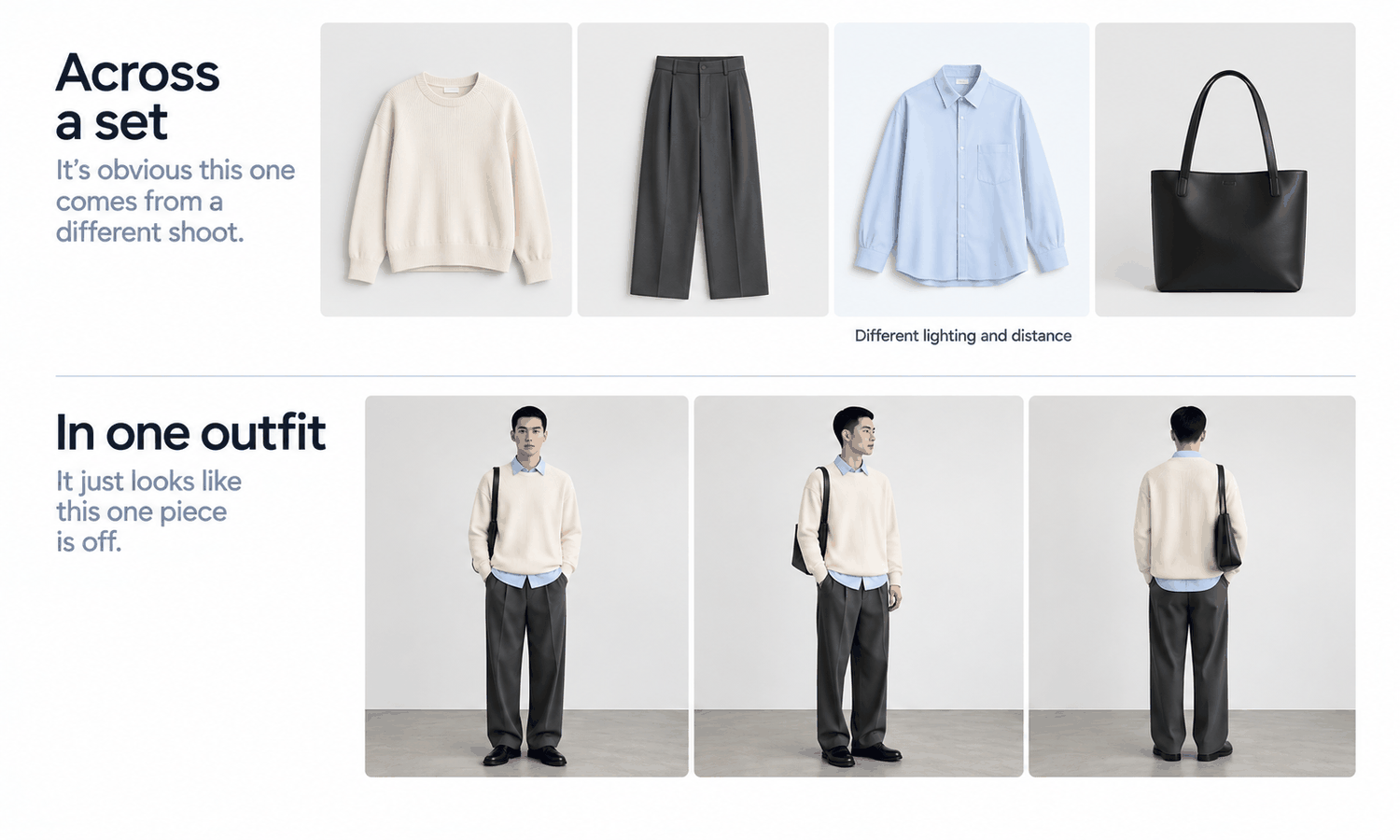
An outfit is not one output with one source. It is several garments sharing a frame, each derived from its own photograph, taken on its own day, under whatever standard applied at the time.
That structural fact produces a set of mistakes that single-garment work does not, and the most consequential one is invisible in every other kind of output. Everywhere else, inconsistency between captures shows up across a collection page. In a look, it shows up inside one image.
An outfit swapper makes assembling a look cheap. It does not make the look one thing.
Four mistakes that outfits produce
| The mistake | Why outfits produce it | Where it shows |
|---|---|---|
| Pieces captured in different sessions styled into one look | Each garment carries its own source, taken on its own day under whatever standard applied | Inside one image, as one garment that reads somehow off while the others do not |
| Checking the look instead of the garments | The composition reads well, so a per-piece comparison feels redundant | At a customer, on the third piece nobody compared against its source |
| Leaving the boundaries unchecked | Nothing at an overlap belongs to any single garment, so it is nobody's item | A hem that changes width behind a jacket, a collar at the wrong height |
| Selecting the styling from the outputs | Generating combinations is cheap, so the look gets chosen rather than decided | A plausible styling nobody specified, plus more outputs to check |
The first row is the one worth dwelling on, because it is the only failure in this class that has nowhere else to hide. Drift between two shoots is a subtle thing across a grid and an obvious thing when both garments are on the same body in the same frame.
The others are versions of familiar disciplines that quietly multiply once several pieces are in play.
Sources from different sessions in one frame
A jacket photographed in March and a shirt photographed in July are two different lighting conditions, two different distances, and possibly two different people holding the camera. Composited onto one figure, they do not read as two garments. They read as one garment that is correct and one that is somehow off, and the viewer cannot say which.
This is the mistake most likely to be attributed to the generation rather than to the inputs, because the output is doing exactly what it was asked to do with what it was given. The failure entered months earlier, in two sessions nobody thought of as related.
The correction is a scheduling decision rather than a technical one. Capture the pieces that will be styled together in the same session, to the same standard, with one shoulder line and one center-front axis across all of them. Where that is not possible, check the sources side by side before building the look rather than judging the result afterwards, since side by side the mismatch is obvious and inside a composed frame it is only a feeling.
The check does not divide across a look
For a single garment, the conformity check is one comparison against one source. For a look it is that comparison for every visible piece, plus the boundaries where they meet.
Logos, printed text, care labels, and small hardware get compared against the source image on every single on-model output, without exception, and in an outfit that means every garment's source rather than the one that was being paid attention to. Reconstructed detail lands almost right — a letterform slightly off, a stitch count wrong, a zipper pull the wrong shape — and in a styled look it hides behind the composition, because the eye is reading the outfit rather than inspecting a cuff.
The boundaries need a check of their own, and it is the one most often missing because nothing there belongs to any single garment. A hem that changes width behind a jacket, a collar reappearing at the wrong height, a sleeve thinning under a strap: none of those is a defect in a piece, and all of them fail at a glance once somebody knows to look. Where the rest of the frame is sound, a targeted correction to that boundary is smaller than rebuilding the look.
Layered styling with occlusion is a documented weak spot, and the boundaries are exactly where that shows. That is a reason to plan the look around fewer overlaps rather than a reason to check the overlaps harder.
Deciding the look after generating instead of before
The third mistake is a sequencing error that feels efficient. Somebody generates several combinations and then chooses the styling from what came back.
What that does is hand the styling decision to whatever the run produced. The layering order, which piece sits open, whether a sleeve is pushed up — each becomes a property of the output rather than a choice, and the result is plausible and unspecified. It also produces more outputs than anybody needs, each of which requires the multiplied check described above.
Deciding the look first costs a short conversation and reduces the review load proportionally. Decide which piece carries the detail, and either put it on the outside where nothing crosses it or shoot it on its own and join it to the seasonal styling as a separate frame. A detailed garment buried under a layer is asking for the reconstruction to happen exactly where reconstruction is weakest.
In Lightchain AI (apparel AI) the uploaded sources stay beside every AI Virtual Try-On output derived from them, which matters more for looks than for single garments: with three garments in a frame there are three sources to compare against, and a check that requires locating three files does not survive a busy week.
What a styled look cannot claim
A look is more persuasive than a single garment, and persuasive is when the limits need restating.
The output is a visual asset. It does not predict fit, determine sizing, model how a fabric behaves in motion, or forecast returns. Those come from measurements, a graded pattern, a physical sample, and your own data. An outfit adds a specific version of this: a look can show whether pieces read together visually, and it cannot show whether they work together on a body — whether there is enough ease in the shirt for the jacket, whether the layers sit without pulling, whether the proportion holds at both ends of the size range.
Proportion in an image is proportion at whatever the image depicts, and a size range is not one body. Nothing about styling several garments together changes that, and a look that appears to demonstrate it is demonstrating an appearance.
Color runs across every piece in the frame and settles in none of them. Screen color is not a physical reference, exact code matching is not something to promise, and the gap between a monitor and a roll of cloth stays open regardless of display quality. Colorways get settled by strike-offs against an agreed standard, so two pieces that harmonize on screen are two screen colors rather than two fabrics that have been placed next to each other.
Footwear is not covered by this class of workflow, which is worth knowing before a look is planned around it.
A short pre-flight for a look
Most of these are prevented before generating rather than caught afterwards.
-
Confirm the pieces were captured in the same session or to the same standard, and if not, put the sources side by side before building anything
-
Decide the layering order and which piece carries the detail, in the brief rather than in the selection
-
Count the overlaps and reduce them where the look permits, since each one is a boundary somebody has to check
-
Plan the check as one comparison per garment plus one pass on the boundaries, and staff it accordingly
-
Keep the look out of any statement about fit, ease, or how the pieces work together physically
Across a catalog at scale the first item is the one that compounds, because a body captured to the standard can be styled with anything else captured to the same standard, and a body captured outside it can only ever be styled with itself. Whether the work runs through Lightchain AI or a camera, that constraint is set at capture and cannot be recovered later.
Frequently asked questions
How many pieces can go in one look?
Fewer than the maximum, in most cases, and the limiting factor is overlaps rather than piece count. Three garments styled with little overlap come back cleaner than three stacked. Design the look around the boundaries you are creating rather than around how many items you can include.
Our looks always have one garment that reads wrong. Where do we start?
Check whether the pieces came from the same capture session. A single garment reading differently within an otherwise good frame is almost always a source mismatch rather than a generation problem, and it is diagnosed in seconds by putting the sources side by side.
Do we have to check every garment separately?
Yes, plus the boundaries between them. The composition makes a per-garment check feel redundant, which is exactly why it gets skipped, and a wrong trim on the third piece has no reason to announce itself when the look as a whole reads well.
Can we let the model choose the styling?
You can, and what you get is a plausible styling nobody specified, along with more outputs to check. Deciding the look first costs a short conversation and reduces the review load proportionally. Selection from outputs is the expensive version of briefing.
What about accessories in a look?
Small hard-edged items behave like hardware: recognizable shapes that need the same per-image comparison against a source. They are also the details a reviewer stops seeing once the composition reads well. Check them explicitly rather than as part of a general impression.
Is it worth building looks at all, given the overlap problem?
For showing how pieces sit together and for styling direction, yes, and the constraint is a design consideration rather than a prohibition. Build looks with fewer overlaps and put detailed pieces where nothing crosses them. Where a look genuinely needs heavy layering, that is a photography job.
In closing
The mistakes that outfits produce come from one structural fact: several garments in a frame means several sources, several checks, and several places for a boundary to go wrong. The one that only outfits produce is a mismatch between capture sessions appearing inside a single image, where it reads as a bad result rather than as two good photographs taken months apart. Capture pieces that will be styled together to one standard, decide the look before generating rather than selecting it afterwards, and plan the check as one per garment plus the boundaries.
Start here
Take a look you were unhappy with and put the source photographs for each piece side by side, before looking at the output again. If one of them was shot differently, that is the answer, and it was the answer before anything was generated. Most teams find this on the first look they check, and it changes what they schedule rather than what they review. Then group the bodies you intend to style together and shoot them in one session.
**Start with the on-model workflow → **https://www.lightchainai.com/global/solutions/aiVirtualTryOn