
When a brand can explore eight colorways in an afternoon, something has to narrow them back down. Somebody has to establish which are achievable on the substrate, which have matching trims available, and which are worth a lab dip.
Before the exploration got cheap, that narrowing happened inside the brand, because each direction cost enough to be considered before it was raised. Now it frequently happens at the supplier, who receives eight inquiries where they used to receive two.
Nobody decided to move that task. It moved because the constraint that was doing the narrowing was removed on one side and left in place on the other.
Four tasks, and whether they should have moved
| The task | Where it used to sit | Should it have moved |
|---|---|---|
| Narrowing explored directions to a set worth quoting | Inside the brand, because each direction cost enough to be considered first | No, and nobody agreed that it did. This is the one absorbed rather than invoiced |
| Answering whether a shade is achievable on a substrate | With the supplier, at a volume set by how many directions survived narrowing | It belongs there. What changed is the volume, which is discussable |
| Finding matching thread, tape, labels and hardware | With the trims supplier, once a shade was close to committed | It belongs there, and one screen colorway can become four separate inquiries |
| Judging which requests to take seriously | Nowhere, because the question rarely arose | No. It is a judgment the supplier has to make and has no information to make it with |
The first row is the one nobody agreed to and the one that does the most damage, because it is absorbed rather than invoiced. The other three are ordinary shifts in workload that can be discussed, priced, or reduced.
A color changer clothes workflow is not the cause of this. It removed a constraint, and the transfer is what happens when a constraint is removed from one side of a shared process.
The filtering task, and why it moves silently
Filtering is invisible work. When a brand narrows eight directions to two internally, nobody logs the six that were dropped, and when the supplier does it instead, nobody logs them either.
That invisibility is what lets the transfer happen without a conversation. The brand experiences its own process as unchanged, since it is still sending inquiries and still receiving answers. The supplier experiences a change in volume and, more importantly, a change in the ratio of inquiries to orders.
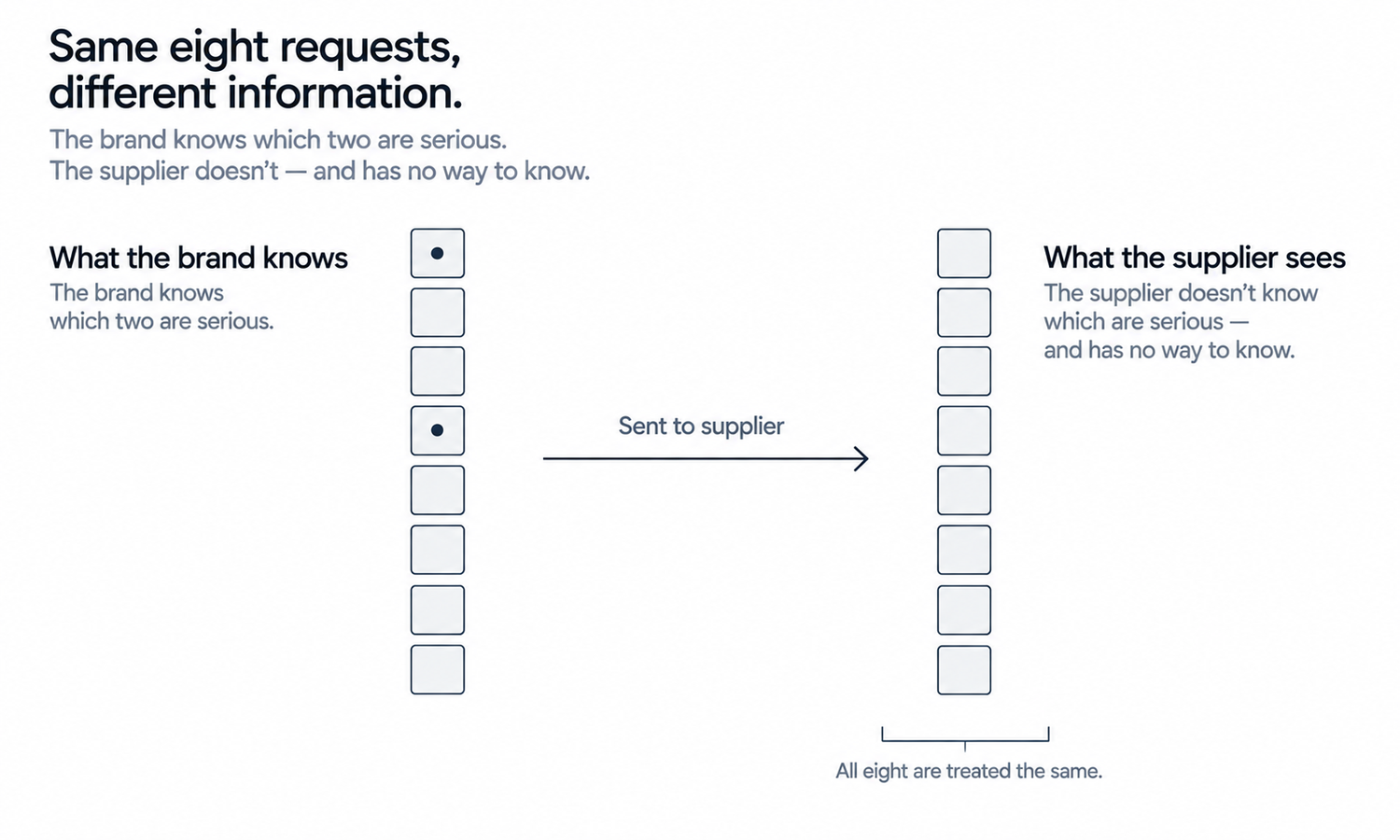
There is an information asymmetry underneath it that makes the transfer more expensive than it needs to be. The brand knows which two of its eight directions are serious; the supplier does not, and has no way to find out. So every inquiry gets handled at the same level, which is the worst available allocation for both sides: the two that mattered get the same attention as the six that did not, and the six consume attention that would have improved the two.
Marking which is which costs a word and is the single cheapest improvement available here. It is also the one that most reliably does not happen, because from inside the brand all eight feel like the same kind of question.
Deciding colorway and fabric direction early is legitimate and worth doing. The question is whether the narrowing that has to accompany it is happening where somebody planned for it, and in most cases the honest answer is that it is happening where there was capacity to absorb it.
What it looks like from the other side
The response is rarely a complaint. Suppliers are commercial and a rising inquiry count from an existing account is not, on its face, a bad thing.
What happens instead is prioritization. An account whose inquiries convert becomes the one answered first, and an account whose inquiries mostly evaporate moves down the queue. That is a rational response and it is invisible to the brand, which experiences it as slower replies rather than as a decision anybody made.
The second effect is on answer quality. An inquiry that is one of eight, on a shade with no substrate named, from an account whose last six inquiries went nowhere, gets an answer proportionate to that. The answer is not wrong; it is approximate, and an approximate answer about whether a shade is achievable travels onward as though it were a checked one.
There is a third effect, slower and harder to reverse. A supplier who has spent a year answering exploratory questions from an account has learned something about how that account works, and that learning persists after the behavior changes. Restoring a reply time takes longer than degrading one did, which is the usual shape of a reputation effect and the reason this is worth noticing early rather than correcting late.
None of the three announces itself. All three are visible in the ratio of inquiries to strike-offs long before they are visible in the relationship.
What should not move
Some tasks belong on the brand's side regardless of who has capacity, and stating which ones is what makes the rest negotiable.
The commitment decision stays. A supplier can say what is achievable; deciding which colorways a range will carry is a commercial judgment about the brand's own customers and margin.
The accuracy standard on published imagery stays. Logos, printed text, care labels, and small hardware get compared against the source image on every single on-model output, without exception, and reconstructed detail lands almost right — a letterform slightly off, a stitch count wrong, a zipper pull the wrong shape. That check answers to the brand's customers rather than to the supplier's process.
And the substrate belongs with the request. A shade with no fiber and no quality attached is unanswerable, since the same target reads differently on a cotton interlock and a wool flannel. Supplying it is a brand-side field rather than a supplier-side inference, and it is the single change that most improves what comes back.
What no arrangement changes
Redistributing work does not change what any of it is working on.
The output is a visual asset. It does not predict fit, determine sizing, model how a fabric behaves in motion, or forecast returns. Those come from measurements, a graded pattern, a physical sample, and your own data. Moving a task to a supplier does not make a rendered shade into an approved one, and no arrangement makes an image into a colorway.
Screen color is not a physical reference, exact code matching is not something to promise, and the gap between a monitor and a roll of cloth stays open regardless of display quality. Colorways get settled by strike-offs against an agreed standard, which is a shared physical process rather than a task either side can absorb on the other's behalf. A colorway shown before that point is a direction, and saying so is what keeps the shared process shared.
Footwear is not covered by this class of workflow, and lace and open work, sheer fabrics, complex prints, and heavily layered looks are documented weak spots. Those verdicts do not move with the workload.
What to agree explicitly
The fix is a short conversation rather than a process, and it is easier to have before the ratio has already shifted.
-
Name the narrowing: who reduces a set of explored directions to a set worth quoting, and at what point in the week
-
Attach the substrate to every request, since an unanswerable request costs a round trip on both sides
-
Send inquiries in batches rather than as they occur, because a batch can be triaged and a stream cannot
-
Say which are firm and which are exploratory, so the supplier can allocate effort deliberately rather than guessing
-
Agree what a lab dip request means, since sending one implies an intention and sending eight implies a different one
For anything heading toward production, the substrate and the agreed standard belong in the tech-sheet material rather than in a thread. In Lightchain AI (apparel AI) the uploaded source stays beside every AI Virtual Try-On output derived from it, which matters here because a supplier asked about a shade shown in an image can be shown what that image was derived from. Whether the work runs through Lightchain AI or a camera, the exploration is yours and the narrowing has to be somebody's.
Frequently asked questions
Our supplier has not complained. Is there a problem?
A complaint is not the usual signal. Watch the ratio of your inquiries to strike-offs and the time to first reply, since prioritization shows up there long before anybody raises it. A supplier who is deprioritizing you is behaving rationally rather than badly.
Is it wrong to ask a supplier to screen options?
Not at all, provided it is agreed rather than assumed, and provided the request is answerable. Screening is real work and suppliers often do it well. The problem is an unagreed transfer of unbounded volume, not the task itself.
How do we narrow before asking?
Against what you already know can be bought: your existing palette, what that mill has run, and what trims you hold in stock. Most sets of eight reduce to three on that basis alone, which is a brand-side filter using brand-side information.
Should exploratory inquiries be marked as such?
Yes, and it costs a word. It lets a supplier answer quickly and approximately where that is appropriate, and carefully where it matters, rather than treating everything at one level and getting both wrong.
What if we genuinely need eight options quoted?
Then send eight, say they are eight, and expect the answer to take longer or to cost something. That is a legitimate request made visibly rather than an invisible one. The difference is whether the supplier can plan for it.
Does this apply to trims suppliers as well as mills?
More so, since a shade decision propagates into thread, zip tape, labels and hardware, each of which may sit with a different supplier. One colorway explored on screen can become four separate inquiries, and the multiplication is rarely visible from the brand side.
In closing
Cheap exploration removes a constraint on one side of a shared process and leaves it in place on the other, and the narrowing that used to happen inside the brand moves to whoever still has capacity. That transfer is absorbed rather than invoiced, so it shows up as slower replies and more approximate answers rather than as a cost. The commitment decision, the accuracy standard on published imagery, and the substrate on every request stay on the brand's side. Everything else is negotiable, provided somebody says out loud that it moved.
Start here
Count last month's colorway inquiries and how many reached a strike-off, then ask your main supplier what their reply time to you looks like compared with a year ago. Those two answers together describe a transfer that has probably already happened. Both take a phone call, and neither requires anybody to change how they work before the conversation. If the ratio has moved, the narrowing is the thing to put back.
**Start with fabric and colorway work → **https://www.lightchainai.com/global/solutions/designWithPurpose