
A marketing team runs a clothing try on pilot on twelve styles and it goes well. Everyone reviews everything, the two bad outputs get caught in the first pass, and the deck writes itself. The following season the same workflow is pointed at four hundred styles, and something that was never a problem at twelve becomes the only problem there is.
What changes at volume is not the quality of any individual image. It is that the work stops being production and starts being review, and that mistakes stop happening one at a time.
Those two shifts arrive together and get treated as one, which is why the usual response — check faster, check a sample, add a reviewer — makes the second one worse.
The constraint moves from production to review
At a dozen styles, generation is the slow step and checking is something you do while waiting. At four hundred, generation finishes overnight because it runs as queued batches rather than one style at a time, and a queue of unchecked outputs is sitting there in the morning. The bottleneck has moved, and it has moved to a step that does not get faster when you add capacity to the step in front of it.
Teams meet this in a predictable order. They review everything and fall behind. They add a second reviewer and fall behind more slowly. Then somebody proposes reviewing a sample, on the reasonable-sounding basis that the outputs all came from the same process, so a representative check should cover them.
That reasoning is exactly backwards, and understanding why is most of what a marketing team needs to know about operating on-model generation at scale.
Errors stop being independent
| Twelve styles | Four hundred styles | |
|---|---|---|
| Where a defect comes from | Something particular to that image | Something every output in the batch passed through |
| How defects are distributed | Independently, one at a time | Correlated, arriving as a whole category at once |
| How a defect gets found | Reviewing everything, which is affordable | Only by checking what the outputs shared, since a sample can miss a category entirely |
| What one defect costs | A rerun and an apology | A pulled category, and the same fix applied several hundred times |
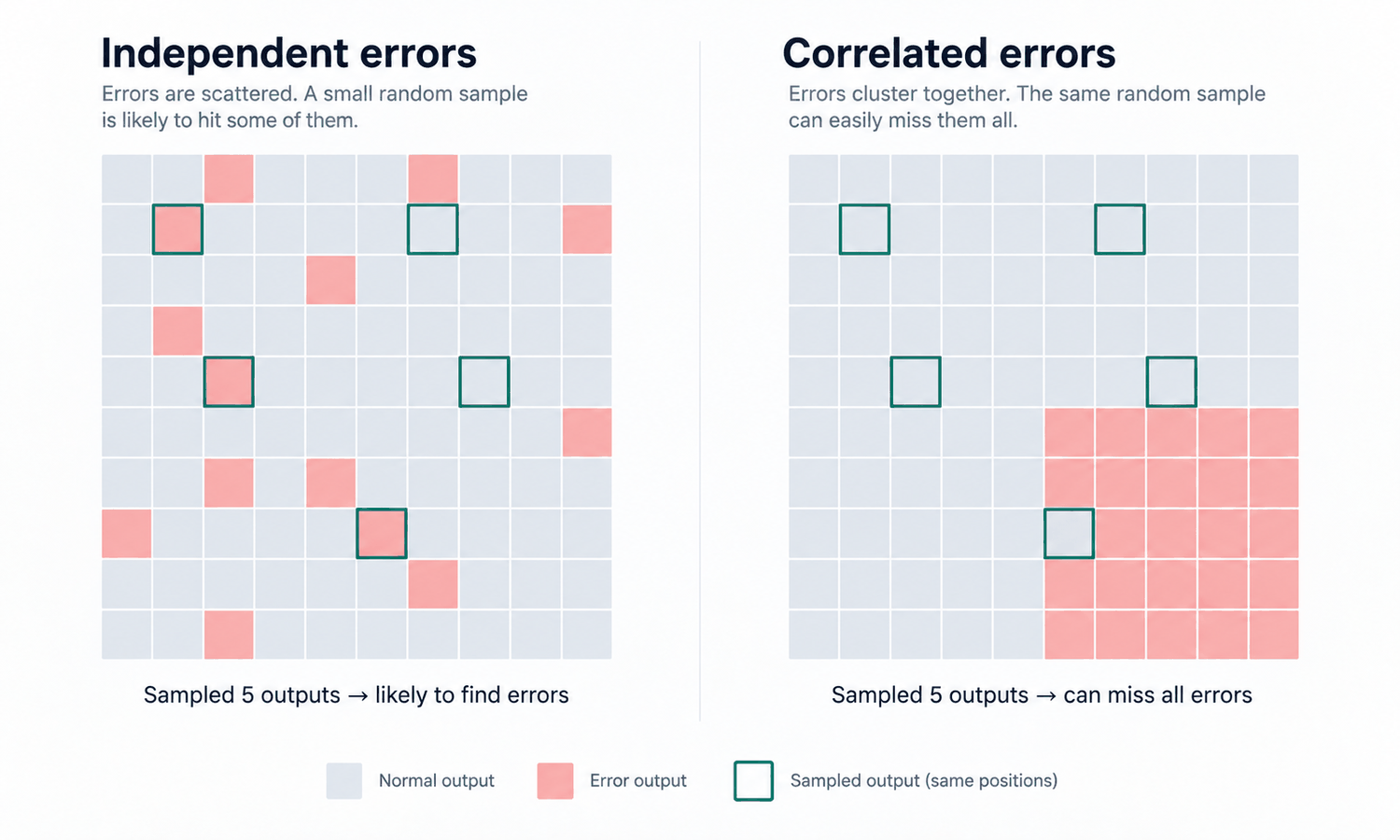
At twelve styles, defects behave randomly. Each one has its own cause, a sample would miss most of them, and reviewing everything is cheap enough that nobody thinks about it.
At four hundred, the outputs share a source photo standard, a settings profile, and a way of preparing inputs. Anything wrong in those shared upstream elements is wrong in every output that passed through them. A defect is no longer an event; it is a property of a batch.
This is what makes sampled review dangerous rather than merely incomplete. Sampling assumes independence — that a clean sample implies a mostly clean population. When failures are correlated, the sample is clean or the sample is dirty, and either way it tells you about the batch rather than about the images. A sample that comes back clean when a whole category is wrong is not a rare accident. It is the ordinary outcome when the defect sits in something all of them share.
Fix the input standard before you scale the output
Correlation is bad news for review and good news for repair. A defect shared by two hundred images usually has one cause, and one cause has one fix, which is a much better position than two hundred separate corrections.
That is only true if the shared elements are actually recorded. Photo standard, settings, and preparation steps have to be written down and versioned before a batch runs, or a category-wide defect turns into an archaeology project. In Lightchain AI (apparel AI) the source files and the generation history stay attached to the outputs they produced, which is the difference between tracing a defect to its input in an afternoon and rerunning four hundred styles because nobody can say what was different about the ones that failed.
There is a rule here that volume does not soften. Logos, printed text, care labels, and small hardware get compared against the source image on every single output, without exception. Reconstructed detail lands almost right — a letterform slightly off, a stitch count wrong, a zipper pull the wrong shape — and almost right survives review at twelve images and survives it far more easily at four hundred.
The way to live with that rule at scale is not to check fewer outputs. It is to produce fewer outputs that need checking: fewer variants per style, a tighter set of approved settings, and a source standard strict enough that the detail check becomes a fast confirmation rather than an investigation.
What review looks like when it cannot all be discretionary
Review at volume works when it is split into two activities that were previously one, and treated differently.
-
The conformity check asks whether the output matches its source garment: details, print placement, construction as visible. This one is mandatory on every image and can never be sampled, because it is where correlated defects surface
-
The judgment pass asks whether the image is good — styling, mood, whether it belongs in the campaign. This one can be sampled, delegated, or run on a category level, because a weak image is a cost and a wrong image is a liability
Splitting them changes what you can hire and automate against, and it is the reason a settings profile in Lightchain AI is worth versioning: a recorded profile turns the conformity check into a comparison against a known standard rather than against somebody's recollection of one. The conformity check is comparison work with a right answer, which means it can be distributed to people who did not commission the shoot and completed in a fraction of the time a full creative review takes. The judgment pass is the part that needed the senior person, and it was the part getting squeezed when both ran together.
When conformity fails in one region and the rest of the image is sound, a targeted correction to that region is a smaller intervention than a rerun, and at four hundred styles that difference is the whole argument: the region is rebuilt against the source in Partial Redraw while the rest of the batch keeps the settings it was produced under, and it keeps everything else in the batch comparable. Rerunning one style in a category is how a set stops matching itself.
What volume cannot change
Scale improves throughput and does not extend what the asset is able to support. The output is a visual asset. It does not predict fit, determine sizing, model how a fabric behaves in motion, or forecast returns. Those come from measurements, a graded pattern, a physical sample, and your own data.
Four hundred images do not add up to a fit claim, and neither do four thousand. Nothing in a marketing set entitles anybody to state that a style runs true to size, and a size guide built from generated imagery is a sizing document with no measurement behind it.
The same restraint applies to the outcome numbers marketing gets asked about. A generated asset cannot be presented as the reason a return rate moved or a conversion figure changed, because both sit at the end of a chain that includes sizing, price, assortment, and traffic. Volume makes this temptation stronger, since a bigger program needs a bigger justification, and it does not make the claim any more available.
Color has a hard edge that gets crossed most often at scale. Screen color is not a physical reference, exact code matching is not something to promise, and the gap between a monitor and a roll of cloth stays open regardless of display quality. Colorways get settled by strike-offs against an agreed standard, and values must never be read off a generated asset and used downstream. Running a category of colorways through a workflow does not make any of them approved.
Consistency becomes the visible quality signal
At twelve images a shopper sees one at a time. At four hundred they see a grid, and a grid is a comparison whether or not anybody designed it as one. The quality signal shifts from whether an image is good to whether the set looks like it came from one place.
Sets drift for ordinary reasons: a model direction changed midway, a batch ran with different settings, a few styles got rerun after a fix and came back subtly different. None of those is visible in a single image and all of them are obvious in a grid. Holding the model, the pose, and the scene constant across a category in Model Studio is worth more at volume than raising the quality of any individual output, and it is the cheapest rule to enforce in a campaign asset program.
Video is where drift is least forgiving. Frame-to-frame consistency is a documented weak spot for this kind of generation, and a wobble that reads as nothing in a still becomes the thing a viewer watches. Treat video as a separate program with its own smaller shortlist rather than as an extension of the still workflow, and choose the styles for it deliberately.
Frequently asked questions
We cannot review four hundred outputs individually. What actually gets cut?
The judgment pass gets sampled and the conformity check does not, which is the opposite of what most teams do under pressure. A weak image that reaches a channel costs some engagement; an image with the wrong logo reproduced across a category costs a takedown and a reprint. Cut depth from the discretionary work and keep the comparison work complete.
How many variants per style should we generate?
Fewer than the tool makes possible, and the number should be decided before the batch rather than discovered during it. Every extra variant per style multiplies the review load by the number of styles and adds nothing until somebody chooses between them. Two per style with a clear selection rule beats six with none.
A defect showed up in one image. How do we know if the batch is affected?
Identify what that image shared with the others — source standard, settings profile, preparation step — and check three more outputs that shared the same element rather than three chosen at random. Correlated defects are found by following the shared cause, not by widening the sample. If those three are clean, the defect was probably local.
Can we reuse last season's approved settings profile?
Yes, and it should be versioned and dated so that a defect can be tied to a profile later. Reusing a profile is what makes categories comparable across seasons, which is worth more than a marginal quality gain from retuning. Change one element at a time and record why.
Does higher output quality reduce the review burden?
It reduces the judgment pass and does very little to the conformity check. Better outputs are more convincing, which means a wrong detail is less likely to be noticed rather than less likely to occur. The comparison against the source stays the same length regardless of how good the image looks.
Should the same person do both review passes?
Not at volume, and separating them is usually the change that makes the queue survivable. Conformity is comparison work that can be distributed widely once the standard is written down. Judgment is the part that needs the person who owns the campaign, and it works better when they are not also checking zipper pulls.
In closing
Scaling a try on workflow does not scale the problems from the pilot. It replaces them. Production stops being the constraint and review takes its place, and defects stop arriving one at a time because everything downstream of a shared input inherits whatever was wrong with it. Both point the same direction: write down the source standard and the settings, keep the conformity check complete and never sampled, and cut variants rather than checks. The batch that has to be pulled is almost never the one with a bad image in it. It is the one where nobody can say what the four hundred had in common.
Start here
Take the last batch you ran and answer one question about it: what did every output in it share? Name the source photo standard, the settings profile, and whoever prepared the inputs. If any of the three cannot be stated in a sentence, that is the correlated defect waiting to happen, and it is cheaper to write down now than to trace after a category ships. Then decide the variant count for the next batch before you run it rather than after.
**Start with the on-model workflow → **https://www.lightchainai.com/global/solutions/aiVirtualTryOn