
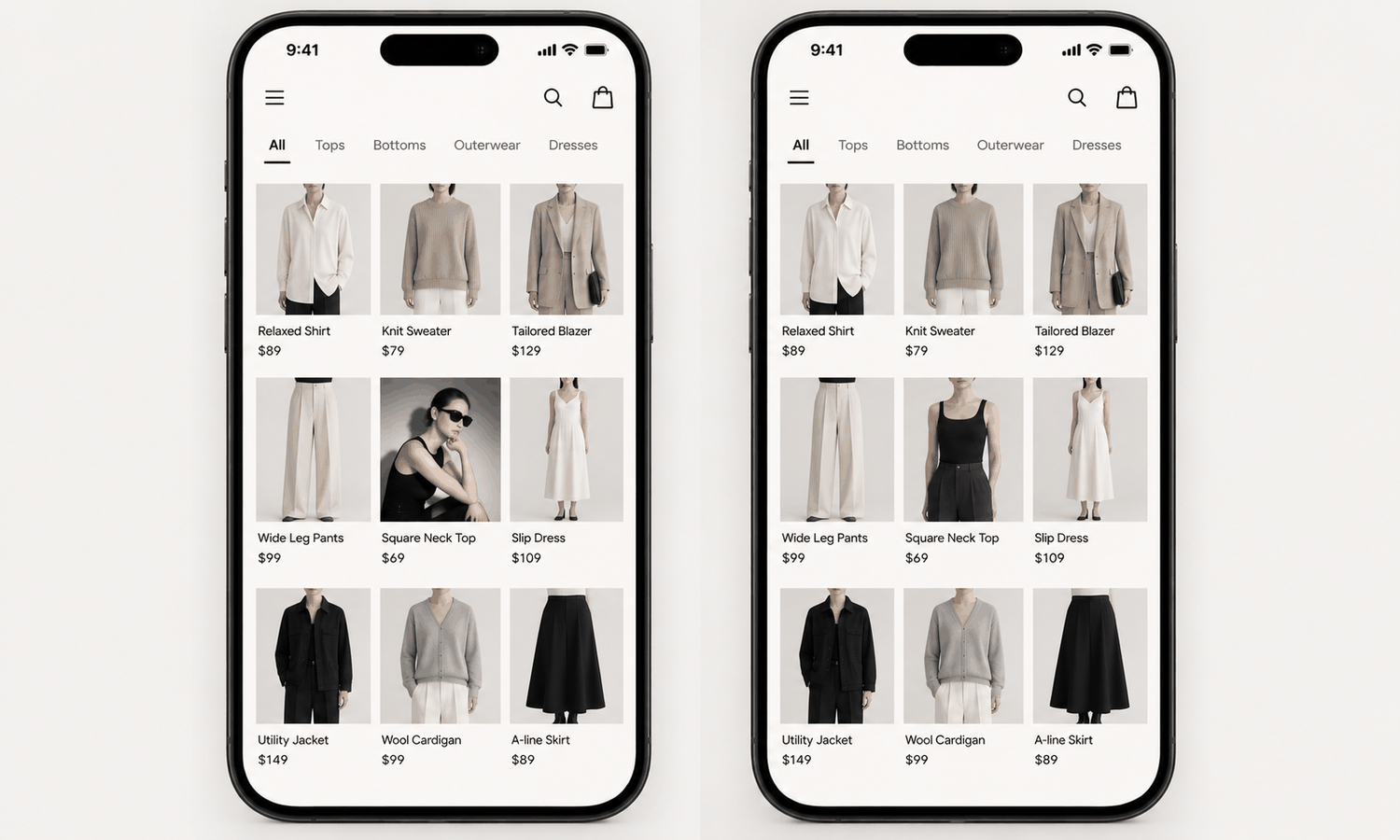
A boutique owner testing this is not evaluating a tool. They are deciding whether an afternoon is better spent here than on the window, the buy, or the floor — and that framing changes what the test should measure.
A larger business tests for capability: does it work, how well, on what. A boutique tests for displacement: what did this stop me doing, and did the result justify it. The second question is answerable in one afternoon on one style, provided the afternoon is set up correctly.
Test the style you sell most, not the one you like most
The instinct is to test something interesting — the piece with the unusual cut, the one that photographs badly, the one that has been sitting.
Test your highest-selling style instead. It is the product where imagery has the most work to do, where you already know what good looks like because you have sold it repeatedly, and where an improvement compounds across the largest number of listings and posts.
Testing the difficult piece answers a question about the tool. Testing the volume piece answers a question about your shop.
The distinction sounds academic and decides what you do next. A finding about the tool leads to another test; a finding about the shop leads to a decision, and a boutique owner has time for one of those.
There is a second reason. You have existing photography of that style, taken however you normally take it, which means the test runs on realistic inputs rather than on something prepared for the occasion.
Decide what the afternoon is competing with
Write down what you would otherwise have done in those hours. Not as an accounting exercise — as the comparison the result has to beat.
If the answer is dressing the window, then the test has to produce something worth more than a redressed window. If the answer is writing product descriptions that are already overdue, the bar is different. A test without a named alternative gets judged against nothing, and anything looks worthwhile compared to nothing.
This is the single discipline that separates a useful boutique test from an interesting one.
It also protects against the most common outcome, which is not disappointment but drift. An afternoon that produced pleasant results and displaced nothing identifiable turns into a recurring habit nobody has evaluated, and by the third month it is consuming a morning a week that was never budgeted.
What to actually produce in the session
Keep the output list short and tied to something you were going to need anyway.
Three or four on-model images of that style, in the format your listings and posts actually use. Not a colorway exploration, not a range of poses to admire, not variations you have no immediate use for. Assets you would otherwise have had to obtain some other way.
That constraint does two things. It keeps the session finite, and it makes the result directly comparable against the cost of getting the same assets another way — a shoot, a stock alternative, or going without.
Judge it against your own shelf
The comparison that matters is not against a vendor example. It is against the imagery already on your own site.
Put the new assets beside your existing product photography for the same item, at the size a customer sees them. Then ask three questions. Would I publish this without explaining it. Does it sit consistently with what is already there. Does it show the customer something the flat product shot does not.
Three yeses is a pass. Two is a maybe worth one more session. Fewer than two is a clear answer and the afternoon has done its job by producing it.
The consistency question is the one boutique owners underweight. A single striking image that does not match the rest of your site makes the site look inconsistent rather than making the product look good. Laying the new asset beside your existing images on one canvas, at the size a customer sees, makes that judgment a comparison rather than a guess.
Small shops are particularly exposed here because the whole site is visible in a few scrolls. A large retailer can absorb variation across thousands of listings; a boutique with sixty products cannot, and a customer forms an impression of the entire shop from one screen.
What one afternoon cannot settle
The scope is narrow and worth stating so the result is not overread.
One style tells you about that style. Silhouettes behave differently, and a good result on a structured piece does not predict a good result on something soft or sheer.
Consistency across a range is not testable in one session, because it is a property of a set produced over time rather than of any single asset.
And the output is a visual asset throughout. It does not predict fit, determine sizing, model how a fabric behaves in motion, or forecast returns. Screen color is not a physical reference either, so a colorway that looks right on your monitor is not a colorway you can commit to.
What to do with a pass
A pass is not a decision to adopt. It is permission to run a second, larger test with a defined stopping point.
The useful second step is one week of ordinary work: produce imagery for whatever you would have been listing anyway, in the normal rhythm, and count the hours. That produces the number the first afternoon could not — how much of your week this consumes at realistic volume. Set the stopping point before the week starts, because a second test that runs until someone loses interest produces no decision at all.
Where the imagery you need is a colorway or material variant of something already photographed, the substitution route is usually shorter than producing from scratch — swapping the fabric, color or style on the existing design — see Design with Purpose. For the on-model output itself, see AI Virtual Try-On.
What to do with a fail
A fail on one style is a finding, not a verdict on the category — and it is worth spending five minutes attributing before moving on.
If the output looked wrong in an obvious way, the input photograph is the first suspect: heavy occlusion, difficult pose, or a garment that changes shape when handled. If only one region is wrong in an otherwise usable image — a collar, a cuff, a print — rebuilding that region against a reference is usually cheaper than another full attempt, and it is worth one try before writing the style off. If it looked fine but did not fit your site, that is a consistency issue rather than a quality one. If it was fine and simply took too long, that is the displacement answer and it is the one the test was designed to produce.
Write the attribution down in one line and keep it. Somebody will suggest this again in a year, probably you, and a dated line saying what was tried and why it stopped is worth more than the memory of having been unimpressed.
The dated part matters because two of the three causes can change. Input photography is under your control and can be improved; the category moves and difficult silhouettes become less difficult. Only the displacement finding is durable, since your hours will not become less scarce.
Questions boutique owners ask
Which style should I test? The one you sell most. You know what good looks like for it, you have existing photography of it, and any improvement applies across the largest number of listings.
How long should the test take? One afternoon, with a named alternative use for those hours written down first. A test with no stated alternative gets judged against nothing.
What should I compare the result to? Your own site, at the size customers see it, not a vendor example. The question is whether it sits alongside what you already have.
Is a striking image a good result? Only if it matches the rest of your site. A single asset that stands out from everything else makes the site look inconsistent rather than making the product look better.
Can I decide from one style? You can decide whether to run a second, larger test. Adopting a workflow from one style ignores how differently silhouettes behave and how much of the cost only appears at volume.
What if it works but takes too long? That is a legitimate result and it is the one this test exists to find. The hours are the constraint in a boutique, and a good output that costs a working afternoon each time has answered the question.
What the afternoon should leave you with
A comparison against your own shelf, an honest note about what those hours displaced, and one line recording the outcome with a date. Test the style you sell most, produce only assets you actually needed, judge against what is already on your site, and name what the session cost you before you decide whether it was worth it. A boutique has no spare hours, which makes displacement the right question — and it is answerable in a single afternoon if nobody blurs it into a question about the technology.
Name the alternative before you start.
**Write down what those hours would otherwise have gone to, then produce three on-model images of your highest-selling style and put them beside your existing photography at the size customers see. Three questions, one line of notes, and a dated record of the outcome. That is the whole test, and it is worth more than any comparison run on somebody else's products. → **AI Virtual Try-On
About the author
[REPLACE — real person's name, role, relevant experience, LinkedIn URL. No team byline.]