
Most advice about measuring an AI rollout assumes a team, a dashboard, and somebody whose job is reading it. A freelance designer has a calendar, an invoicing app, and one folder per client. The question after adopting a clothing changer AI is narrower than the advice suggests and harder to answer honestly: did anything change that you can charge for?
The first few weeks almost always feel faster. That feeling is real, and it is a poor basis for a decision. Output speed is the easiest thing to notice and the loosest thing to connect to income. A tool can double the images you produce in an afternoon and leave the invoice for that project exactly where it was, because the extra images went into attempts, revision rounds, and explanatory emails nobody quoted for.
The number worth watching is not how long an image takes. It is how many hours of a project reach an invoice.
Start the clock at the first paid delivery
For a company, adoption gets measured from the first successful generation. For one person billing by project, that milestone means very little — your first successful generation probably happened at eleven at night, on a garment nobody was paying you for. The useful start date is the first time generated material went to a paying client and came back accepted.
Mark that date. Then reconstruct a rough baseline from the three projects immediately before it: the fee, the number of revision rounds, and an honest estimate of hours. Invoices, sent-mail folders, and file timestamps will get you most of the way there. A reconstructed baseline built consistently beats a precise one built for only half your projects, because every comparison you make later is a comparison against yourself.
Keep two things out of the baseline. Learning time is not project time, and the first two paid projects after adoption are not representative — they carry the cost of working out your own process. Start measuring at the third.
Count against accepted work, not produced work
Once output gets cheap, production volume stops carrying information. Ten variations cost a few minutes and one of them ships. Counting the ten flatters the tool. Counting the one describes your business.
Set the denominator to accepted deliverables: material the client signed off and put into a line sheet, a product page, or a deck. Everything else is an attempt, including work that was good and lost to a change of direction. This feels harsh in month one and stops feeling harsh the first time a client rejects eight strong options for a reason that has nothing to do with the images.
The same discipline applies to cost. Credit consumption varies by feature and by settings — an on-model try-on pass and a round of local corrections are not the same line item — and a new account carries enough allowance to run the test above before any purchase decision is involved. What no published package figure can give you is your cost per accepted deliverable, because accepted is always a smaller number than produced. The only version of that figure worth having is your own spend divided by your own accepted work.
Four numbers that fit on one weekly line
| Number | Where it comes from | What a poor reading looks like |
|---|---|---|
| Attempts per accepted deliverable | Generations counted against the deliverables a client signed off | The figure climbs while the fee stays flat, meaning you absorbed the search |
| Share of revision rounds traceable to the material | Tag each round as brief-driven or material-driven at the moment you log it | Material-driven rounds hold steady as your volume rises |
| Unbilled hours per project | A fifteen-minute log kept for six weeks, then stopped | Unbilled hours grow in step with the work you take on |
| Quoted hours against actual hours | Your quote compared with your own time record at project close | The gap is stable and always runs in the same direction |
There is a fifth thing to look at, and it is a distribution rather than a metric: check whether a single client accounts for most of your unbilled hours. Concentration changes what you do next. Spread across every client, it is a pricing problem. Concentrated in one, it is a scoping conversation, and raising your rate across the board would be the wrong fix.
Telling your rework apart from the rework you were hired to expect
A client changing direction is billable work and always has been. Material that failed against its own source is not. The two look identical in a calendar and completely different on a profit-and-loss line, and if you do not separate them at the moment they happen, you will not separate them afterwards.
Separation gets easier when you check the same things every time. Logos, printed text, care labels, and small hardware have to be compared against the source image on every single output, without exception. Reconstructed detail tends to land almost right — a letterform slightly off, a stitch count wrong, a zipper pull the wrong shape — and almost right is more dangerous than obviously wrong, because it survives your review and fails at the client's. A targeted correction to one region is a much smaller job than a regeneration, but only if somebody catches the region first. Where the rest of the output is sound, that correction is a rebuild of the selected region against the source rather than a fresh generation — Partial Redraw does exactly that, leaving the parts that already passed untouched.
Keep a one-line note per attempt recording what it came from. Working inside a single environment makes that cheap: an attempt made in AI Virtual Try-On sits alongside the source file it was generated from, so the trail exists without you rebuilding it later from folder names and memory.
What these numbers cannot cover
Before any of this becomes something you say to a client, be exact about what is being measured. The output is a visual asset. It does not predict fit, determine sizing, model how a fabric behaves in motion, or forecast returns. Those come from measurements, a graded pattern, a physical sample, and your own data.
That rules out an entire family of metrics that look attractive on a freelance capability deck. You cannot report that you reduced a client's fit problems, because fit was never measured. You cannot report a movement in their return rate, because the chain from an image to a return runs through sizing, merchandising, and their customers, none of which passed through your file.
Color carries its own limit. Screen color is not a physical reference, exact code matching is not something to promise, and the gap between what a monitor shows and what comes off a roll of cloth does not close with a better display. Colorways get settled by strike-offs against an agreed standard; a generated image narrows the candidates and stops there. Color approvals cleared is not a number you can own either.
What is left is still worth having. Your attempts, your rework, your hours, your quote — all of that is yours to count.
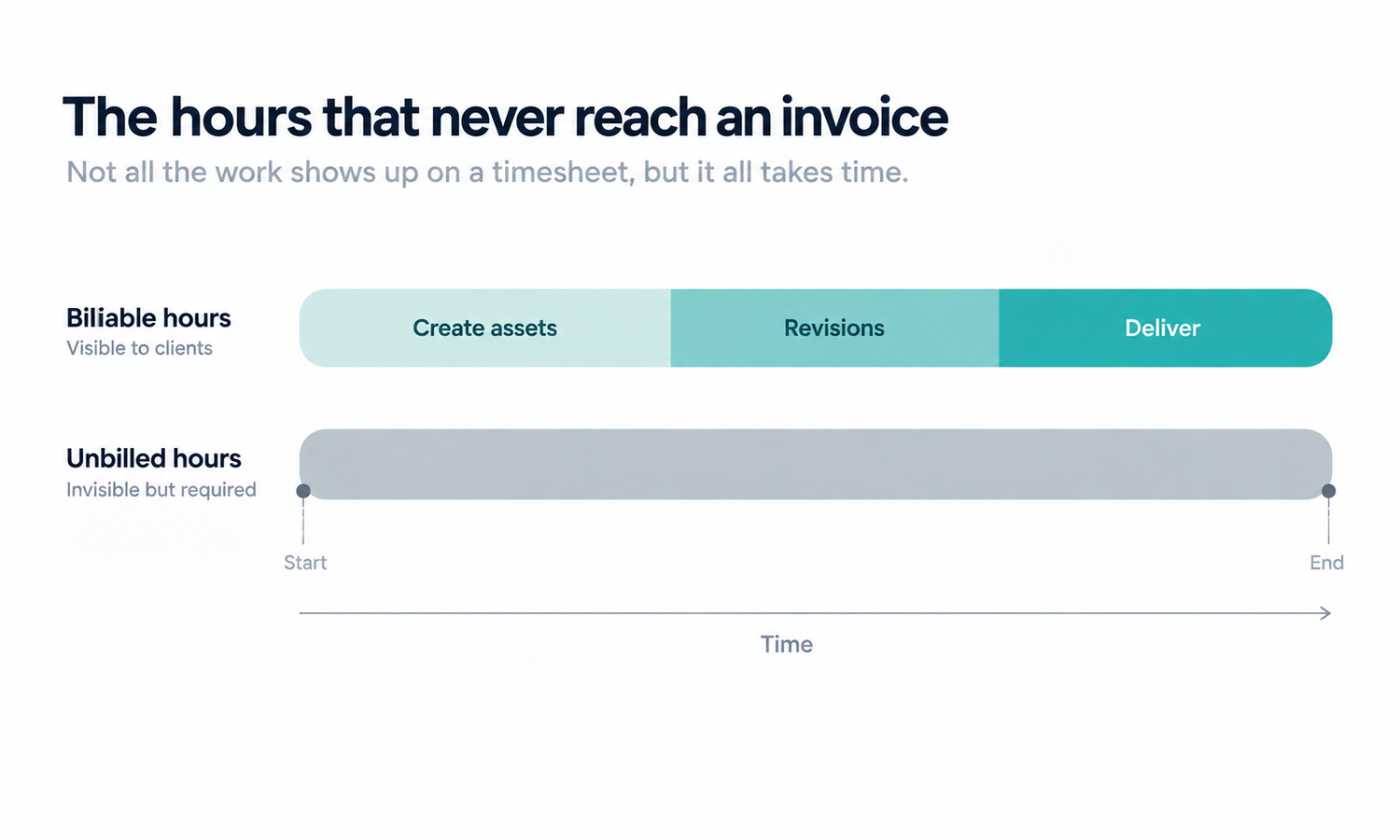
The hours that never reach an invoice
Ask a freelancer where the time goes and you get a shrug. Six weeks of fifteen-minute logging turns the shrug into a distribution, and the distribution tends to surprise people in one specific way: the largest category is rarely production.
-
Clarifying a brief that arrived as a flat lay and one sentence
-
Renaming and versioning files because the client has no convention and somebody has to
-
Redoing work because the source photo was wrong and nobody flagged it
-
Explaining what a generated image is and is not, usually twice, usually to two different people
The second one compounds. When a client has no naming or versioning system, you end up maintaining theirs at no charge, and the better your output gets, the more files there are to maintain. That cost arrives disguised as a success.
Brief quality is the variable you can move. A brief that arrives as a flat lay and a sentence is a different job from one that arrives with a source-file reference, a named colorway and fabric direction, and the channel it is going to. The second costs you a setup and a review in Model Studio. The first costs you a conversation you never quoted for. Publishing a short intake list is not administrative tidiness; it is the cheapest reduction in unbilled hours available to you.
Repricing once the numbers hold
Give it two months from that third project. If attempts per accepted deliverable has settled and unbilled hours has come down, the gain is real, and it belongs in your rate structure rather than in your evenings. Freelancers generally take it one of three ways. Some price per accepted deliverable instead of per day, which puts search cost on their side and predictability on the client's. Some write a revision allowance into the quote, counted in rounds, with material-driven rounds excluded from the count so the incentive stays honest. Some bill source-material preparation as its own line, on the grounds that it is the input everything else depends on and it is exactly where the unbilled hours were hiding.
The subscription is the easiest cost to see and the least useful one to manage. A Lightchain AI credit pack is a fixed number you can read off a receipt; the hours behind an accepted deliverable are not, and those are the ones deciding whether the year works.
If the numbers say nothing moved — attempts flat, rework flat, hours flat — that is a result rather than a failure to measure properly. Some practices are small enough, or specialized enough, that search cost was never the constraint. Dropping the tool and keeping your existing process is a legitimate conclusion, and reaching it after two months of records is a better place to be than reaching it after two years of vague dissatisfaction.
Frequently asked questions
How long should I measure before deciding anything?
Two months from your third paid project using the tool. The first two carry your learning curve and will read worse than the truth. If your project cycle runs longer than a month, count four completed projects instead of a fixed date, because the unit that matters is the project rather than the week.
I never recorded a baseline. Is it too late?
No. Reconstruct one from your last three invoices, the revision emails, and file timestamps. It will be rough, and rough is fine provided you apply the same method to the projects you measure afterwards. Consistency between the two sides of the comparison matters more than precision on either side.
Should I count the time I spend learning the tool?
Track it, and keep it out of your project figures. Learning time is an investment with an end date; project time recurs. Mixing the two makes the early months look ruinous and the later ones look better than they are.
What if one client accounts for most of my unbilled hours?
Then you have a scoping problem rather than a pricing problem, and a rate rise across every client would be the wrong response. Take the log to that client, show which categories the hours fall into, and propose either an intake list or a separate line for preparation work. Concentration is easier to solve than a general drift.
Do faster deliveries mean I should charge less?
Speed is not what the client is buying; a deliverable that survives their review is. If attempts per accepted deliverable dropped, you got better at the search, and that is a skill rather than a discount. Price per deliverable if you want the client to feel the speed, and keep the margin.
Can I show a client my before-and-after numbers?
Your own operating numbers are yours to share, with one caution: they describe how your work gets made, not what happens to their business. Attempts per deliverable and hours saved must not be read as evidence about their fit, their sizing, or their returns, because none of those was measured. Present it as process, and keep outcome claims out of it.
In closing
All of it reduces to one habit: put accepted work in the denominator. Images produced, hours that felt saved, and how fast the afternoon went will improve on their own and tell you nothing. Attempts per accepted deliverable, rework you caused against rework you were paid to expect, unbilled hours, and the gap between quote and actual will move slowly and tell you whether the practice actually changed. Four numbers, one line a week, six weeks of honest logging. That is the whole instrument.
Start here
If you want to test the four numbers on something real, take one style you have already delivered the conventional way — you know what that cost, so the comparison is honest — and run it again from the same source files, logging attempts, rework cause, and hours as you go. A single style is enough to show whether your unbilled time sits in the brief, in the source photos, or in the review. Then make the call with a record in front of you instead of an impression.
**Start with the on-model workflow → **https://www.lightchainai.com/global/solutions/aiVirtualTryOn