
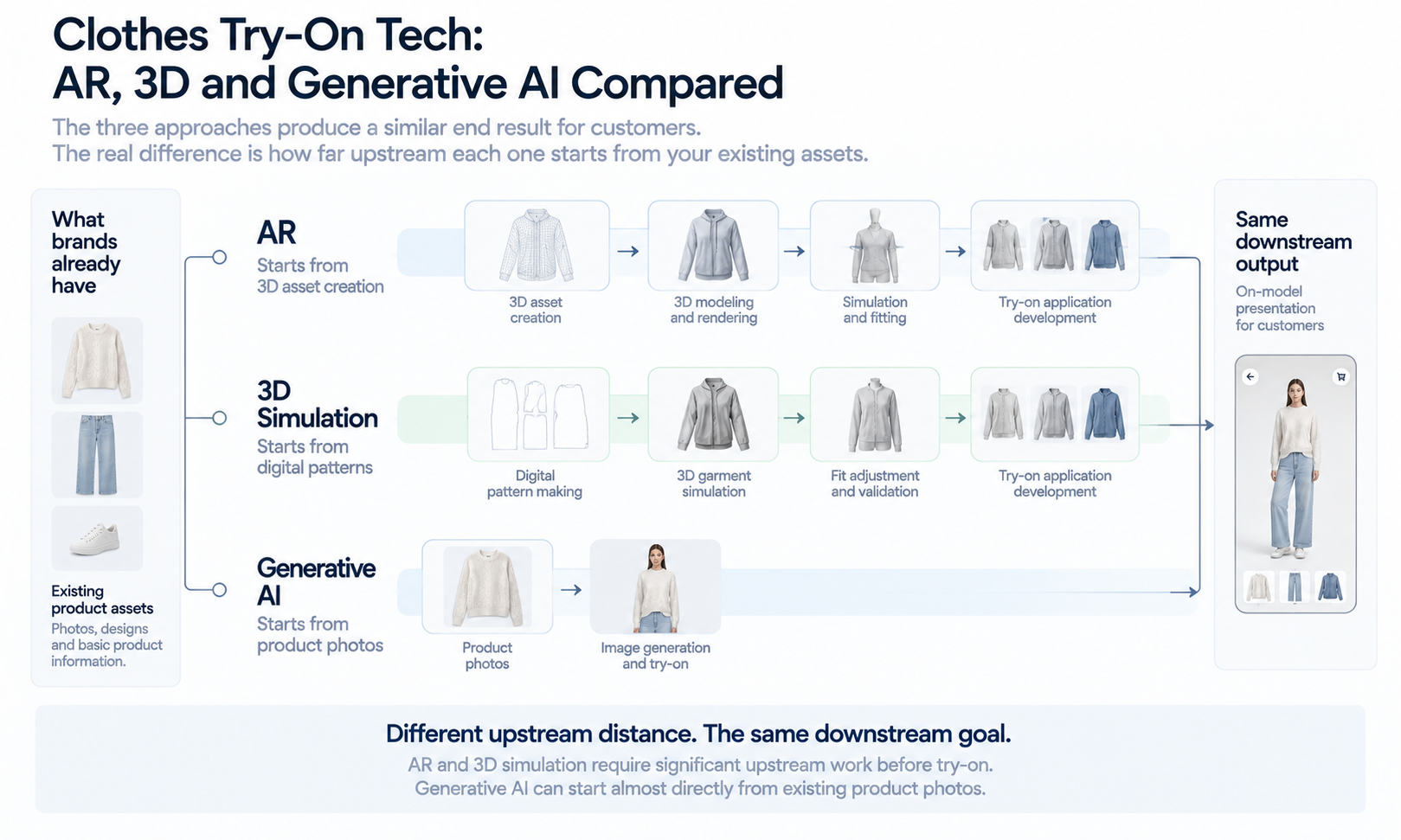
Comparisons of these three usually start with the experience — what the shopper sees, how impressive it feels, whether it converts. That is the wrong end to start from, because the experience is the part you can evaluate in a demo and the part that has almost no bearing on whether you can actually deploy it.
The decisive difference is upstream. Each of the three requires a completely different asset to already exist before it can produce anything, and for most brands that requirement, rather than the output, is what makes the choice.
They differ by what they require you to already have
Augmented reality needs a three-dimensional asset for every product it displays. Physics-based simulation needs a digital garment built from a pattern. Generative imagery needs a photograph.
Read that list against what your business already produces and the comparison largely resolves itself. Brands produce photographs as a matter of course. Very few produce digital garments. Almost none hold a 3D asset for every SKU.
The common failure is choosing on experience quality, committing, and then discovering that the input requirement is an entire production pipeline nobody scoped. That discovery usually arrives after a budget has been approved on the strength of a demo built with one carefully prepared sample product.
Worth asking every vendor the same question early: what has to exist before this produces anything for us, and who makes it. A vendor whose answer is specific and unwelcome is more useful than one whose answer is that they will handle it, because handling it is the recurring cost and it will appear somewhere regardless of who performs the work.
What each one needs, produces and costs to maintain
| Augmented reality | Physics-based 3D | Generative imagery | |
|---|---|---|---|
| Requires | A 3D asset per product | A digital garment from a pattern | A product photograph |
| Produces | An interactive view on a device | A simulated garment on an avatar | A finished image |
| Who it serves | The shopper, in the moment | Product development, before sampling | Every channel that renders pictures |
| Maintenance | New asset per style, every season | Pattern updates flow through | Regenerate from the base photo |
| Where it fails | No asset, no feature | Requires pattern data most brands lack | Reflects appearance, not behavior |
The maintenance row deserves more attention than it usually gets. A capability that needs a new specialist asset for every style every season is not a one-off investment; it is a recurring production line, and its cost scales with range size rather than with usage.
Augmented reality: the asset problem behind the experience
AR is the most impressive in a demonstration and the most demanding in practice, because it cannot render anything it does not have an asset for.
Storefront platforms are specific about the formats involved: Shopify accepts 3D product media in GLB and USDZ (source: Shopify product media types). Producing files in those formats, for every style, to a standard that holds up on a customer's phone, is the actual project.
The economics work where a small number of products are displayed repeatedly over a long period. A brand with a handful of signature items, or one selling rigid goods that hold their shape, can amortize the asset creation across years. A seasonal apparel range with hundreds of styles cannot, because the assets expire with the range.
There is also a category constraint. Rigid products model well; soft garments do not, for the same reasons that make them difficult everywhere else in this space.
That constraint interacts badly with the economics. The products that amortize asset creation most effectively are the ones displayed for years, and the products that model most reliably are rigid — so the strong case for AR sits at the intersection of two conditions that most apparel ranges satisfy neither of. Accessories and footwear are a different matter.
Physics-based 3D: closest to fit, furthest from a photograph
Simulation is the only one of the three that models material behavior, and that makes it the only one with a legitimate relationship to fit questions.
The requirement is a digital garment constructed from a pattern, with material properties assigned. Where a brand already works this way — and some do, particularly in performance and technical categories — the incremental cost of simulation is modest and the value is real, because changes flow from the pattern through to the visualization.
Where a brand does not already work this way, adopting simulation means adopting digital pattern making first. That is a change to how the product development team works rather than a tool purchase, and it takes seasons rather than weeks.
The sequencing is what gets missed in planning. Simulation is frequently proposed as the answer to a marketing timeline problem, and it cannot address one, because the prerequisite sits in product development and the payback also sits there. A brand short of listing imagery will not solve that by investing in digital patterns, however sound that investment is on its own terms.
Worth being precise about what this buys. Simulation can inform development decisions before a sample exists. It is not a shortcut to marketing imagery, and rendered simulation output rarely substitutes for photography on a product page.
Generative imagery: a photograph in, a photograph out
The requirement here is the one every brand already meets. A product photograph exists, and the output is another photograph-like image that goes into the slots photography already fills.
That alignment is why it deploys quickly and why the maintenance question barely arises — a change in the product means regenerating from a new base photo, using the same process as before.
The trade is equally clear. This route does not model material behavior and does not produce an interactive asset. It reflects appearance, which is what a listing, a lookbook and a channel asset all consume. The AI Virtual Try-On module in Lightchain AI (apparel AI) works this way, from an existing product photo — see AI virtual try-on, and scaling e-commerce imagery for how the output distributes across a catalog.
Choose by your pipeline, not by the demo
Three questions settle it faster than any feature comparison.
Do you already hold patterns in digital form. If yes, simulation is available to you at a reasonable incremental cost and can inform development. If no, treat it as a multi-season change rather than a purchase.
Do you have a small, stable set of products displayed over years. If yes, AR asset creation can amortize. If your range turns over seasonally, it will not.
Do you produce product photography. Everyone does, which is why generative imagery has the shortest path from decision to output — and also why it answers image questions rather than fit questions.
Most brands find that two of the three are ruled out by their existing pipeline before quality enters the discussion at all. That is a useful outcome rather than a disappointing one, since it converts an open-ended evaluation into a single option to assess properly.
What none of them do
Each has a boundary and they are not the same boundary, which is why they get confused.
Generative imagery produces a visual asset. It does not predict fit, determine sizing, model how a fabric behaves in motion, or forecast returns. Those come from measurements, a graded pattern, a physical sample, and your own returns data.
AR displays an asset in a customer's space. It shows scale and placement and says nothing about how a garment will fit a specific body.
Simulation models behavior from a pattern and material properties, and its output is only as good as those inputs. It informs development decisions; it does not replace a physical sample, and any brand treating simulation output as final approval will find out why at the fitting.
Questions apparel teams ask
Which one suits a fashion e-commerce brand? Generative imagery for listings and campaigns, because the input requirement is already met and the output goes where imagery goes. AR only where a small set of products is displayed for years, and simulation only where digital patterns already exist.
Can we do AR without building 3D assets? No. AR renders an asset, so no asset means no feature. That requirement is the project, and it recurs every season for a changing range.
Does simulation answer fit questions? It informs them, from a pattern and material properties, before a sample exists. It does not replace the physical sample, and its accuracy depends entirely on the quality of the pattern data behind it.
Can we combine them? Yes, and larger brands do — simulation in development, generative imagery for channels, AR on a small set of hero products. The mistake is treating them as competing choices when they serve different stages.
Which is cheapest to maintain? Generative imagery, because the maintenance action is regenerating from a photograph you would have taken anyway. AR carries a per-style asset cost every season, which is the largest recurring commitment of the three.
Where should a brand with none of this start? With the route whose input requirement you already satisfy, which for almost every apparel brand is photography. Starting elsewhere means building a production capability before producing anything.
What the comparison actually decides
Not which technology is better, but which one your existing pipeline can feed. AR needs an asset per product, simulation needs a digital pattern, and generative imagery needs the photograph you already have — and that ordering explains why deployment timelines differ by years rather than weeks. Check what you already produce before evaluating what any of them display. If the answer is photographs, the shortest route is the one that consumes photographs, and it answers questions about appearance rather than about fit.
List what your pipeline already produces before the next vendor call.
**Write down whether you hold digital patterns, whether you have 3D assets for any product, and how many photographs you produce per style. That list rules out most of the field in about ten minutes, and it prevents the common outcome of approving a demo whose input requirement nobody has scoped. → **AI virtual try-on
About the author
[REPLACE — real person's name, role, relevant experience, LinkedIn URL. No team byline.]