
Most evaluations test the tool. Apparel retail needs to test the operation the tool would sit inside, because the thing that decides the outcome is rarely the output.
A platform can produce excellent results in a clear week, with one prepared style, reviewed by whoever was most interested, and still be unusable in a business with a launch calendar, four channels with different requirements, and one person who can check images between other duties. That failure is not visible in any test run under favorable conditions, and favorable conditions are what a demonstration is made of.
So the useful evaluation is the same test conducted under the constraints you actually have.
Lab conditions and retail conditions
| What gets tested | How it is usually tested | What only appears under the real constraint |
|---|---|---|
| Output quality | One prepared style, in a clear week | Almost nothing more. This is the part a demonstration answers honestly |
| Review capacity | By whoever proposed the trial, giving it full attention | How long the check takes when it is one duty among several on a Thursday |
| Turnaround | Measured from generation to approved master | Where the sequence breaks when a style arrives late and a page is already built |
| Consistency | Across a handful of styles chosen for the test | Across a collection page, where drift between styles becomes visible |
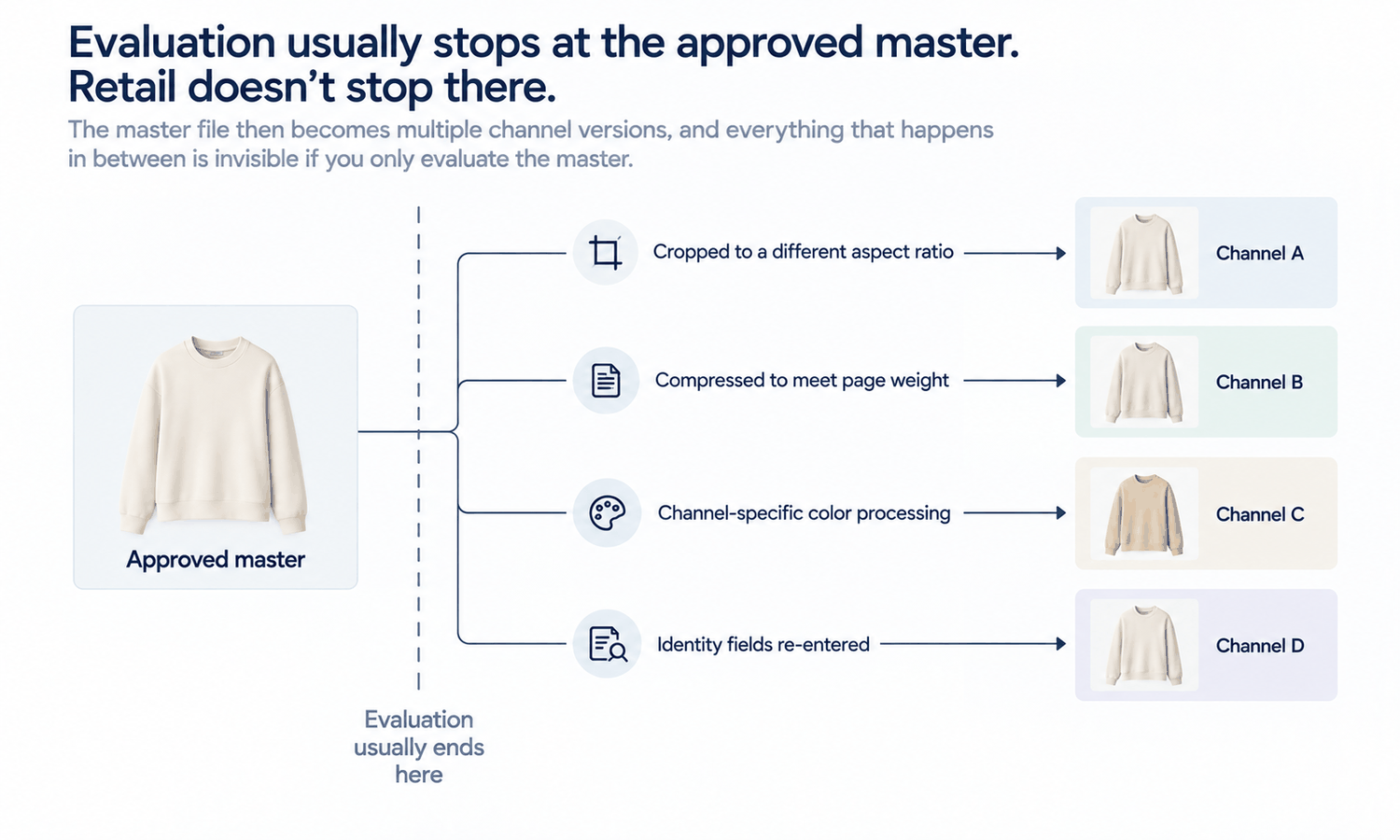
| What reaches a customer | Not tested. The evaluation ends at the master | What each channel does to the file: crop, compression, its own color handling |
Reading down the third column, each row describes something that only appears when the constraint is present. Removing the constraint to make the test cleaner removes the finding.
This is why an evaluation that goes well and an adoption that goes badly are so often the same platform. The test measured the output and the operation was never in the room.
Test on your calendar, not on a clear week
A test run in a quiet period tells you what is achievable when nothing else is happening, which is a state your business is in for a few weeks a year.
Run the evaluation against a real deadline, ideally a small one you can afford to miss. What surfaces is the sequence of compromises that will happen every season: which step gets shortened first, who gets pulled onto something else, whether the styles that arrive late are the difficult ones, and what somebody does at eleven at night when an asset is missing and a page is built.
That sequence is more predictive than any output quality measure, because it is what the workflow will actually look like in the months after adoption. A platform that survives it is a platform that fits.
The corollary is that a test which slips its own deadline has produced a finding rather than a failure. Note where it slipped and why, since that is the constraint you will meet again.
Test with the headcount you have
Evaluations are usually staffed by whoever proposed them, working with more attention than the role will receive afterwards. That inflates every result that depends on review.
The conformity check is where this bites. Logos, printed text, care labels, and small hardware get compared against the source image on every single on-model output, without exception, and reconstructed detail lands almost right — a letterform slightly off, a stitch count wrong, a zipper pull the wrong shape. During an evaluation somebody performs that check carefully because the evaluation is the task. In production it is one duty among several, performed on a Thursday.
So test it at production attention rather than at evaluation attention: give the check to the person who will actually own it, in a normal week, with their other work still on their desk. What you are measuring is not whether the check catches things, which it does, but how long it takes and whether that length survives contact with the rest of the job. In Lightchain AI (apparel AI) the uploaded source stays beside every AI Virtual Try-On output derived from it, and the reason that matters is arithmetic rather than convenience: a two-second comparison survives a busy Thursday and a two-minute one does not.
Where a single region fails and the rest is sound, a targeted correction to that region is a smaller intervention than a rerun, and the evaluation should establish how long that takes too, since partial failures are most of what a real batch produces.
Test the channel requirements, not the master file
An evaluation almost always ends at the approved master, and a retail operation does not. The master becomes a set of channel versions with different ratios, backgrounds, minimum resolutions, and ingest behavior, and things happen to it on the way.
Take one approved output through to a live listing on each channel you sell through, and compare what is live against what was approved. Check the crop, whether the shade shifted through a platform's own processing, and whether a care label or a small mark is still legible at full size after compression.
Whatever that comparison shows is a property of your channels rather than of the platform, which is exactly why an evaluation that stops at the master will not find it. Across a catalog at scale this is where the identity fields matter too: check whether the style code, colorway, season and state survive the crossing or get re-entered by hand.
What a test cannot establish
Testing under real conditions extends what an evaluation can tell you. It does not extend what the output is.
The output is a visual asset. It does not predict fit, determine sizing, model how a fabric behaves in motion, or forecast returns. Those come from measurements, a graded pattern, a physical sample, and your own data. No test design reaches any of them, and a result that looks convincing is not evidence about a garment on a body.
So a size chart cannot be validated by an evaluation, and no trial should be scoped against a return-rate or conversion outcome, since both sit at the end of a chain running through sizing, price, assortment, and traffic. An evaluation that promises to establish either is measuring something it cannot control.
Color cannot be scored either. Screen color is not a physical reference, exact code matching is not something to promise, and the gap between a monitor and a roll of cloth stays open regardless of display quality. Colorways get settled by strike-offs against an agreed standard, so a test can check that a colorway pass produces usable candidates and cannot check the shade.
Two scope answers save evaluation time. Footwear is not covered by this class of workflow, and that is structural. Lace and open work, sheer fabrics, complex prints, and heavily layered looks are documented weak spots, so including them tells you where the line sits rather than whether the platform works.
What to record so the next evaluation is a comparison
Most evaluations produce a decision and no record, which means the next one starts from nothing.
-
The source photographs and the outputs, kept together, so a rerun after a product update compares rather than re-opines
-
The settings or profile used, since a defect traced later needs to know what the batch shared
-
Attempts per accepted output, by category rather than as an average
-
How long the conformity check took at production attention, and who performed it
-
The category verdicts with reasons, so a category ruled out does not return to the agenda each season
Write the finding as a sentence about a category and an operation rather than as a verdict about a platform. Placement prints held at our review capacity; layered looks did not; the channel crop removed the hem on two of four channels. That kind of statement survives being repeated to somebody who was not there, and it is what makes a second evaluation shorter than the first. Whether the work runs through Lightchain AI or a camera, the record is what turns an opinion into a comparison.
Frequently asked questions
How long should a retail evaluation run?
Long enough to include one real deadline, which usually means a small drop rather than a fixed number of weeks. A test that never meets a deadline has not tested the thing that decides adoption. Choose a deadline you can afford to miss.
Who should perform the checks during the trial?
The person who will own them afterwards, working a normal week. A trial staffed by its enthusiast measures a version of the operation that will not exist in month three. If that person cannot be spared for the trial, that is itself a finding about capacity.
Should we include our difficult categories?
Yes, and choose them for difficulty rather than convenience, since the result tells you where the boundary sits in your own range. A test built from easy categories produces a flattering average and no usable information about the styles you were worried about.
What if the trial misses its deadline?
Record where it slipped and why, because that is the constraint you will meet every season. A slipped trial is not a failed trial. It is the only version that produced information about how the operation behaves under pressure.
Do we need to test every channel?
Test each channel with different ingest behavior at least once, since the differences between them are what an evaluation ending at the master never sees. Channels sharing the same requirements can be treated as one. The finding is about your channels rather than the platform.
How do we compare two platforms fairly?
Identical garments, identical source photographs, identical preparation, identical reviewer, and the same real deadline for both. Keep the results internal, since a comparison worth publishing needs a stated method and a defined evaluation set that a live trial does not provide.
In closing
An evaluation conducted under favorable conditions measures output quality, which is the part that takes care of itself. What decides adoption is whether the workflow survives a launch calendar, the review capacity you actually have, and four channels that each do something to the file on the way to a page. Run the test against a real deadline, staffed by the person who will own it, all the way through to a live listing. Then write the finding as a sentence about your categories and your operation rather than as a verdict, so the next evaluation is a comparison.
Start here
Pick the next small drop and run the evaluation inside it rather than beside it. Give the checks to the person who will own them, take one style all the way to a live listing on every channel, and note the first thing that got shortened when the week got busy. That first shortcut is the most useful output of the entire trial, and it never appears in a test run on a clear week.
**Start with the on-model workflow → **https://www.lightchainai.com/global/solutions/aiVirtualTryOn