
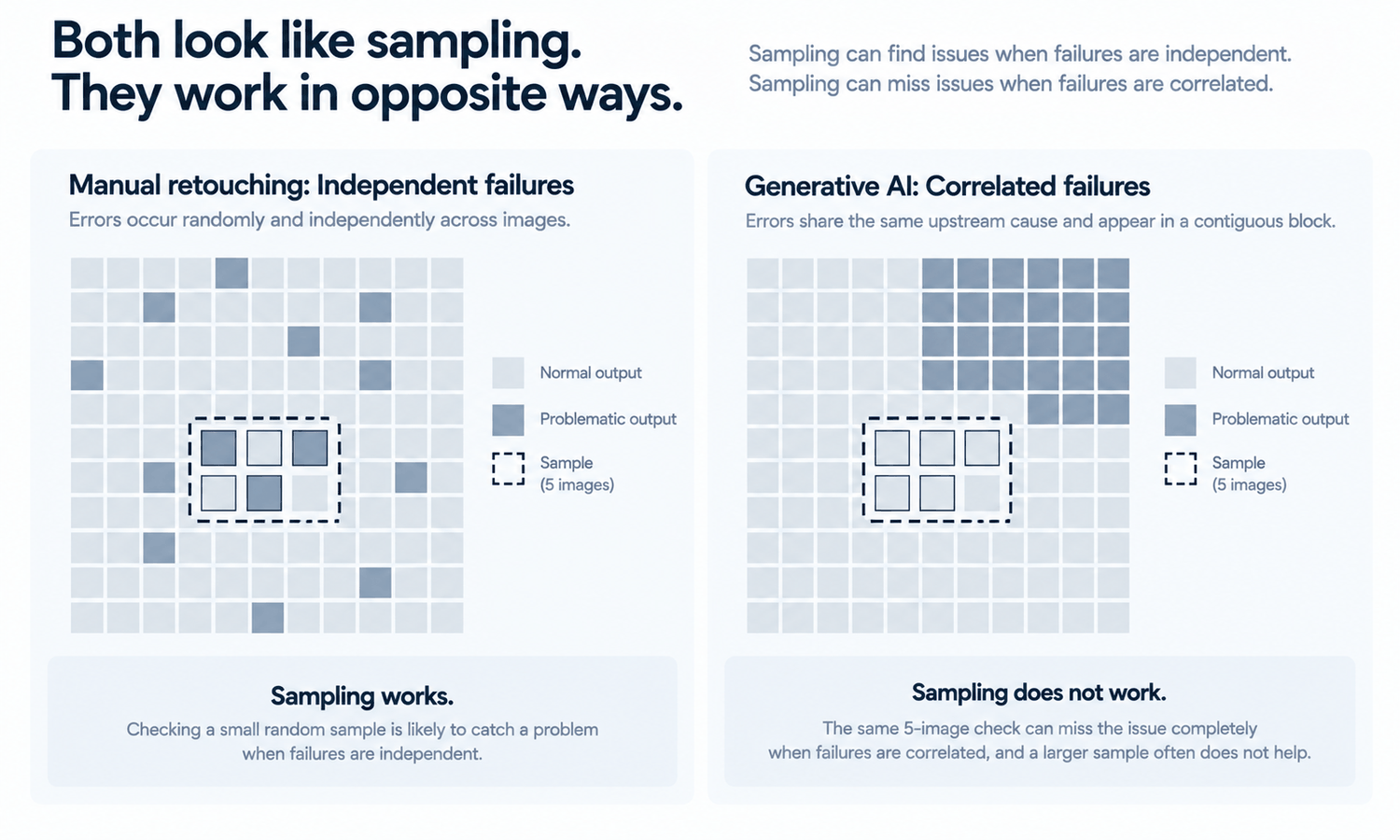
Manual retouching and generative production are usually compared on cost per image, which is the axis where the answer is obvious and the least interesting. The useful difference shows up at volume, and it is not that one is cheaper. It is that they fail in opposite directions.
Manual retouching scales linearly. A hundred images cost roughly a hundred times one image, quality stays roughly constant because a person handles each one, and when something goes wrong it goes wrong on that image and no other. The cost is the problem and the failure mode is benign.
Generative production inverts both. Cost per image drops substantially, and defects stop being independent, because outputs sharing a source standard and a settings profile fail together. The cost stops being the problem and the failure mode becomes the problem.
Opposite failure modes
| Manual retouching | Generative production | |
|---|---|---|
| How cost behaves with volume | Linear. A hundred images cost about a hundred times one | Sub-linear. One disciplined capture supports many outputs |
| How defects are distributed | Independently. A mistake stays on the image it was made on | Correlated. Outputs sharing a source and a settings profile fail together |
| Whether sampling works as a check | Yes. A clean sample implies a mostly clean population | No. A clean sample describes the batch rather than the images |
| What a defect costs to fix | One correction, on one image | One cause, one fix, applied across however many inherited it |
| What has to exist first | Nothing beyond the images you already have | A capture standard, held, or the derivation carries its faults forward |
| Where the binding constraint lands | Budget, since per-image cost is close to fixed | Review capacity, since production stops being the limit |
Neither column is better. They are different shapes of risk, and an operation at volume needs to know which shape it is holding, because the management response to each is the opposite of the response to the other.
Linear, independent failure is managed by sampling, since a clean sample genuinely implies a mostly clean population. Correlated failure cannot be sampled at all, since a clean sample tells you about the batch rather than about the images. A team that carries a sampling habit from one into the other has kept the method and lost the reason it worked.
Manual retouching: predictable in both directions
The case for retouching at volume is stronger than the cost comparison suggests, and it rests on that independence.
Each image is handled by somebody who sees it. Judgment is applied per item, unusual cases get noticed because they are unusual, and a mistake stays where it was made. For a range with many exceptions — irregular garments, unusual constructions, styles where the interesting thing is also the difficult thing — that per-item attention is the product rather than an overhead.
It is also the approach that does not require a capture standard to be in place first. A retoucher works with what exists, which makes it the practical answer for a back catalog shot inconsistently over several years and never going to be reshot.
What it does not do is get cheaper. The cost per image is close to fixed, so volume is a budget question with no structural relief, and the quality ceiling is whoever is available that week.
Generative production: cheaper per image, and correlated
The case for generative production at volume is the derivation economics: one disciplined capture supports many outputs, and the marginal image is close to free.
The condition attached is the one that decides everything. Every output derives from a source, so a source captured badly is wrong in every image derived from it, and a settings profile with a problem produces a batch with the same problem. That is what correlated means in practice, and it is why the comparison against source has to happen on every output rather than on a sample.
Logos, printed text, care labels, and small hardware get compared against the source image on every single output, without exception. Reconstructed detail lands almost right — a letterform slightly off, a stitch count wrong, a zipper pull the wrong shape — and in a correlated failure it lands almost right on two hundred images at once. In Lightchain AI (apparel AI) the uploaded source stays beside every AI Virtual Try-On output derived from it, which is what makes a per-output comparison fast enough to actually happen at volume rather than aspirational.
The upside of correlation is worth stating too, since it runs both ways. A defect shared by two hundred images usually has one cause and therefore one fix, which is a better position than two hundred separate corrections. Correlation is bad news for detection and good news for repair.
The hybrid most operations land on
Framed as a choice, this resolves into an either-or that few operations actually run. In practice the split falls along category lines rather than along tooling preference.
-
Bodies that recur across colorways, channels and seasons go to generative production, since that is where derivation repays the capture discipline
-
Documented weak spots — lace and open work, sheer fabrics, complex prints, heavily layered looks — go to photography, and retouching handles whatever remains
-
Hero images and anything that will be looked at rather than scrolled past usually justify per-item attention regardless of volume
-
The existing back catalog stays with retouching, because reshooting it to a standard is a project nobody has scheduled
-
One-off exceptions and irregular constructions go to whoever can see the item, which is the retoucher
Where a single region of a generated output is wrong and the rest is sound, a targeted correction to that region sits between the two approaches, and it is worth counting separately because it changes what a partial failure costs.
What neither approach supplies
Both produce images. Neither produces the things images are frequently asked to supply.
The output of either route is a visual asset. It does not predict fit, determine sizing, model how a fabric behaves in motion, or forecast returns. Those come from measurements, a graded pattern, a physical sample, and your own data. A retoucher cannot supply them and neither can a generative pipeline, because the limit is in what a visual asset is.
So a size chart cannot be produced by either, and fit language on a page has to trace back to the measurement chart and the fit session whichever route made the image. And no comparison between the two should be scoped against a return-rate or conversion outcome, since both sit at the end of a chain running through sizing, price, assortment, and traffic.
Color is the same on both sides. Screen color is not a physical reference, exact code matching is not something to promise, and the gap between a monitor and a roll of cloth stays open regardless of display quality. Colorways get settled by strike-offs against an agreed standard, and a retoucher matching a shade on a calibrated monitor has produced a match on a monitor.
Footwear is not covered by this class of generative workflow, and that is structural rather than a gap waiting to close.
Deciding per category rather than per tool
The decision is easier once it stops being about which approach is preferable.
Sort the range by reuse first. A body appearing in five colorways across two channels is ten outputs from one capture, and that arithmetic is what makes the capture discipline worth building. A body appearing once is a photograph and a retoucher.
Then sort by whether the interesting thing is also the difficult thing. Where the reason somebody buys a garment is its surface, its transparency, or its layering, that is both the selling point and the documented weak spot, and the answer is a camera regardless of volume.
Then decide who owns the comparison, since that is the constraint the generative route lands on and the one the retouching route does not have. Across a catalog at scale the review capacity binds long before the production capacity does, and whether the work runs through Lightchain AI or a retoucher, the images somebody actually checked are the only ones that count.
Frequently asked questions
Is retouching obsolete for bulk work?
No, and it holds two roles that do not disappear: the existing back catalog, which nobody is going to reshoot to a standard, and the exceptions, where per-item attention is the point. What changes is that it stops being the default for bodies that repeat.
Can we sample-check generated output the way we sample-check retouched output?
No, and this is the single most transferable-looking habit that does not transfer. Retouched defects are independent, so a clean sample implies a mostly clean population. Generated defects are correlated, so a clean sample implies almost nothing about the batch.
Which is cheaper?
Generative production per image, substantially, once a capture standard exists. Whether that translates into a cheaper operation depends on review capacity, since the saving lands in production and the cost lands in checking. Compare cost per accepted, checked output rather than per image.
What if we have no capture standard?
Then the generative route is not yet available in the form that pays, and retouching is the honest interim answer. Building the standard is a photography project rather than a tooling one. Adopting before it exists produces a range that does not match itself.
Do we need both long term?
Most operations at volume end up with both, split by category rather than by preference. Deciding the split explicitly and writing it down is what stops it being renegotiated every season. The categories move slowly; the arguments do not.
How do we compare quality between the two?
As two numbers rather than one: conformity to the source, checked on every output, and appeal, sampled. Retouching and generation differ more on the first than on the second, and conflating them produces a comparison that supports no decision.
In closing
The two approaches differ less in what they produce than in how they break. Retouching costs linearly, applies judgment per item, and fails one image at a time. Generative production costs far less per image and fails in batches, because everything derived from a shared source inherits whatever was wrong with it. That difference decides the management method: sampling works on one and is meaningless on the other. Sort the range by reuse and by whether the difficult thing is also the selling point, and the split follows from the categories rather than from a preference between tools.
Start here
Take your range and count, for each body, how many published images derive from a single capture. Bodies with a count above one are where derivation repays the discipline; bodies with a count of one are a photograph and a retoucher. That single count sorts most catalogs in an afternoon and replaces an argument about tooling with a list of categories. Then decide who owns the comparison for the first group, since that is the constraint the split lands on.
**Start with catalog-scale asset work → **https://www.lightchainai.com/global/solutions/scaleECommerce