
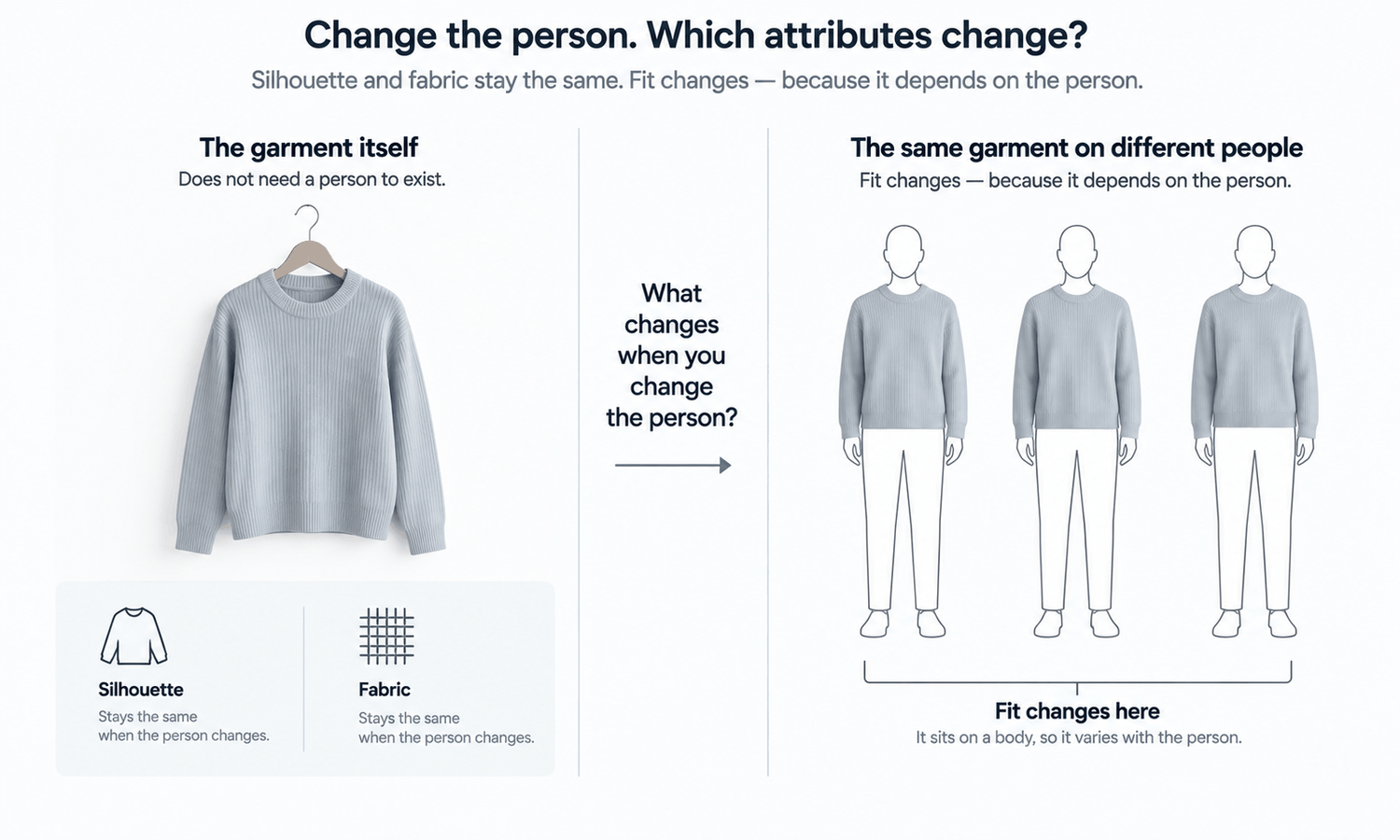
Silhouette, fabric and fit get listed together as though they were three attributes of the same kind. Two of them are. The third is not, and confusing that is why product filters, design briefs, and size guidance behave unpredictably.
Silhouette and fabric are properties of a garment. They exist whether or not anybody is wearing it, they can be recorded once, and they stay true for the life of the style. Fit is a relationship between a garment's measurements and a particular body, which means it does not exist in the garment at all and cannot be recorded as one of its attributes.
Any clothes filter, any brief, and any product page that treats the third like the first two will produce results that seem almost right and disappoint specifically.
Two properties and a relationship
| What it is | How it should be recorded | |
|---|---|---|
| Silhouette | A property of the garment. It exists on a hanger and does not change with the wearer | A controlled vocabulary: a fixed list of terms, each with a reference image and a distinguishing measurement where one exists |
| Fabric | A property of the garment, and the one that predicts most of what a customer notices on arrival | Fiber, weight and construction, as a specification rather than an adjective |
| Fit | Not a property of the garment. A relationship between its measurements and a particular body | A measurement chart, plus size guidance derived from your own returns and reviews and labeled as such |
The third row is the one that causes trouble, because a garment can be described as relaxed or true to size and the description sounds like the other two. It is a summary of how a population of bodies has experienced the garment, which is useful information and a different kind of thing.
The practical test is whether the attribute changes when the wearer changes. Silhouette does not. Fabric does not. Fit does, entirely.
Silhouette: filterable only against a controlled vocabulary
Silhouette is objectively present in a garment and subjectively named. Oversized, relaxed, boxy, straight, and fitted describe real differences and mean different things at different brands and in different categories.
That makes silhouette filterable in principle and unreliable in practice unless the vocabulary is controlled. A controlled vocabulary means a fixed list of terms, each with a reference image and, where possible, a measurement that distinguishes it: a chest measurement relative to the body block, a shoulder drop, a hem circumference.
Without that, a filter for relaxed returns garments from three designers who each meant something different, and the shopper who used the filter has been given a set that does not share the property they selected for. The fix is unglamorous and permanent: write the list, attach a reference image to each term, and use only those terms in briefs, on pages, and in filters. Deciding silhouette and fabric direction against a written list is what makes the same word mean the same thing twice.
Fabric: the most informative attribute and the least recorded
Fabric is the most objectively describable of the three and usually the worst recorded, because it gets captured as a marketing word rather than as a specification.
A garment described as soft cotton has been described in a way that filters nothing. The same garment described by fiber, weight, and construction — a 240gsm cotton interlock, a 12oz rigid denim, a viscose crepe — carries information a shopper can use and a technical team can act on. Weight in particular does more work than almost anything else on a product page and appears on almost none of them.
This matters beyond filtering. Fabric determines how a garment behaves, so it is the attribute that predicts most of what a customer will notice on arrival: drape, weight in the hand, how it recovers, whether it presses. A page that describes fabric properly is doing more for expectation accuracy than most of what surrounds it.
For anything heading toward production, the same specificity is what a line drawing or tech-sheet draft has to carry, and those outputs remain drafts a technical designer reviews.
Fit is a relationship, not an attribute
This is where the distinction has consequences, and it is worth stating in the terms that make it checkable.
Fit comes from measurements, a graded pattern, a physical sample, and your own data. It is settled by a garment on a body, and the record of it lives in a measurement chart and in what your customers reported after wearing it. It is not present in an image, and no visual asset supplies it.
The output of any imaging workflow is a visual asset. It does not predict fit, determine sizing, model how a fabric behaves in motion, or forecast returns. That is a property of what the asset is rather than a limitation of any particular result, and it does not change with better rendering.
So a size chart cannot be assembled from imagery, and fit language on a page has to trace back to the measurement chart and the fit session rather than to how a garment looks. Guidance like runs small is an inference from your own returns and reviews, which makes it a claim about your customers rather than a specification of the garment — legitimate to publish, and worth labeling as what it is.
Color belongs in the same category of care. Screen color is not a physical reference, exact code matching is not something to promise, and the gap between a monitor and a roll of cloth stays open regardless of display quality. Colorways get settled by strike-offs against an agreed standard.
What this changes about how you describe and filter
Once the three are separated, the practical changes are small and specific.
-
Filter and brief on silhouette using a controlled list with reference images, and treat any term outside the list as undefined rather than as a synonym
-
Record fabric as fiber, weight and construction, and publish the weight, since it is the single most useful number most pages omit
-
Do not offer fit as a filter dimension. Offer measurements, and offer size guidance separately, labeled as guidance derived from your own data
-
Keep the three in separate fields rather than in one description, because a merged description cannot be filtered on any of them
-
Check that the same word means the same thing across categories, since silhouette vocabulary drifts between departments faster than anywhere else
Across a catalog of any size the merged-description problem is the expensive one, since it cannot be fixed retrospectively without rewriting every entry.
Where imagery helps, and where it does not
Imagery serves two of the three well and the third not at all, which follows directly from what each one is.
For silhouette, an image is the clearest available description, and it is why a controlled vocabulary works better with a reference image attached to each term than with a definition. For fabric, an image conveys surface and character — how a cloth reads at a distance — while the specification carries weight and construction, and the two together do more than either alone. In Lightchain AI (apparel AI) an on-model output from AI Virtual Try-On shows how a piece reads on a body, which is a silhouette and styling question rather than a fit one, and the source photograph stays beside it so the surface description can be checked against the cloth that was captured.
For fit, imagery contributes nothing, and the risk is that a convincing image invites the inference anyway. That is the reason for keeping fit language traceable to the chart rather than to the picture, on the page and in internal records alike. Whether the work runs through Lightchain AI or a camera, the division is the same: two attributes an image describes well, and one relationship it does not touch.
Frequently asked questions
Can we filter by fit at all?
Offer measurements as filters and size guidance as a separate, labeled feature, since those are the two things that actually exist. A fit filter implies the garment has a fit attribute, which invites a shopper to select for something that depends on their own body. Measurements let them do the comparison themselves.
What should a controlled silhouette vocabulary contain?
A short fixed list of terms, each with a reference image and, where possible, a distinguishing measurement. Short matters more than complete, since a term used inconsistently is worse than a term that does not exist. Add a term only when a real distinction is being lost without it.
Why publish fabric weight?
Because it predicts more of what a customer notices on arrival than almost anything else on the page, and because it is objective in a way that adjectives are not. A shopper comparing two similar garments can use a weight and cannot use soft. It is also already recorded somewhere in your supply chain.
Our silhouette terms differ between categories. Is that a problem?
It is the most common version of the problem, since vocabulary drifts by department faster than anywhere else. Decide whether a term means the same thing across categories or whether the categories need different lists, and write down which. Silent divergence is what makes a site-wide filter unreliable.
Does better imagery reduce the need for measurements?
No, and it slightly increases it, since a more convincing image raises the confidence with which a shopper infers fit from appearance. The measurement chart is what that inference should be checked against. Better imagery and better measurements work on different halves of the same problem.
Where should size guidance live?
Next to the measurements rather than inside the product description, and labeled as derived from your own returns and reviews. That separation keeps a claim about your customers distinct from a specification of the garment. Merging them is how guidance gets read as a property of the style.
In closing
Silhouette and fabric are attributes and fit is a relationship, and the difference decides how each one should be recorded, filtered, and described. Silhouette needs a controlled vocabulary with reference images or the same word means three things. Fabric needs fiber, weight and construction rather than an adjective, and the weight is the number most worth publishing. Fit needs measurements and your own data, and it cannot be offered as a filter or read out of a picture, however convincing the picture is.
Start here
Open three product pages from different categories and check whether the same silhouette term appears with the same meaning, and whether any of them publishes a fabric weight. Most teams find the first answer is no and the second is rarely. Those two findings are actionable this week and they cost nothing to establish, which is unusual for anything that improves both filtering and expectation accuracy at once.
**Start with fabric and silhouette work → **https://www.lightchainai.com/global/solutions/designWithPurpose