
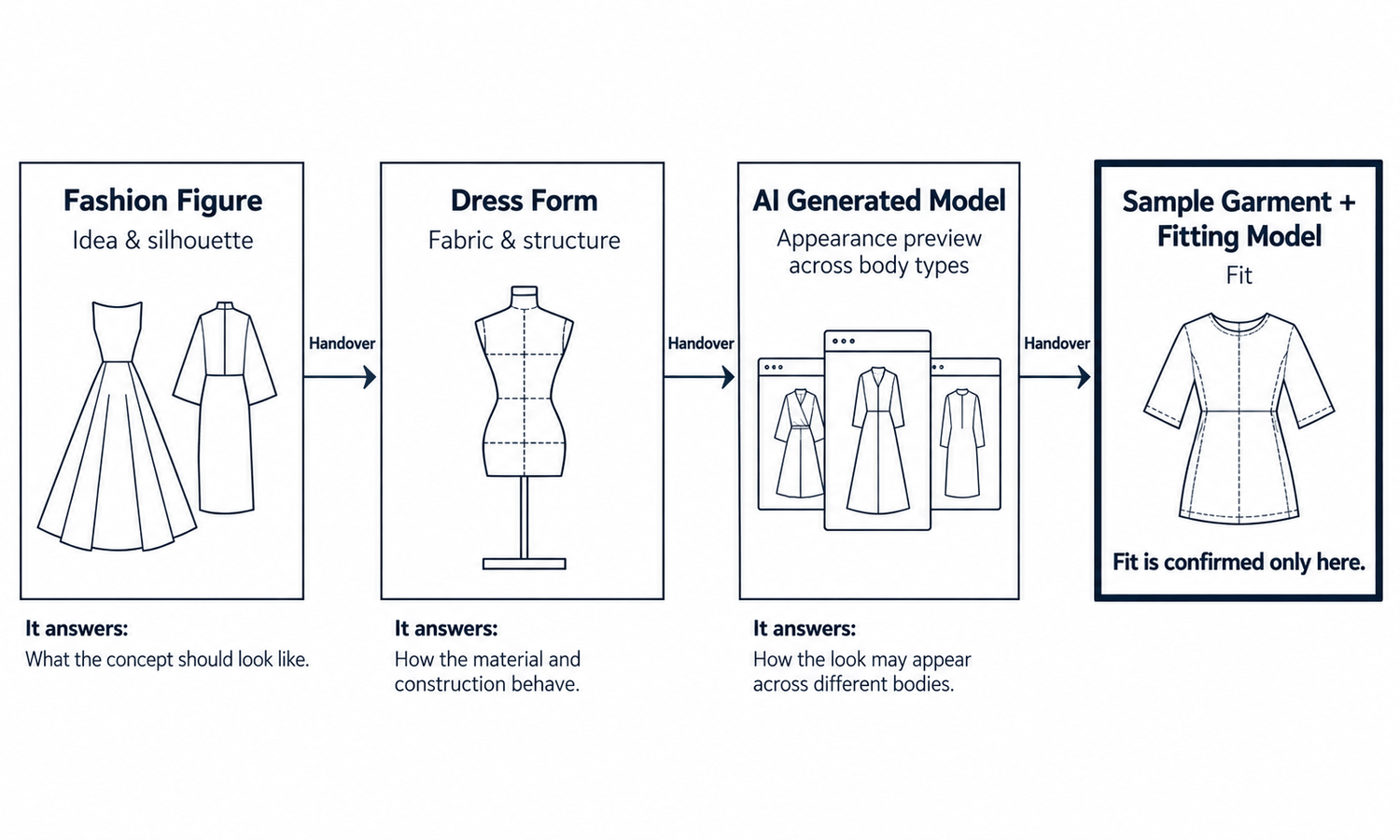
Every clothes design model answers a different question. A designer working on a new garment usually relies on three of them without calling them models at all: the croquis sketched on paper or screen, the dress form in the studio and, increasingly, an AI-generated model that shows the design as a realistic image. Each one is good at something the others cannot do, and each one can mislead if it is asked the wrong question.
The confusion is understandable. All three show a garment on a body of some kind. But the croquis shows a stylized body, the dress form shows a physical body with no movement, and the AI model shows a realistic body that only exists in a picture. What each can tell you follows directly from what kind of body it is.
This article explains what each of the three is for, what it can and cannot tell a designer, how to choose between them for a given question and how to bring a realistic preview into design review.
| Question the designer is asking | Croquis | Dress form | AI-generated model |
|---|---|---|---|
| What does the silhouette look like? | Quickly, in stylized proportions | Yes, in three dimensions | Yes, as a realistic image |
| How does the fabric fall on a body? | No | Yes, with real fabric | Rendered, not calculated |
| Where should seams and darts go? | Roughly | Yes, by draping and pinning | No |
| How will it look on the customer range? | No | Only at one size | Yes, as appearance across builds |
| Does it fit? | No | Partly, at the base size | No |
| How quickly can many ideas be compared? | Very quickly | Slowly | Quickly |
The Croquis: Thinking in Lines
The croquis is the fastest of the three. It is a stylized figure, drawn taller and leaner than any real body, on which a designer sketches ideas in minutes. It is ideal for exploring silhouettes, comparing directions and communicating intent to a team.
Its stylized proportions are also its main limitation. Hems, cropped lengths, waistlines and detail placements drawn on a croquis can read differently on a realistic body, because the croquis stretches some parts of the figure more than others. The croquis answers the question of what an idea looks like as a line. It does not answer how the garment will look worn, how the fabric will behave or whether it will fit.
The Dress Form: Where Fabric Meets a Body
The dress form is the physical design model. It is a three-dimensional body, usually made to the brand's base size, on which designers and pattern makers drape real fabric, pin it, mark it and cut it. It is where a flat idea first meets a shape.
A dress form answers questions no image can.
-
How real fabric falls. Draping actual fabric on the form shows its weight, its stiffness and how it folds, gathers and hangs. That behavior is physical, not rendered.
-
Where seams and darts belong. Pinning fabric to the form shows where shaping is needed and how panels should be divided, which becomes the basis of the pattern.
-
How proportions sit on a three-dimensional body. Lengths and placements can be checked on a body the designer can walk around.
-
How a toile behaves. A first muslin or toile placed on the form shows whether the pattern's shape works before real fabric is cut.
The dress form has limits too. It is one size, usually the base size, so it shows nothing about how the design looks across the customer range. It does not move, so it cannot show how a garment behaves when the wearer walks or reaches. And it is not a person: fit is confirmed on a fit model, a real person at the base size, who can report where a garment pulls, gapes or restricts movement.
The AI-Generated Model: A Realistic Preview
The AI-generated model is the newest of the three and the most visual. A design, turned into a realistic flat-lay or photographed as a toile, can be placed on a generated model and shown as if it had been made and photographed. The model can be set to different ages and builds, different poses and different scenes.
Its strength is appearance at speed and across a range. A designer can see how a silhouette reads on several builds, how proportions look in a relaxed pose and how a range of ideas compares side by side, all before a sample exists. For design review and early conversations with buyers, that realistic view is valuable.
Its limits are the ones any image has. It shows appearance, not fit. The drape is rendered, not calculated, so it is evidence about the picture rather than about the fabric. Details the inputs did not specify, such as trims, fabric texture and finish, are filled in. Color is a screen rendering: screen color is not a physical reference, there is no promise of an exact color-code match and the colorway is settled by the lab dip or sample. Complex prints, lace and openwork, sheer fabrics and layered garments remain current weak areas for generated imagery. And every image of an unmade design is a concept, to be labeled as one wherever it is shown.
The dress form and the AI model can also work together directly. Once a toile has been draped and refined on the form, it can be taken off, laid flat and photographed. That photograph carries the real seam lines, panel shapes and proportions the draping established, so a preview generated from it shows the design as developed rather than as sketched. It still shows appearance rather than fit, but it starts from something physical instead of something drawn, and there is less for the image to fill in.
Choosing the Right Clothes Design Model for Each Question
The practical rule is to match the model to the question. Most design problems can be sorted quickly.
Questions about ideas and direction belong to the croquis. When a team needs to explore many silhouettes or agree a direction, sketching is still the fastest route.
Questions about fabric and shape belong to the dress form. How a fabric drapes, where the seams go and how a pattern takes shape are physical questions, and they are answered with real fabric on a real form.
Questions about appearance across the range belong to the AI-generated model. How a design looks on the builds the line is meant for, how a range reads side by side and how a style will look in the brand's imagery can be previewed realistically before sampling.
Questions about fit belong to none of the three. They belong to the sample on a fit model.
In a typical development flow, the three are used in sequence and each hands over to the next. Ideas start on the croquis. Key pieces are draped on the dress form, and the pattern takes shape there. A realistic preview on generated models, across the planned range of builds, lets the team review appearance before committing to samples. The sample, tried on a fit model, confirms what the images could only suggest. Skipping a step usually means asking another model a question it cannot answer.
The mismatches are easy to recognize once named. Judging a hem length on the croquis asks a stylized body a proportion question. Judging a range's appearance on the dress form asks one size to speak for many. Judging drape or fit from a generated image asks a picture a physical question. Each of these happens in busy studios, and each is avoided by asking which clothes design model the question actually belongs to before anyone answers it.
Bringing the Preview Into Design Review
The realistic preview is most useful between the dress form and the sample, when proportions and appearance can still change cheaply.
In Lightchain AI (apparel AI), the preview step connects to the rest of development.
-
Line Sketch to Flat Lay turns a design sketch into a realistic flat-lay for review, as described on the Production-Marketing Synergy page, and a photographed toile or first sample can serve as the garment source instead.
-
AI Virtual Try-On places that flat-lay on generated models, including on a saved model set, so every design in a review appears on the same models.
-
Model Studio sets body and size across the planned range and fixes pose and scene, so designs can be compared on equal terms.
For design teams that want a realistic preview before sampling, Ideas to Reality is the Lightchain AI solution built for that stage. The dress form, the sample and the fit model keep the questions that only physical garments can answer.
Frequently Asked Questions
What is a clothes design model?
It is any body a designer uses to see a garment during development. In practice there are three: the croquis for sketching, the dress form for draping real fabric and the AI-generated model for realistic previews.
What can a dress form show that an image cannot?
How real fabric falls, where seams and darts belong and how a toile takes shape in three dimensions. Those are physical questions answered with real fabric on a real form.
What can an AI-generated model show that a dress form cannot?
How a design looks across a range of builds, in different poses and scenes, and how many designs compare side by side. It shows appearance quickly, before a sample exists.
Can an AI-generated model replace the dress form?
No. It shows appearance, while the dress form shows how real fabric behaves and where the pattern's shaping belongs. The two answer different questions.
Does a dress form confirm fit?
Only partly. It shows shape at the base size, but fit is confirmed on a fit model, a real person who can report where the garment pulls or restricts movement.
Where does the croquis fit in?
At the start, for exploring ideas and agreeing a direction. Its proportions are stylized, so lengths and placements should be checked later on a realistic body.
Which Lightchain AI solution helps with realistic design previews?
Ideas to Reality is the one to use. It turns sketches or photographed toiles into realistic flat-lays and places them on generated models across the planned range, so designs can be reviewed before sampling.
In Closing
A clothes design model is not one thing. The croquis turns ideas into lines quickly. The dress form shows how real fabric meets a body and where the pattern's shaping belongs. The AI-generated model previews appearance realistically across a range of builds. None of them confirms fit; that stays with the sample on a fit model. Match each question to the model that can answer it, use them in sequence and let each hand over to the next.
Start Here
If your design team wants to see designs as realistic garments on a range of builds before sampling, Ideas to Reality is the solution to use. It is built for turning apparel designs into realistic visuals early in development: you turn sketches or photographed toiles into flat-lays, place them on generated models and compare designs on equal terms. Start with a few designs from your next range, and keep the dress form and fit model for the questions they answer.
**Explore Ideas to Reality → **https://www.lightchainai.com/global/solutions/ideasToReality