
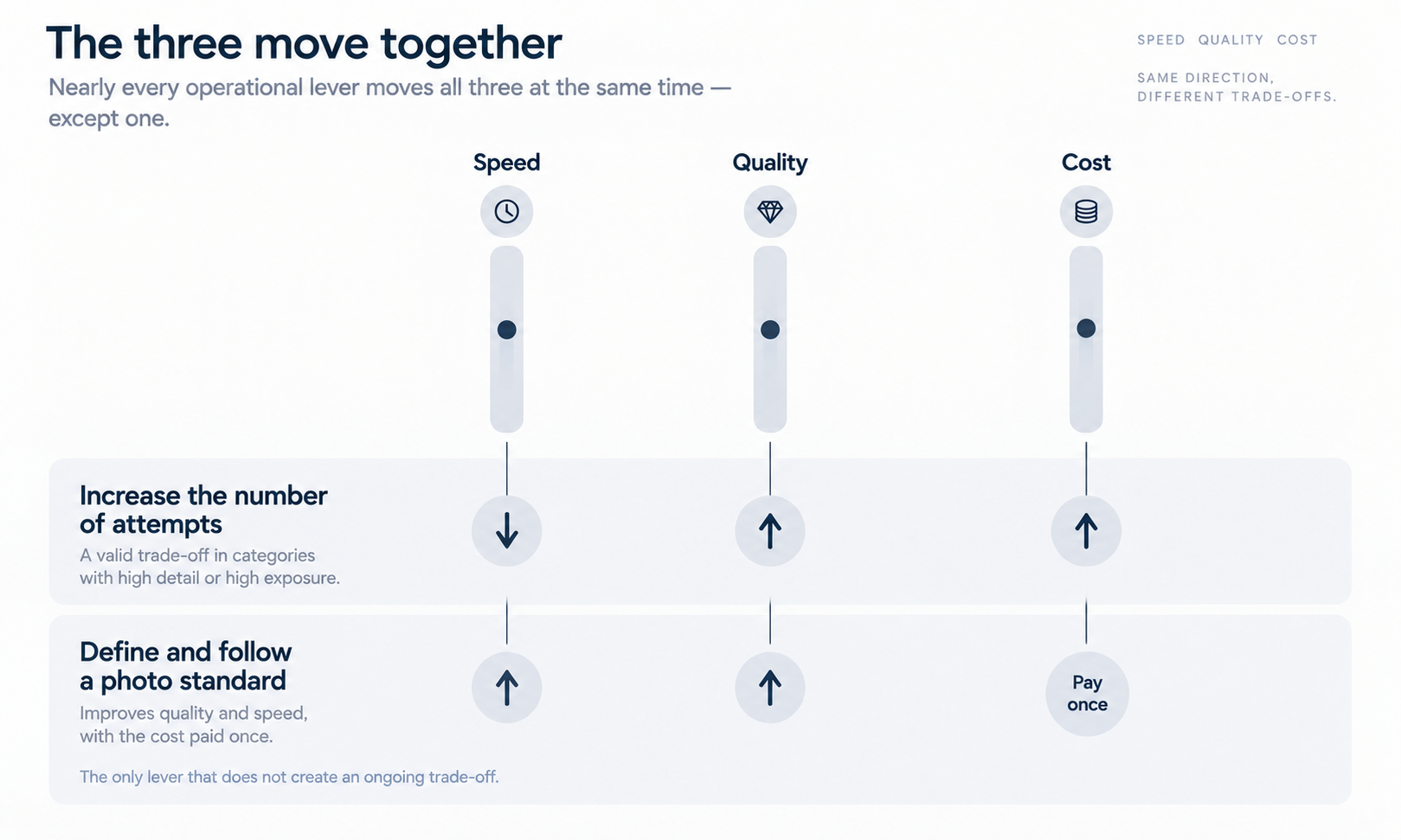
Speed, quality and cost get evaluated as three separate scores. They are three readings from one dial, and almost every decision in a clothes change workflow moves all three at once.
That is why scoring them independently produces a comparison that does not survive contact with a real range. A setting that raises quality lowers speed and raises cost, in a ratio determined by your fabrics and your review capacity rather than by anything in a specification. The question worth answering is not which option scores highest on each axis. It is which trade-off your range can absorb.
The three move together
| Lever | Speed | Quality | Cost |
|---|---|---|---|
| More attempts per style | Down | Up, to a point | Up |
| Fewer variants per style | Up | Unchanged | Down |
| Stricter conformity bar | Down | Up, on the half that reaches customers | Up |
| Sampling the comparison instead of checking every output | Up | Down, invisibly, since correlated defects fail together | Down |
| A written capture standard, held | Up, after an initial slowdown | Up | Paid once, then down |
| Routing a weak-spot category to photography | Up on the rest of the range | Up | Up for that category, down overall |
Every row moves at least two of the three, and most move all three. That is the structure of the problem rather than a complication in it.
The row worth reading twice is the capture standard, because it is the only one that improves two axes at the expense of a cost paid once. Everything else is a genuine trade. That asymmetry is the most useful thing in the table.
Speed: what actually takes the time
Generation is the fast part and it is not where the time goes. On a style that takes a day from start to published, the generation itself is minutes.
The time sits in three places. Preparing a source that meets the standard, which is a photographic task. Deciding — how many variants, which one, whether a near miss is acceptable — which is a person's attention rather than a process. And the comparison against source, which is minutes per output and does not compress.
So a claim of higher speed should be read as a question about which of those three it touches. Faster generation moves the smallest of the three. Something that reduces attempts per accepted output moves a larger one, because attempts consume both machine time and the review that follows each of them. And anything that lets a failing region be fixed with a targeted correction rather than a rerun removes an entire cycle rather than shortening one.
The honest version of the speed question is per accepted, published image rather than per generation, and those two numbers can differ by a factor that has nothing to do with how fast anything runs.
Quality: define it before scoring it
Quality in this context is two different things, and conflating them makes it unscorable.
The first is conformity: whether the output matches the garment it came from. This has a right answer, two reviewers will agree, and it is checkable. Logos, printed text, care labels, and small hardware get compared against the source image on every single on-model output, without exception. Reconstructed detail lands almost right — a letterform slightly off, a stitch count wrong, a zipper pull the wrong shape — and this is the failure that reaches a customer.
The second is appeal: whether the image is good. This is a judgment, it varies by brand, and it is the one people mean when they say quality in a demonstration.
They behave differently under pressure and they should be scored differently. Conformity is a pass or fail per image and can never be sampled, because outputs sharing a capture standard fail together. Appeal is a distribution and can be sampled. A comparison that scores quality as one number has averaged a liability and a preference.
In Lightchain AI (apparel AI) the uploaded source stays beside every AI Virtual Try-On output derived from it, which is what keeps the conformity half checkable at volume rather than aspirational.
Cost: the unit that makes the other two legible
The published rate is the smallest component and the one most often compared. The number that connects to the other two axes is cost per accepted output: your spend divided by the images that passed the comparison and went somewhere.
That figure is where speed and quality show up as money. A category needing three attempts per acceptance costs three times one needing one, at the same rate, and it also takes three times the review. Raising the conformity bar raises both. Lowering the variant count lowers both.
There is a second reason the unit matters. When a single change reads as a gain on one axis and a loss on the others, the three readings cannot settle the argument between them, and the tiebreaker is exposure per style rather than any of the three. A wrong detail on a low-volume, high-price piece costs more than the same defect spread across a basic, so the same tightening of the conformity bar is worth it in one part of a range and not in another. That is a merchandising judgment wearing an operational disguise.
For the platform's published figures, point packages start at $9.90 for 600 points, described by the company as roughly 20 images, with further tiers published alongside; read the current pricing page rather than an article. Treat published rates as a floor, since they describe a case where every attempt succeeded and nobody spent time reviewing.
What no setting on the dial buys
Moving the dial changes what the workflow produces and how much it costs. It does not change what the output is.
The output is a visual asset. It does not predict fit, determine sizing, model how a fabric behaves in motion, or forecast returns. Those come from measurements, a graded pattern, a physical sample, and your own data. No quality setting, no budget, and no amount of speed converts appearance into dimension.
So a size chart cannot be bought as a quality tier, and fit language on a page has to trace back to the measurement chart and the fit session. No spend can be committed against a return-rate or conversion outcome either, since both sit at the end of a chain running through sizing, price, assortment, and traffic.
Color sits outside the dial entirely. Screen color is not a physical reference, exact code matching is not something to promise, and the gap between a monitor and a roll of cloth stays open regardless of display quality. Colorways get settled by strike-offs against an agreed standard, which is a physical step with its own cost that no setting removes.
Footwear is not covered by this class of workflow at all, and lace and open work, sheer fabrics, complex prints, and heavily layered looks are documented weak spots. Those are category verdicts rather than quality settings, and spending more does not move them.
Choosing the trade-off your range can absorb
The choice is easier once it is framed as a trade rather than as a search for the highest score.
-
If your range is large and mostly stable fabrics, buy speed by lowering the variant count and holding the conformity bar, since breadth is where review capacity binds first
-
If your range is small and detail-heavy, buy quality by raising attempts and accept the cost, since a wrong trim on a low-volume style is a larger share of your exposure
-
If your styles repeat across colorways and seasons, invest in the capture standard first, because it is the only lever that improves two axes for a cost paid once
-
If your categories include documented weak spots, spend nothing there and route them to photography, since no setting reaches a category verdict
-
If you cannot say which of the three is currently binding, measure attempts per accepted output before changing anything, because that figure tells you which axis is actually costing you
Across a catalog of any size the same asymmetry holds. Whether the work runs through Lightchain AI or a camera, one lever improves two axes and every other lever trades one against another, which is the whole of the decision.
Frequently asked questions
Can we get all three?
Only through the capture standard, which improves quality and eventually speed for a cost paid once rather than per style. Every other lever trades. Teams looking for a tool that delivers all three simultaneously are usually looking for the capture work they have not done.
Our generation is fast but publishing is slow. What is wrong?
Probably nothing is wrong with the tool, since generation is the smallest of the three time sinks. Look at source preparation, at decisions about variants, and at the comparison against source. The last one does not compress and should not, which means the first two are where the time is.
How do we score quality in a trial?
As two numbers rather than one: conformity, checked on every output and reported as pass or fail, and appeal, sampled and reported as a distribution. Scoring them together averages a liability with a preference and produces a figure that supports no decision.
Is a higher tier worth it?
That depends on whether your binding constraint is generation volume, which for most teams it is not. Work out attempts per accepted output by category first. If review capacity is the constraint, a higher tier buys more of the thing you already cannot process.
What is the fastest change we can make?
Lowering the variant count per style, decided before generating rather than during. It improves speed and cost immediately and costs only the options nobody was going to choose. Most teams find the number they need is smaller than the number they were producing.
Does higher output quality reduce the review burden?
It reduces the appeal half and does very little to the conformity half. A more convincing image makes a wrong detail less likely to be noticed rather than less likely to occur, so the comparison against the source stays exactly as long. Quality improvements move the ceiling rather than the floor.
In closing
Speed, quality and cost are readings from one dial, and every lever except one trades them against each other. The exception is the capture standard, which improves quality and speed for a cost paid once, and it is the lever most often skipped because it looks like photography rather than like a tool decision. Around all of it sits a boundary no setting reaches: fit, sizing, material behavior, physical color, and returns come from measurement and samples rather than from anything on the dial.
Start here
Work out attempts per accepted output for one category, which needs no new tooling and takes an afternoon of counting. That single figure tells you which of the three axes is currently costing you, and it is usually not the one being discussed. Then change one lever and recount, since the value of the number is in the comparison rather than in the level. One category, two counts, and the trade-off stops being an argument about preferences.
**Start with the on-model workflow → **https://www.lightchainai.com/global/solutions/aiVirtualTryOn