
A clothes change color result that looks fake is almost never a rendering failure. It is a decision made earlier arriving late.
That distinction matters because it determines where to look. If the problem is in the image, the response is to look harder at outputs. If the problem is in a decision taken before anything was generated, looking at outputs will find the symptom and never the cause, and the same result will come back next week from the same setup.
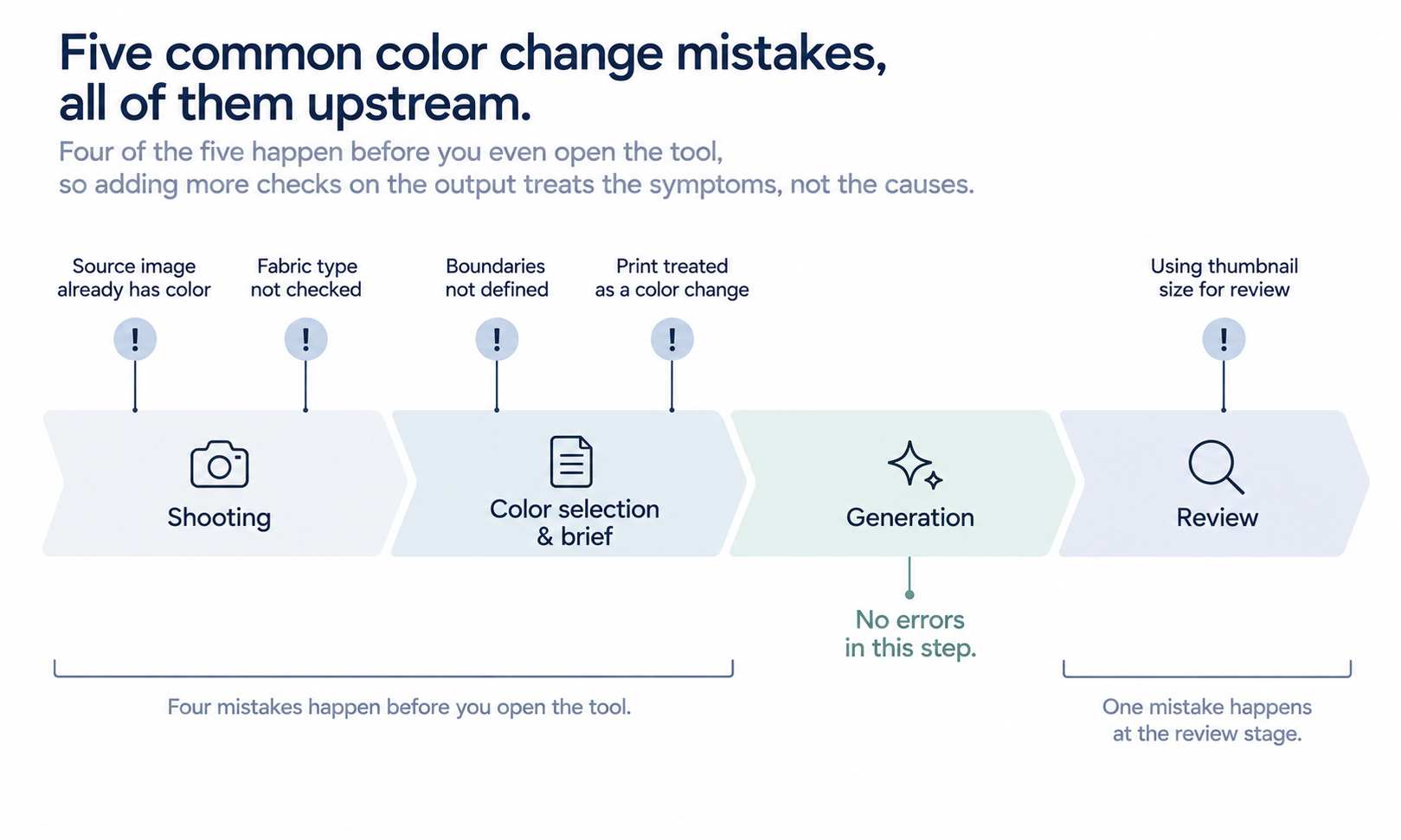
Five mistakes account for most of it. All five are upstream of the image, and each has a fix that costs less than the reviewing it replaces.
Five mistakes, all of them upstream
| The mistake | When it was made | What it produces |
|---|---|---|
| Deriving from a source already shot in a colorway | At capture, weeks earlier | A result carrying the original shade's behavior while wearing the new hue. Wrong in a way nobody can locate |
| Choosing a shade without checking what the fiber takes | In a meeting, before anything was generated | A saturation no dyed cloth of that type reaches, and sometimes a colorway that cannot be produced |
| Recoloring the image rather than the garment | In the brief, by not stating the boundary | Color on skin, hair or background, or trims that shifted when they were meant to stay |
| Briefing a print recolor as a color change | In the brief, as a category error | A colorway of the print that is plausible and that nobody specified |
| Reviewing in a grid rather than at full size | In the review, and it is why the others survive | Nothing new. It lets the first four reach a page |
Each row describes a decision rather than an operation. That is the pattern worth noticing: nothing in the list is about how carefully somebody ran the generation, and everything in it is about what was decided before they did.
The consequence is practical. A team that responds to unconvincing results by tightening review is treating a cause as a symptom, and will spend more attention for the same outcome.
Recoloring from a source that was already in a colorway
The first mistake is the most common and the least visible, because the source looks perfectly good.
A garment photographed in navy carries navy's behavior in its shadows, its highlights, and the way its surface reads. Deriving a pale colorway from it produces something that carries the original's weight while wearing the new hue, and the result reads as wrong in a way nobody can locate. The same style photographed neutral derives cleanly in every direction.
The fix belongs at capture rather than at review. Shoot the bodies that will carry multiple colorways in a neutral state, complete and unobstructed, and treat every colorway direction as a derivation from that. Where a source already exists in a colorway, deriving a nearby shade is usually fine and deriving a distant one is not, which is a useful rule of thumb and a poor substitute for reshooting the bodies that recur.
Two decisions taken before the tool is opened
The second and fourth mistakes are both made in a meeting rather than in a tool, and neither is recoverable afterwards.
The second is choosing a target shade without checking the fiber. It happens in a meeting rather than in a tool. Somebody selects a shade on a screen, and nobody asks whether cloth of that fiber, at that weight, takes that color.
Saturations that no dyed fabric of a given type would reach read as artificial even to viewers who could not explain why, and the failure is often attributed to the generation rather than to the choice. The check is quick: hold the proposed shade against what that fiber does, and against what your mill has run before.
This is also the mistake that costs money later rather than only credibility. A shade chosen without that check may be unreachable in production, which turns a colorway that reviewed well into a colorway that cannot be made — and the discovery usually arrives after the imagery is already in a line sheet.
What escapes detection, and why
The remaining two mistakes belong together, because the first produces a failure and the second is the reason it survives.
The third is a scope error. A recolor is supposed to change the garment and leave the model, the background, and everything attached to the garment alone.
When the boundary is not held, color reaches skin, hair, or background, or stops short at a seam, and the eye registers it immediately even at small sizes. The reverse happens too: trims, hardware, contrast topstitching, and woven labels shift with the body when they were meant to stay. Both are found by comparing against the source, and in a recolor the comparison carries an extra question — not only whether an element is correct, but whether it was supposed to change at all.
Logos, printed text, care labels, and small hardware get compared against the source image on every single on-model output, without exception. Reconstructed detail lands almost right — a letterform slightly off, a stitch count wrong, a zipper pull the wrong shape — and a mis-shifted trim belongs to the same family of failure. When one element is wrong and the rest is sound, a targeted correction to that region is smaller than rerunning the colorway. In Lightchain AI (apparel AI) the uploaded source stays beside every AI Virtual Try-On output derived from it, which is what makes the supposed-to-change question answerable in seconds rather than from memory.
The fourth mistake is a category error and sits in the same place. Recoloring something with a print in it is a design decision, not a color change, and briefing it as the latter hands the design to whatever the run produces.
A print has internal relationships: which color is ground, which carries the motif, which accent makes it read at distance. Changing them proportionally is one option among many and rarely the one a designer would have chosen. Specifying the recolor element by element in the brief costs a short conversation and removes an entire class of plausible-but-unwanted results.
The fifth is procedural, and it is why several of the others survive.
Uniform shadow behavior, flattened surface texture, and boundary bleed all look acceptable at thumbnail size and become visible at the size a customer views. A review conducted in a contact sheet is a review of composition, which is a real activity and a different one. Whatever else changes, the detail pass has to happen at full size, and doing it on fewer images at full size beats doing it on all of them in a grid.
What none of these fixes changes
Correcting all five produces convincing images. It does not extend what the output is.
Screen color is not a physical reference, exact code matching is not something to promise, and the gap between a monitor and a roll of cloth stays open regardless of display quality. Colorways get settled by strike-offs against an agreed standard, and values must never be read off a generated asset and sent to a mill or published as a product attribute. A recolor that survives all five checks has produced a convincing image and not an approved shade.
The output is a visual asset. It does not predict fit, determine sizing, model how a fabric behaves in motion, or forecast returns. Those come from measurements, a graded pattern, a physical sample, and your own data. A style shown in eight colors is no closer to a fit answer than the same style in one.
Footwear is not covered by this class of workflow, and lace and open work, sheer fabrics, complex prints, and heavily layered looks are documented weak spots. A recolor in those categories inherits the category verdict, and none of the five fixes reaches it.
Where to spend the correction
The five are not equally expensive to fix, and the order is worth deciding rather than discovering.
-
Neutral capture for recurring bodies: highest value, paid once, and it removes the first mistake permanently rather than per colorway
-
Full-size review for the detail pass: costs nothing and recovers several of the others
-
The fiber check on a proposed shade: one question in a meeting, and it prevents a production problem rather than an image one
-
Element-by-element print briefs: a short conversation per print, and only for styles that carry one
-
Boundary and trim comparison: this is the per-output check and it does not compress, so make it fast rather than optional
Across a catalog of any size the first two account for most of the improvement, which is worth knowing before anybody proposes a broader process. Whether the work runs through Lightchain AI or a camera, four of the five mistakes are made before a tool is opened.
Frequently asked questions
Our source photos are all in colorways. Do we have to reshoot everything?
Only the bodies that recur across colorways or seasons, which is usually a small share of a range. Deriving a nearby shade from an existing colorway is generally workable; deriving a distant one is where the results go wrong. Sort by reuse rather than reshooting the whole library.
How do we check whether a fiber takes a color?
Ask whoever handles your fabric sourcing, since the answer usually exists in the building already. A shade that no mill has run in that quality is a signal worth taking seriously. This is a sourcing question that has been mistaken for a rendering question.
Why do trims change when they should not?
The boundary between the garment body and things attached to it is not obvious from an image alone, so adjacent elements can be treated as part of it. The comparison against the source is what catches it, with the extra question of whether the element was supposed to change at all.
Can we review in a grid to save time?
Review composition in a grid and details at full size, since those are different passes with different failure modes. Several of the mistakes described here are invisible at thumbnail size by construction. Fewer images checked properly beats more images checked in a contact sheet.
Which mistake should we fix first?
Neutral capture for the bodies that repeat, because it is paid once and eliminates the most common failure permanently. Full-size review is second and costs nothing. The remaining three are cheaper individually and narrower in what they fix.
Does a better tool fix any of these?
Four of the five are decisions made before a tool is opened, so no tool reaches them. The fifth, the per-output comparison, is made faster by having the source next to the output, which is a workflow property rather than an output-quality one. Judge accordingly.
In closing
A swap that looks fake is usually a decision arriving late: a source already in a colorway, a shade nobody checked against the fiber, a boundary that was not held, a print treated as a color, or a review conducted at the wrong size. Four of the five happen before anything is generated, which is why tightening review does not fix them and why the correction is cheaper than the reviewing it replaces. What none of it produces is an approved color, since that is settled physically against a standard.
Start here
Take the last three recolors somebody thought looked off and check one thing about each: was the source neutral or already in a colorway. That single question resolves a large share of these cases and takes a minute per style. If the answer is that the sources were already colored, the fix is at capture rather than anywhere in the review process, and it applies to every colorway that style will ever carry.
**Start with fabric and colorway work → **https://www.lightchainai.com/global/solutions/designWithPurpose