
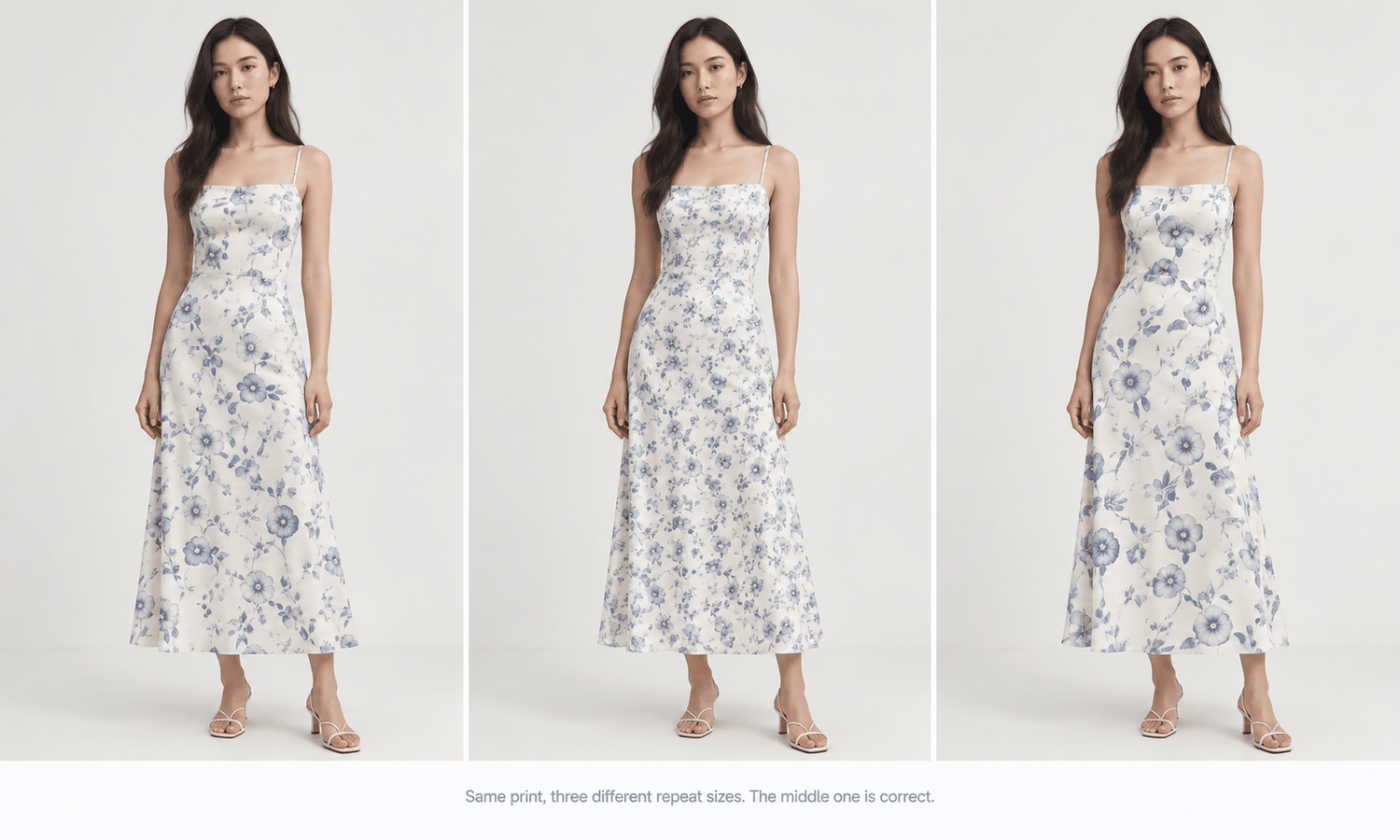
A plain garment has one thing to get right: the shape. A printed garment has three, and two of them are invisible in the source photograph.
Scale, placement and orientation are properties of how a print meets a body, not properties of the print itself. A flat-lay records the artwork. It does not record how large the motif reads against a shoulder, where the repeat falls relative to a side seam, or which way is up once the garment is worn. Those get reconstructed, silently, and a print team that does not specify them has delegated three decisions it was hired to make.
Three things a print does that a plain garment does not
Shape errors announce themselves. A collar in the wrong place looks wrong to anyone.
Print errors do not. A repeat rendered at eighty percent of its true scale produces a garment that looks entirely plausible and is not the product. A motif that should sit centered on the chest, drifting two centimeters left, reads as a slightly different design rather than as an error. And a directional print rotated is simply a different fabric.
The common factor is that all three produce images that pass review while depicting something other than what was specified. That makes them a brief problem rather than a quality problem, which is a useful reframing because briefs are cheap to fix.
It also explains why these errors persist through several rounds of feedback. A reviewer says the image looks slightly off, the operator regenerates, and the new attempt reproduces the same unstated assumptions. Three rounds later everyone concludes the tool struggles with prints, when nothing in the instruction ever changed.
What the source photograph cannot supply
Be precise about the gap, since it determines what the brief has to cover.
A flat-lay resolves the artwork at whatever resolution it was shot. It gives a reliable record of color, motif shape, and the relationship between elements within the repeat.
It does not establish physical scale, because nothing in the frame states how many centimeters the repeat measures. It does not establish placement in wear, because a garment lying flat distributes its panels differently from a garment on a body. And it rarely resolves orientation for prints whose direction is ambiguous when viewed from above.
Everything in that second paragraph is what the brief exists to state.
There is a tidy test for whether something belongs in the brief. If a competent person could look at the flat-lay and still get it wrong, it needs stating. If the photograph makes it unambiguous, it does not, and adding it only lengthens a document that has to stay short enough to be read.
What belongs in the brief
| Item | Why it cannot be inferred | How to express it |
|---|---|---|
| Repeat dimensions | Nothing in a photograph states physical size | Measurement of one repeat, in units |
| Scale reference on the body | Perceived scale changes with garment size | Repeats across a stated chest width |
| Placement anchor | Panels shift between flat and worn | Distance from a named seam or point |
| Orientation | Direction is often ambiguous from above | Which edge is up, stated plainly |
| Matching requirement | Cross-seam matching is rarely reconstructed | Whether panels must align at seams |
| Colorway separations | Variants must stay consistent with the base | Which elements change, which hold |
Six lines. Written once per print rather than once per asset, since the same print appears across sizes, colorways and styles.
The scale reference line does more work than the others combined. Stating that a repeat measures a given width, and that it should appear a stated number of times across the chest, converts an unbounded judgment into a checkable fact.
Cross-seam matching is the one that gets skipped
Engineered placement and seam matching are the parts of print work that carry the most craft and survive reconstruction the least.
A stripe that aligns across a side seam, a border placed relative to a hem, a panel print engineered to a specific cut — these depend on relationships between pattern pieces that no photograph of a finished garment fully records. Reconstruction tends to produce something continuous and plausible rather than something matched.
State whether matching is required, and where. If a print is engineered, say which points must align, and expect those assets to need closer checking than the rest Where a named alignment point is the only thing wrong in an otherwise sound asset, targeted revision rebuilds that region against a reference rather than re-running the whole set.. If matching is not required, saying so explicitly saves a reviewer from flagging a non-issue.
The second half of that is worth emphasizing. A brief that only lists requirements creates work; a brief that also states what does not matter removes it. Reviewers with no guidance tend to flag everything unusual, and an engineered-looking mismatch on a print that was never meant to match will consume a round of correspondence for nothing.
Colorways need a base and a rule
The colorway case is where print teams get the most value and also where drift is easiest.
Establish one approved base, then express each variant as a rule against it rather than as an independent instruction. This element becomes that color, the ground stays as it is, the outline holds. Expressed that way, variants stay related to each other, which is what a customer sees when they view the color options side by side.
Variants generated independently from separate instructions will differ in more than color, and the difference shows up precisely where it matters — on the product page, in a row, where a customer compares them side by side and reads the inconsistency as a quality signal about the product rather than about the imagery. The substitution operations for material and color work from the approved base for this reason — swapping the fabric, color or style on the existing design — see Design with Purpose.
What the brief cannot fix
Some limits sit below the level any instruction reaches.
Fine repeats can fall below the resolution the source photograph recorded, at which point the output approximates texture rather than reproducing the motif. No brief overcomes a source that did not capture the detail; that is a photography decision made earlier. Where the detail was captured, setting output to 2K or 4K and upscaling keeps it legible at larger display sizes — that fixes display, not capture.
The output is also a visual asset. It does not predict fit, determine sizing, model how a fabric behaves in motion, or forecast returns. A print rendered convincingly on a body says nothing about how the fabric will hang, and print teams are frequently asked to interpret exactly that from an image.
Color accuracy remains outside it as well. Screen color is not a physical reference, and a colorway approved on a monitor still needs a strike-off and a physical standard before anyone commits.
Where the brief sits in the workflow
Write it at print approval rather than at asset production, and attach it to the print rather than to the style. Keep the artwork and its six lines in a shared library rather than in a folder on one machine — a print filed where the whole team draws from is reused rather than rewritten, and serves every garment that print appears on, across seasons, without being rewritten by whoever happens to be producing assets that week.
It also puts the specification in the hands of the people who know it. Repeat dimensions and matching requirements are print team knowledge, and asking an operator to infer them at generation time is how the three silent errors enter in the first place. An operator asked to guess will guess reasonably, which is the problem — a reasonable guess produces a convincing image of the wrong thing. For the on-model output that consumes this brief, see AI virtual try-on.
Questions print teams ask
Why does the print look the right size in some images and not others? Because perceived scale depends on garment size and body, and nothing in the source states the physical dimension. A stated repeat measurement and a chest-width reference remove the ambiguity.
Do we need to specify orientation for every print? For anything directional, yes, since direction is often ambiguous in a flat-lay viewed from above. For a true tossed repeat it matters less, though stating it costs nothing.
Will cross-seam matching ever be reliable? Treat it as unreliable and check it. Reconstruction produces continuity more readily than alignment, and engineered placement depends on relationships a finished-garment photograph does not fully record.
How should colorways be briefed? As rules against one approved base rather than as independent instructions. Variants produced independently drift in more than color, and the drift is visible exactly where customers compare them.
Can we approve a colorway from a generated image? No. Screen color is not a physical reference, and a strike-off and agreed standard still govern. The image narrows the options and does not settle them.
Where should the brief live? With the artwork, not with the style. Prints appear across multiple garments and seasons, so a brief attached to the print gets reused rather than rewritten.
What the brief is really protecting
The three decisions a print team is paid to make. Scale, placement and orientation are invisible in a source photograph and get reconstructed whether or not anyone specifies them, and the resulting images pass review while depicting a different product. Six lines per print, written at approval and filed with the artwork, remove that exposure. State the repeat measurement, name a scale reference on the body, anchor the placement to a seam, say which way is up, declare whether matching is required, and express colorways as rules against one base.
Write the six lines for your highest-volume print this week.
Take the print that appears on the most styles, state its repeat measurement, a chest-width reference, a placement anchor, its orientation, its matching requirement and its colorway rules. File it with the artwork rather than with a style. One print, ten minutes, and it applies to every garment that print reaches this season and next. → Design with Purpose
About the author
[REPLACE — real person's name, role, relevant experience, LinkedIn URL. No team byline.]