
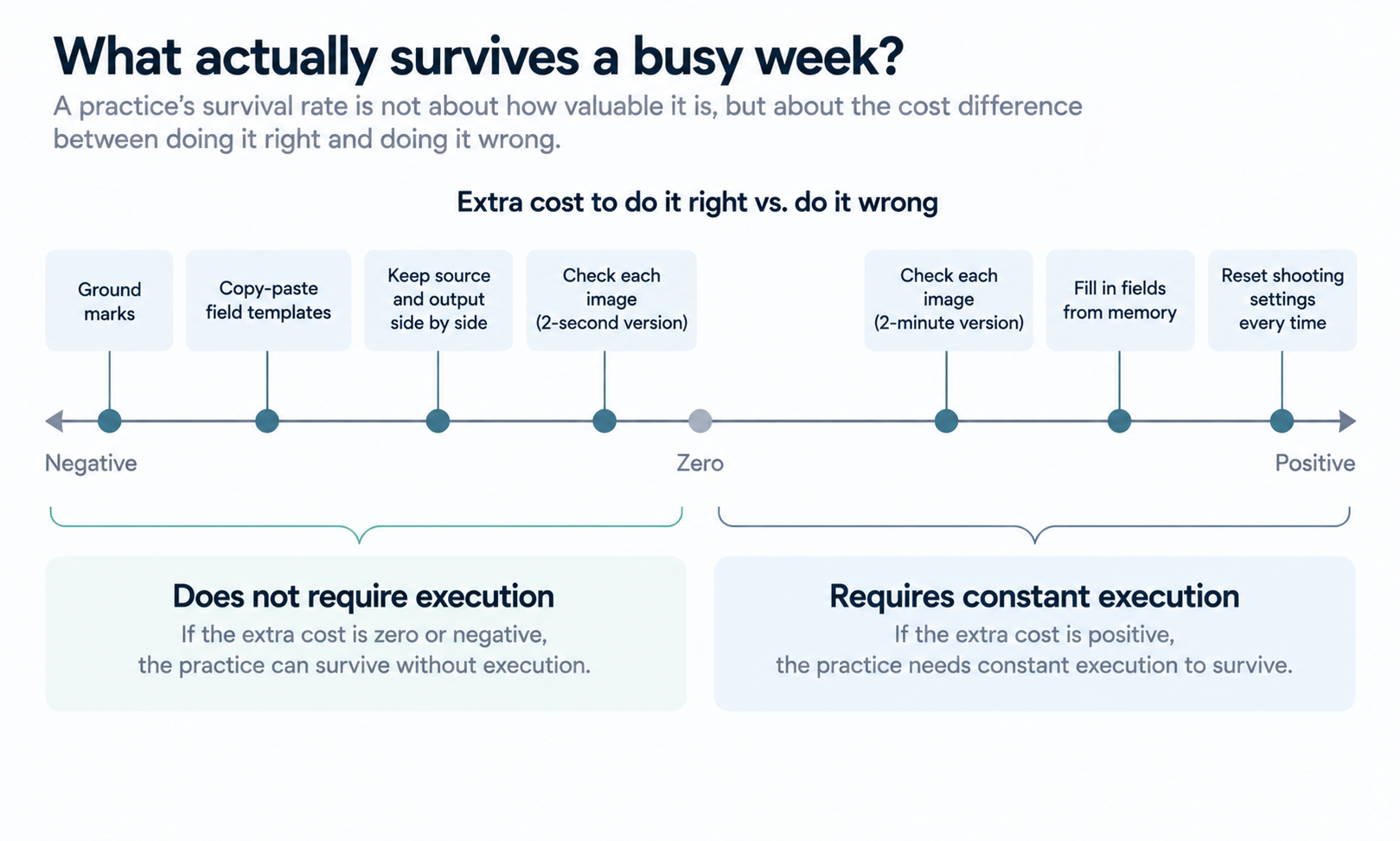
Most lists of practices are sorted by how much good each one does. That is the wrong axis. A practice that requires somebody to remember it will be dropped in the first busy week, and its value on paper is irrelevant after that.
The useful sort is by whether doing the right thing is easier than doing the wrong thing. Practices that pass that test survive without enforcement. Practices that fail it need enforcement forever, and a team using a clothes change ai free route has no enforcement mechanism at all.
This matters more without a system than with one, because a workflow embedded in a company does some of these things automatically and a browser tab does none of them.
Sort by survival, not by value
| The practice | What it costs to do right | Does it survive |
|---|---|---|
| Capture to a consistent standard | Nothing per shot, once the position is marked and the setup is photographed | Yes. The marks are on the floor whether or not anybody remembers the rule |
| Attach identity fields to every file | Ten seconds to paste a block, or a minute to recall five fields | Only in the pasted version. The recalled version arrives partially filled |
| Compare every output against its source | Two seconds if the source is one click away, two minutes if it has to be found | Only in the two-second version. The other decays into a general look |
| Decide the variant count before generating | One decision per batch, made in advance | Yes if written down, no if it is a preference somebody holds |
| Record which categories go to photography | One line per category, written once with the reason | Yes. A written verdict stops the argument reopening every season |
The distinction in the second column is whether the practice is a decision made once and then embodied in something physical or textual, or a behavior that has to be repeated by a person under time pressure.
Almost every practice can be moved from the second category to the first, and doing that is worth more than adding practices to the list.
Practices that hold because the setup does the work
Three examples, each of which converts a behavior into a fact about the environment.
Tape on the floor. A capture standard written as a paragraph is a thing to remember; two marks on the floor and a camera position are a thing to stand on. The written version and the reference photographs are what let it be rebuilt, but the marks are what make it happen on a Tuesday when somebody is in a hurry.
A pasted template. Identity fields — style, colorway, season, state — are a thing to remember if they have to be typed and a thing that happens if there is a block of text somewhere to copy. Five lines that take ten seconds to paste will be pasted. Five fields that must be recalled will be partially filled.
A folder where the source sits next to the output. This is the one a casual route gives you least help with, since a downloads folder actively separates them. Keeping the source photograph adjacent to what it produced is what makes the comparison possible later, and where an environment does that by default — as on-model outputs do in Lightchain AI (apparel AI), where the uploaded source stays beside every AI Virtual Try-On result derived from it — the practice costs nothing. Where it does not, somebody has to build the habit, which is exactly the kind of practice that decays.
The practice that cannot be automated, and what to do instead
One thing on the list resists all of this. Logos, printed text, care labels, and small hardware get compared against the source image on every single output, without exception, and no arrangement of folders performs that comparison for you.
Since it cannot be made automatic, the protection has to come from somewhere else: make it fast rather than make it remembered. A check that takes two seconds because the source is one click away survives a busy week. The same check taking two minutes because the source has to be located does not, and it decays into a general look at the image, which is a different activity producing a different result.
Reconstructed detail lands almost right — a letterform slightly off, a stitch count wrong, a zipper pull the wrong shape — and almost right is precisely what survives a general look. That is why the two-second version and the two-minute version are not the same practice at different speeds. One of them happens.
When a check does catch something and the rest of the frame is sound, a targeted correction to that region is smaller than starting over, which also protects the practice: a check whose consequence is an afternoon of rework gets avoided, and a check whose consequence is a small fix does not.
The order things get dropped in
Under pressure the abandonment sequence is consistent, which makes it possible to defend against in advance.
-
The variant budget goes first, because generating more feels free and the cost lands on review rather than on production
-
Identity fields go second, because the file is going to somebody who knows what it is today
-
The comparison against source degrades third, turning into a general look rather than disappearing outright, which is why nobody notices
-
The capture standard erodes fourth and slowest, one convenient shortcut at a time
-
What survives longest is whatever is physically embodied, which is the argument for embodying as much as possible
Knowing the order matters because each item is defensible in the moment and indefensible as a pattern. A team that has agreed the sequence in advance is making a decision about which to give up rather than discovering it afterwards.
What no practice compensates for
Good practice makes a workflow reliable. It does not extend what the output is.
The output is a visual asset. It does not predict fit, determine sizing, model how a fabric behaves in motion, or forecast returns. Those come from measurements, a graded pattern, a physical sample, and your own data. No discipline, however well embodied, converts appearance into dimension.
So a size chart cannot be assembled from imagery, and any fit language has to trace back to the measurement chart and the fit session. And no practice makes an asset presentable as the reason a return rate or a conversion figure moved, since both sit at the end of a chain running through sizing, price, assortment, and traffic.
Color is outside it too. Screen color is not a physical reference, exact code matching is not something to promise, and the gap between a monitor and a roll of cloth stays open regardless of display quality. Colorways get settled by strike-offs against an agreed standard, so a colorway on screen is a shortlist however carefully the workflow was run.
Footwear is not covered by this class of workflow, and lace and open work, sheer fabrics, complex prints, and heavily layered looks are documented weak spots. Those are category verdicts, and no practice reaches them.
The three-item version
If a list has to be short enough to survive, three items is the length.
Mark the capture position physically and photograph the setup. Keep a five-line block to paste with every file. Put the source and the output where they can be seen together, and check the details before anything leaves.
Everything else in this article is an explanation of why those three and not others. On cost, the platform publishes point packages starting at $9.90 for 600 points, described by the company as roughly 20 images, with further tiers alongside; read the current pricing page rather than an article, and read whatever trial or entry terms apply from the same place rather than assuming. None of the three practices above depends on which tier anybody is on.
Deciding colorway and fabric direction is where a lightweight route earns its place, and it earns it only in the categories where the output was stable enough to trust. Whether the work runs through Lightchain AI or a browser tab, the three practices are the same three.
Frequently asked questions
Is there a free version of this kind of tool?
Terms change, so read the current listing rather than relying on any article including this one. What does not change is that the practices cost the same regardless of what generation costs, and they are usually the larger share of the effort. Budget the attention rather than only the fee.
Our team knows what to do but does not do it. What now?
Stop treating that as a discipline problem and look at what each practice costs to perform correctly. A practice that is skipped consistently is usually one where doing it right is harder than doing it wrong, and moving it into the environment fixes what reminders do not.
Which practice should we add first?
Whichever of the three is currently absent, and if all three are absent, the capture marks, since everything downstream derives from the source. It is also the cheapest to embody: two pieces of tape and a photograph of the setup.
Can we skip the detail check on internal work?
For genuinely internal material where a misunderstanding gets corrected in a conversation, the risk is lower. The habit is what carries it into client-facing work though, and a check performed sometimes tends to become a check performed rarely. Decide it as a rule rather than per file.
We are one person. Does any of this apply?
More so, since there is no second person whose habits compensate for a lapse. The three-item version was written with that case in mind, and none of the three requires anybody else to be involved. A one-person setup is where embodied practices matter most.
How do we know a practice has decayed?
Ask whether the last five outputs went through it, specifically rather than generally. Practices decay quietly and self-report optimistically, so the check is a count rather than an impression. If the answer is not five, it has already started.
In closing
Practices survive when doing the right thing is easier than doing the wrong thing, and decay when they depend on somebody remembering. That sorting matters more without a system than with one, since a casual route provides no enforcement. Mark the capture physically, keep a block of identity fields to paste, and keep the source next to the output so the comparison stays a two-second job. Around those sits a boundary no practice reaches: fit, sizing, material behavior, physical color, and returns come from measurement and samples rather than from process.
Start here
Take the three practices and ask, for each one, what it currently costs to do correctly in your setup. Where the answer is more than a few seconds, the practice is already decaying whether or not anybody has noticed. Fixing the cost is a different task from reminding people, and it is the one that works. Start with whichever of the three is most expensive to perform today.
**Start with the on-model workflow → **https://www.lightchainai.com/global/solutions/aiVirtualTryOn