
For an ODM manufacturer, a proposal is a promise. When a factory presents design directions to a brand buyer, the buyer approves what they see, and increasingly what they see is a realistic on-model image: a cloth model, meaning the garment shown on a generated model as if it had already been made. These images are fast to produce and persuasive to look at, which is why they have become a common part of ODM proposals.
They also carry a risk that is specific to manufacturers. A generated image shows more than the design team specified. Trims, fabric finishes, construction details and the overall level of finish are filled in wherever the inputs were silent, and they are filled in to look good. The buyer does not know which details were decided and which were invented. They approve the image. When the sample or the bulk arrives, the factory has to deliver what the image showed, whether or not it can make it at the agreed cost.
This article explains what a proposal image promises, where such images tend to outrun what a factory can make, how to constrain images with the factory's real capabilities, how to label what is concept and what is confirmed and how to carry an approved proposal through to a matching sample.
| Detail in the proposal image | Why it can outrun the factory | How to keep it honest |
|---|---|---|
| Trims and hardware | Filled in with a plausible, often premium-looking trim | Use references from the factory's own trim library |
| Fabric finish and texture | Rendered as the image suggests, not as the mill supplies | Use photographs of fabrics the factory can source |
| Construction details | Complex finishes appear without being specified | Check against the factory's actual capabilities |
| Print and color | Screen rendering, not a physical standard | Confirm with a strike-off or lab dip |
| How the garment sits on the body | A visual placement, not a fit result | Leave fit to the sample |
| Overall level of finish | Generated images tend toward a polished look | Match the finish to the target cost |
What a Proposal Image Promises
A buyer reviewing a proposal is not studying a technical drawing. They are looking at a picture of a garment on a person and deciding whether they want it. Everything visible in that picture becomes part of what they expect: the button that looks like horn, the zipper with a branded pull, the fabric with a soft brushed surface, the seam finished with a neat binding.
With photography of a real sample, those details were real, because the sample existed. With a generated image, many of them may not have been decided by anyone. The design team specified a silhouette, a color direction and perhaps a fabric type. The image supplied the rest, choosing what is most plausible and most attractive for a garment of that kind.
That gap is where problems start. The buyer approves an image in good faith. The factory then has to choose between making what the image showed, which may cost more or require capabilities it does not have, and making something different, which means explaining why the sample does not match what was approved. Neither is a good position, and both are avoidable.
Where Proposal Images Outrun the Factory
Some kinds of detail are especially likely to appear in a generated image without anyone deciding them.
-
Trims and hardware. Buttons, zippers, snaps, buckles and labels are small, and generated images fill them in with whatever looks right. The result often looks more expensive than the trim the factory would actually use at the target price.
-
Fabric finish. A brushed surface, a subtle sheen or a crisp hand can be rendered convincingly whether or not the factory's mills supply that finish in the required quantity and cost.
-
Construction details. Bound seams, bonded edges, complex topstitching or hidden closures can appear in an image even though they add operations, time and cost in production.
-
Print and color. Printed patterns and colors are rendered for the screen, not matched to a physical standard, and some colors cannot be achieved on the proposed fabric at all.
-
Level of finish. Generated images tend toward a clean, polished look. A garment designed for a value price point can look like a premium one in the proposal and disappoint when it arrives as a sample.
None of this is a flaw in the image. It is what image generation does when the inputs are incomplete. The responsibility for completing them sits with the factory preparing the proposal.
Constraining the Image With What You Can Make
The most effective way to keep proposal images honest is to give the generation process the factory's real materials to work from, so there is less for it to invent.
Build a reference library from what the factory actually uses. Photograph the fabrics you can source, flat and under even light, with a scale reference. Photograph the trims in your library, including buttons, zippers, pulls and labels, in close-up. Keep examples of the construction finishes your lines can produce at each price level. These references are what the design team supplies when generating images, instead of leaving those choices to the image.
Where a developed sample or an existing style already exists, start from its flat-lay rather than from a sketch. An image built from a real garment carries real details. An image built from a sketch fills them in.
Then review proposal images with production in the room. A technical designer or production manager looking at a proposal image before it goes to the buyer will spot a trim the factory does not stock, a finish that adds operations or a fabric surface the mill cannot supply. It is far cheaper to change the image before the proposal than to explain the difference after approval.
Some fabrics and constructions remain current weak areas for generated imagery: complex prints, lace and openwork, sheer fabrics and layered styling. For designs built on those, a proposal image says less about the fabric, so support it with physical swatches or a photographed sample.
Labeling Concepts and Confirmed Details
Not every detail in a proposal can be confirmed at the proposal stage, and buyers generally understand that. What they need is to know which is which.
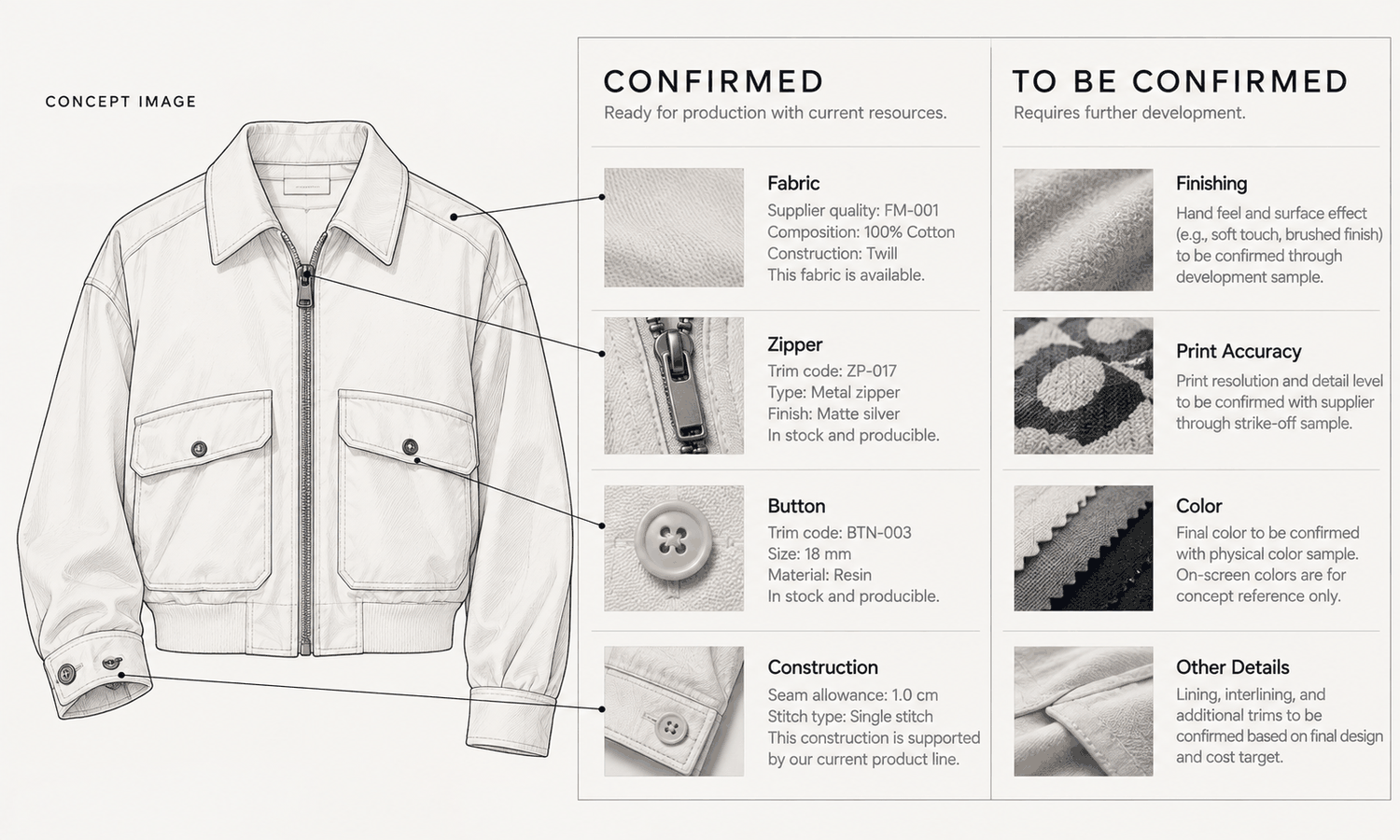
Present each proposal image with a short specification alongside it, stating what is confirmed and what is still a concept. Confirmed details are those the factory has checked it can make at the target cost: the fabric from a named mill quality, the trims from the library, the construction finishes available on that line. Concept details are those shown for direction and still to be confirmed through development. Label the image itself as a concept, and keep that label wherever the image travels.
Be explicit about what an image cannot show. Color on a screen is not a physical reference, and generated imagery does not promise an exact color-code match; the colorway is settled by the lab dip or strike-off against the agreed standard. How the garment sits on the model is a visual placement, not a fit result; fit is confirmed on the sample. The drape shown is rendered, not calculated, so fabric behavior is confirmed with the swatch and the sample.
A proposal that separates confirmed details from concepts is also easier to negotiate. The buyer can see where the price comes from, and any request to upgrade a trim or a finish becomes a clear change with a clear cost.
From Approved Proposal to Matching Sample
Once a proposal is approved, every detail the buyer saw needs a place in the technical documents, so the sample room builds the garment the buyer approved.
In Lightchain AI (apparel AI), the steps from proposal to development connect in one workflow.
-
AI Virtual Try-On places a garment on a generated model from its flat-lay or garment photo, so proposal images can start from real developed samples where they exist.
-
Line Sketch to Flat Lay turns a new design into a realistic flat-lay for review before it goes on a model, and technical-document drafts can be prepared from the approved design for development review, as described on the Production-Marketing Synergy page.
-
Fabric application and color changes let a design team show a style in an alternative fabric or color for discussion, with the final choice confirmed physically.
For ODM teams preparing proposals and refining designs before sampling, Ideas to Reality is the Lightchain AI solution built for that stage. The technical documents themselves remain drafts for the development team to review and complete.
Frequently Asked Questions
What is a cloth model in an ODM proposal?
Here it means a realistic image of a garment design shown on a generated model, as if it had already been made. ODM manufacturers use such images to present design directions to brand buyers before samples exist.
Why can a proposal image promise more than the factory can make?
Because details the design team did not specify, such as trims, fabric finishes and construction details, are filled in by the image. They tend to look plausible and polished, whether or not the factory can make them at the target cost.
How can a factory keep proposal images realistic?
Supply references from what the factory actually uses: fabric photographs, trim close-ups and examples of available construction finishes. Start from flat-lays of developed samples where possible, and review images with production staff before they go to the buyer.
Should proposal images be labeled as concepts?
Yes. Label the image as a concept and present it with a short specification that separates confirmed details from details still to be developed.
Can a buyer approve color and fit from a proposal image?
No. Color is confirmed with a lab dip or strike-off against the agreed standard, and fit is confirmed on the sample. The image shows direction, not those results.
What happens after the buyer approves a proposal?
Every detail the buyer saw needs a place in the technical documents, so the sample room builds the garment that was approved. Any difference should be flagged before sampling, not discovered after.
Which Lightchain AI solution suits ODM proposals?
Ideas to Reality is the one to use. It turns designs into realistic visuals before sampling, can start from flat-lays of developed samples through AI Virtual Try-On and connects to technical-document drafts for development review.
In Closing
A proposal image is a promise to a buyer, and generated images promise more than the design team specified. For ODM manufacturers, the answer is to show only what the factory can make: build images from the factory's real fabrics, trims and developed samples, review them with production staff before they go out, and present each one with a clear line between confirmed details and concepts. Keep color, fit and fabric behavior for the physical stages, and carry every approved detail into the technical documents.
Start Here
If your factory presents design proposals to brand buyers and wants every image to reflect what it can actually make, Ideas to Reality is the solution to use. It is built for turning apparel designs into realistic visuals before sampling: you start from real samples or clean sketches, show designs on models and prepare drafts for development. Start with one proposal, build its images from your own fabric and trim references, and compare the approved image with the first sample.
**Explore Ideas to Reality → **https://www.lightchainai.com/global/solutions/ideasToReality