
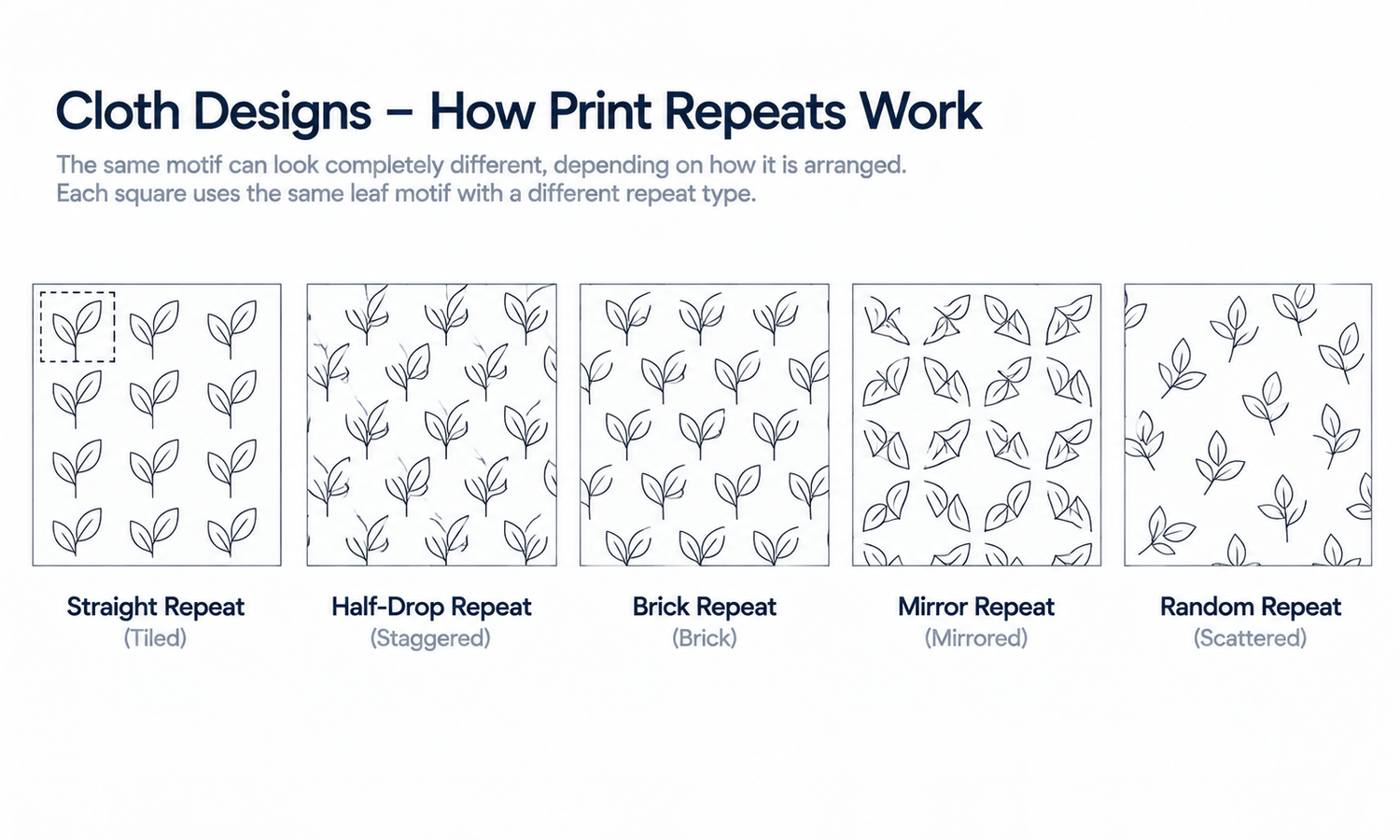
Cloth designs that cover a whole garment are almost never drawn at full size. A floral print on a dress, a geometric pattern on a shirt or a scattered motif on a scarf is usually built from a single tile of artwork, repeated across the fabric like wallpaper. That tile is called the repeat, and the way it repeats decides much of how the finished fabric looks: whether the pattern feels regular or natural, whether seams between tiles are visible and how large the motifs appear on the garment.
Understanding repeats is useful well beyond textile design. Designers choosing prints, product developers ordering printed fabric and anyone reviewing a printed garment all benefit from knowing how a repeat works, because many print problems, such as a visible grid, motifs that land awkwardly on the body or a print that looks far too large on small sizes, can be traced back to the repeat.
This article explains what a repeat is, the common repeat types, how scale, direction and the fabric affect a print, how a print moves from fabric to garment and how to see cloth designs at garment scale before committing.
| Repeat type | How the tile is arranged | How it looks | Watch for |
|---|---|---|---|
| Block | Tiles side by side in a straight grid | Regular, orderly | A visible grid if motifs line up too neatly |
| Half drop | Each column shifted down by half a tile | Less obvious, more flowing | Diagonal lines forming across the fabric |
| Brick | Each row shifted across by half a tile | Staggered, like brickwork | Horizontal banding |
| Mirror | Tiles flipped to create symmetry | Formal, symmetrical | Strong centerlines that must be placed on the garment |
| Tossed | Motifs scattered in many directions within the tile | Natural, random-looking | Clusters or gaps where motifs bunch |
What a Repeat Is
A repeat is the smallest piece of artwork that, placed next to copies of itself, fills the fabric with a continuous pattern. Its size is described by its width and height, and it is designed so that its edges join without a visible break: a flower cut off at the right edge continues on the left edge of the next tile, a vine leaving the top re-enters at the bottom.
When the joins are designed well, the eye cannot tell where one tile ends and the next begins. When they are not, the fabric shows a faint grid of lines or a repeated shape that makes the tiling obvious. Good repeat design hides the structure. Designers check this by viewing several tiles side by side at a small size, where lines and clusters that are invisible in a single tile become obvious. A motif that appears to form a row or a diagonal across the fabric is a sign the repeat needs adjusting.
The repeat's size affects everything else. A small repeat creates a fine, dense pattern and repeats many times across a garment. A large repeat creates bold, open motifs and may appear only once or twice on a small garment. The same artwork can be scaled to different repeat sizes, and choosing the scale is one of the most important decisions in a print.
Common Repeat Types
The way tiles are arranged changes how a print reads, even when the artwork is the same.
-
Block repeat. Tiles sit side by side in a straight grid. It is simple and orderly, which suits geometric and regular designs, but with organic motifs it can create an obvious grid.
-
Half-drop repeat. Each column of tiles is shifted down by half a tile. It breaks up the grid and makes the pattern flow more naturally, which is why it is common for florals.
-
Brick repeat. Each row is shifted across by half a tile, like brickwork. It staggers the pattern horizontally rather than vertically.
-
Mirror repeat. Tiles are flipped to create symmetry. It produces formal, balanced patterns with strong centerlines.
-
Tossed or random layout. Motifs are scattered in different directions within the tile, so the pattern looks natural from any angle.
Stripes and checks are repeats too, in their simplest form. A stripe repeats in one direction and a check in two, and their repeat size sets the width of the bands and the scale of the grid.
Scale, Direction and the Fabric
Scale should be judged against the garment, not the swatch. A motif that looks balanced on a small fabric sample can look enormous on a child's garment or lost on a full-length coat. Because the same print usually appears across a size range, the scale that works on the sample size may look different on the smallest and largest sizes. Viewing the print at the size of the actual garment, rather than on a screen at an arbitrary zoom, avoids surprises.
Direction affects cutting as well as appearance. A directional print, where motifs point one way, such as flowers growing upward, must be cut with every pattern piece facing the same direction. That uses more fabric than a non-directional print, where pieces can be turned to fit more efficiently. A tossed print is non-directional by design, which is one reason it is popular.
The fabric and printing method add constraints of their own. The repeat has to fit within the fabric's printable width, and some printing methods work with fixed repeat sizes set by their equipment, while others allow more flexibility. Those constraints should be confirmed with the printer before artwork is finalized.
From Fabric to Garment
Once the fabric is printed and cut, the repeat meets the garment's shape, and new questions arise.
Placement is the first. On a printed dress, where does the largest motif fall? On the chest, at the waist, across the hip? With a large repeat, cutting decides this, and some designs require motifs to be centered on the front or balanced on both sides. Those decisions are written into the tech pack so the cutting room can follow them.
Matching is the second. Where pattern pieces meet at seams, the print either continues across the seam or breaks. Matching stripes, checks and large prints across seams uses more fabric and more care, and it is part of the quality of the finished garment.
Engineered prints are a different approach altogether. Instead of a repeating tile, the artwork is designed for the shape of a specific pattern piece, such as a motif placed exactly on the front of a shirt. Engineered prints give precise placement but must be redrawn for each size. Border prints sit between the two: the design runs along one edge of the fabric, often the selvedge, and is cut so the border falls at a hem or cuff, which ties the print closely to the pattern layout.
Before bulk, printed fabric is checked on a strike-off, a sample of the print on the actual fabric. The strike-off confirms the colors against the approved standards, since screen color is not a physical reference, and shows the scale and the repeat joins as they really print.
Seeing Cloth Designs at Garment Scale
The hardest thing to judge from a swatch or a repeat tile is how a print will look on the finished garment: how large the motifs appear on the body, where they fall and how busy the whole garment feels. Seeing the print applied to the garment before committing to a strike-off helps answer those questions early.
Previews of printed garments are useful for scale and overall effect, with one caution: complex prints remain a current weak area for generated imagery, so fine detail, exact motif shapes and the joins between tiles are judged on the strike-off, not on a preview.
In Lightchain AI (apparel AI), a print can be previewed on a garment before sampling.
-
Fabric application shows a style in a chosen printed fabric, so the scale and placement of the repeat can be judged on the garment rather than on a swatch.
-
AI Virtual Try-On places the printed style on a model, so the print can be seen at the scale of a body.
-
A preview can be refined in a defined area with Target Revision, as described on the Partial Redraw page, when a placement needs adjusting for discussion.
For design teams exploring prints and fabrics on existing styles, Design with Purpose is the Lightchain AI solution built for that work. The strike-off remains the reference for color, detail and repeat joins.
Frequently Asked Questions
What is a repeat in cloth designs?
The smallest tile of artwork that, placed next to copies of itself, fills the fabric with a continuous pattern. Its edges are designed to join without a visible break, so the tiling does not show.
What is the difference between a block and a half-drop repeat?
A block repeat places tiles side by side in a straight grid. A half-drop repeat shifts each column down by half a tile, which breaks up the grid and makes the pattern flow more naturally.
Why does repeat size matter?
Because it sets how large the motifs appear on the garment. A scale that looks right on a swatch can look too large or too small on the actual garment and across different sizes.
What is a directional print?
A print whose motifs point one way, so every pattern piece must be cut facing the same direction. It usually uses more fabric than a non-directional print.
What is a strike-off?
A sample of the print on the actual fabric, used to confirm colors, scale and repeat joins before bulk printing. It is approved against the color standards before production.
Can a preview replace a strike-off?
No. A preview helps judge scale and placement on the garment, but colors, fine detail and repeat joins are confirmed on the strike-off.
How does Lightchain AI help with cloth designs?
It previews a printed fabric on a style and on a model, so the repeat's scale and placement can be judged at garment scale before a strike-off. Design with Purpose is the solution to use for exploring prints on existing styles.
In Closing
Cloth designs are built from repeats: a tile of artwork arranged in a block, half-drop, brick, mirror or tossed layout, with edges designed to join invisibly. The repeat's size and direction decide how the print looks on the garment and how much fabric the cutting uses, and the printing method sets limits of its own. Judge scale at garment size, plan placement and matching in the tech pack, preview the print on the garment for scale and confirm color, detail and joins on the strike-off.
Start Here
If your team is choosing prints for existing styles and wants to see how a repeat reads on the garment before sampling, Design with Purpose is the solution to use. It is built for variation work: you apply printed fabrics to a style, see them on a model at body scale and compare options side by side. Start with one style and two or three print scales, and take the strongest to strike-off.
**Explore Design with Purpose → **https://www.lightchainai.com/global/solutions/designWithPurpose