
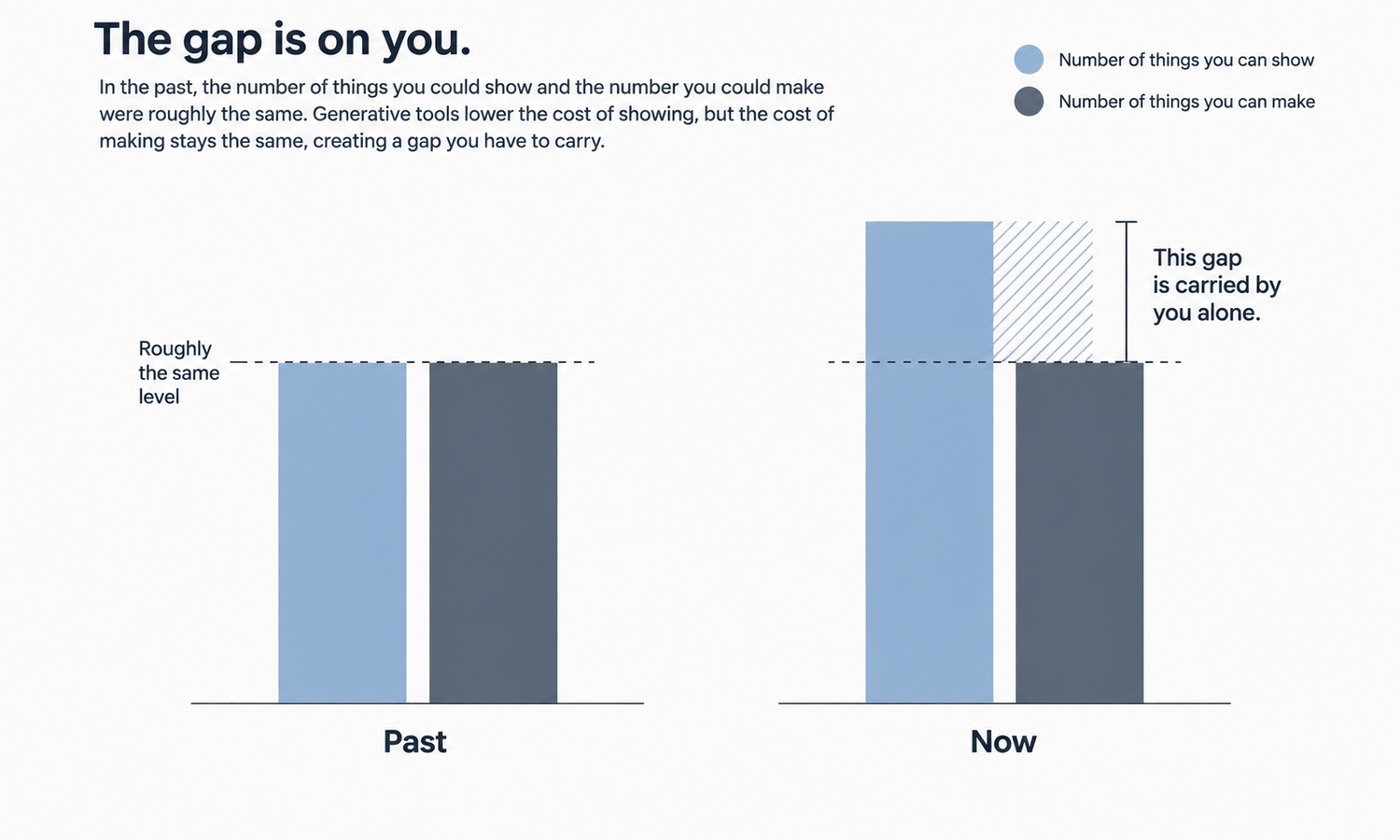
An independent designer runs a business where showing and making used to cost roughly the same order of magnitude. To put a garment in front of anybody, you had to have one, which meant fabric ordered, a sample made, and a shoot arranged. The expense was annoying and it did something useful: it kept the two sides in proportion.
Cloth changer ai breaks that proportion. Showing gets very cheap. Making costs exactly what it did, and in a one-person business the person who has to make it is you.
That is where the expensive assumptions come from, and they are not the same ones a larger team makes. A studio with staff can absorb a mistake by reassigning somebody. An independent designer absorbs it out of the same week, the same account, and the same energy.
The five assumptions, ranked by what they cost
| The assumption | Why it feels safe | What it actually costs |
|---|---|---|
| Showing something costs nothing, so showing it is low risk | The image really was almost free to make | A commitment to produce, made in a comment thread, with fabric and weeks behind it that you have to find |
| The time saved becomes capacity | The production step really did get shorter | Stockists, markets, or a drop taken on against capacity that never arrives in that form |
| A colorway I like on screen is a colorway I can sell | Exploring six of them costs the same as exploring one | Cash. Mill minimums, lead times, and a price that has to survive your margin |
| People will read the image the way I meant it | The distinction is obvious to whoever made it | An exploration read as a product, and a customer waiting for something that was never scheduled |
| My existing photographs are good enough as inputs | Nobody has complained about them | Outputs that stop matching each other, with the cause invisible by the time you are reviewing |
The ranking matters more than the list. Four of these are ordinary problems that get noticed and corrected within a season. The first one is different, because by the time it becomes visible you have already made a commitment to somebody.
The costliest: showing creates an obligation to make
Post a garment and something changes in the world. People reply asking where to buy it. A stockist mentions it. Somebody asks whether it comes in black. None of that required you to have the garment, and all of it produces an expectation that you do or shortly will.
Under the old economics, that expectation was self-limiting. You could not show what you had not made, so the commitment could not run ahead of the capacity. Cheap imagery removes the limiter and leaves the capacity where it was, which is the actual shape of the problem: not that a generated image misleads anyone, but that it can produce demand you have no route to satisfying.
The specific failure is not a moral one. It is that saying yes to those replies commits fabric, a sample, and several weeks, and the decision to commit gets made in a comment thread rather than at a desk. An independent designer who has done this once usually remembers the season it cost.
The correction is a rule rather than a judgment: decide before posting whether this piece is something you would produce if twenty people asked for it, and if the answer is no, label it as a concept when it goes out. That costs nothing and it moves the decision back to where it belongs.
The second: saved time is not capacity when there is nobody to hand it to
The production step genuinely gets shorter. What happens next is that the same person moves to the next queue, and the next queue is review and customer replies, both of which grow with the number of things shown.
That is still worth having, because reviewing your own output is closer to design than arranging a shoot is. It is not the same as capacity. An independent designer who takes on more stockists, more markets, or a bigger drop on the strength of expected capacity is betting on a gain that does not arrive in that form.
There is one place where the saving is real and unambiguous. Testing a direction before committing fabric is cheaper than it has ever been, and for a one-person business that is the constraint that actually binds. Running a look through on-model generation in AI Virtual Try-On to see whether a proportion works before ordering a roll is a decision made earlier and with less money at risk, and that is a real change rather than a rearrangement. In Lightchain AI (apparel AI) the source photograph stays beside the outputs it produced, which is what lets you go back a month later and see which flat lay a direction actually came from.
The one that costs real money: a colorway on screen is not one you can buy
This assumption is fourth in the ranking by frequency and close to first by cash. A colorway explored on a monitor costs nothing. The version you can actually sell depends on what a mill will run, at what minimum, in what lead time, and at a price that survives your margin.
Screen color is not a physical reference, exact code matching is not something to promise, and the gap between a monitor and a roll of cloth stays open regardless of display quality. Colorways get settled by strike-offs against an agreed standard. For an independent designer that has a second edge: exploring six colorway directions is free and ordering six is not, so the exploration has to be narrowed by what you can buy rather than by what appeals most on screen.
The practical version is to check availability and minimums before showing a colorway rather than after somebody asks for it. That sequence is the opposite of how it usually happens and it is the whole difference between an exploration and a promise.
What the images cannot decide for you
The output is a visual asset. It does not predict fit, determine sizing, model how a fabric behaves in motion, or forecast returns. Those come from measurements, a graded pattern, a physical sample, and your own data. That is a property of what the asset is rather than a limitation of any particular result.
For somebody selling their own line this lands in a specific place. You cannot build a size chart from imagery, and a size chart is what a customer will hold you to. Fit answers come from a measurement chart, a graded pattern, and a fitting, and if a piece is made to order the usual correction may not be available to the buyer at all.
Detail carries a rule with no exceptions. Logos, printed text, care labels, and small hardware get compared against the source image on every single output. Reconstructed detail lands almost right — a letterform slightly off, a stitch count wrong, a zipper pull the wrong shape — and a customer buying from an independent label looks at the garment more closely than anybody in a larger business would.
Two scope answers save time. Footwear is not covered by this class of workflow, and that is structural rather than a gap waiting to close. Lace and open work, sheer fabrics, complex prints, and heavily layered looks are documented weak spots, so plan those categories around photography rather than retrying them.
What to actually do about it
The corrections are short, which is the only kind an independent designer will sustain.
-
Label anything you are not committed to producing as a concept, decided before it goes out rather than in the replies
-
Check fabric availability and minimums before showing a colorway, since the exploration is free and the commitment is not
-
Keep the fit and size answers tied to measurements, and say so on the page rather than in a message to one customer
-
Compare details against the source on every output before it leaves, because you are the only reviewer there is
-
Test proportion and direction before ordering cloth, which is the one place the saving is unambiguous and the one that matters most in a business with no slack
Going from an idea to a finished asset quickly is a genuine advantage for somebody working alone, and it is worth taking. Whether the work runs through Lightchain AI or a camera, the thing that has not changed is what it takes to make the garment, and the whole risk in this for an independent designer sits in the widening distance between those two.
Frequently asked questions
Is it dishonest to post something I have not made?
Not if it is labeled, and the labeling is what separates a concept from a promise. Audiences respond well to seeing a direction explored; they respond badly to ordering something that then takes four months or never arrives. Decide which it is before posting rather than in response to the first comment.
How do I test demand without committing?
Show it as a concept and ask directly whether people would buy it, rather than reading intent into engagement. Interest and orders are different signals and the gap between them is wide. If you take expressions of interest, be explicit about what you are and are not committing to.
Should I tell customers which images are generated?
Decide it once as a standing practice rather than case by case, so it reads as how you work instead of a disclosure attached to particular pieces. The more consequential commitment is that the image matches what ships. For an independent label, that match is most of what your reputation consists of.
My photographs are taken at home. Is that a problem?
The equipment matters much less than the consistency, so a phone at a fixed distance on a fixed background in repeatable light will outperform better gear used differently each time. Write the setup down and photograph it. The failure is variation rather than quality.
What about made-to-order pieces?
The imagery has to be accurate to a higher standard, since the customer may have no easy correction available and the piece is being made after they commit. State the measurements, the lead time, and what happens if it is wrong, before the order rather than after. Generated imagery does not change any of that.
Where should I not use this at all?
In the categories that are documented weak spots, and anywhere the surface or the shade is the reason somebody is buying. If your work is lace, sheers, or complex surface treatment, the imagery will underperform exactly where your product is strongest, and photography is the answer rather than more attempts.
In closing
The expensive assumption for an independent designer is not about image quality. It is that showing something is now cheap enough to be free of consequence, when showing produces expectations that only you can meet, with fabric you have to order and weeks you have to find. Everything else on the list is fixable in a week once named. That one is fixable only by deciding, before a piece goes out, whether it is a concept or a commitment, and then saying which.
Start here
Look at the last five things you posted and mark each one as either something you were committed to producing or something you were exploring. Then check whether anybody reading them could have told the difference. If they could not, that is the gap, and closing it costs one word added to a caption rather than a change to how you work. Then write the rule down for yourself, since the decision is easy in advance and very hard in a reply thread.
**Start with the on-model workflow → **https://www.lightchainai.com/global/solutions/aiVirtualTryOn