
Every party in an apparel chain owns something different, and the differences decide what generated imagery is worth to each of them. A factory owns the make. A retailer owns the sell-through. A marketplace owns the traffic.
A brand owns the gap between what it shows and what it ships. Nobody else carries that, and no amount of generated output moves it, which turns out to be the most useful sentence available for thinking about change outfit ai from a brand's position.
The cost of showing something is falling quickly. The obligation to have the thing match is exactly where it was. Everything a brand should decide follows from that asymmetry.
What only a brand owns
| Party | What they own | What cheap imagery changes for them |
|---|---|---|
| Apparel brand | The gap between what was shown and what ships | The cost of showing falls; the obligation to match does not move at all |
| ODM or factory | Whether the thing can be built, on these lines, at this price | More proposals reach more clients, and each one carries an offer that was not costed |
| Retailer or buying team | Assortment, depth, and sell-through | More assets arrive per style, which is adjudication rather than choice |
| Marketplace or channel | Traffic and the rules assets have to meet | More listings clear the format bar, and none of that speaks to accuracy |
Reading across the table, the brand row is the one where the second column does not shrink when the third column changes. A factory that can propose more looks has a bigger sales funnel. A retailer receiving better assets has a better page. A brand producing more imagery has more promises outstanding, each of which has to be met by a physical garment that nothing in the workflow touched.
That is not an argument against adopting. It is an argument for being precise about what adoption is for, because a brand that treats output volume as the win has bought the cheap half of a transaction and left the expensive half unfunded.
What actually changes, and what does not
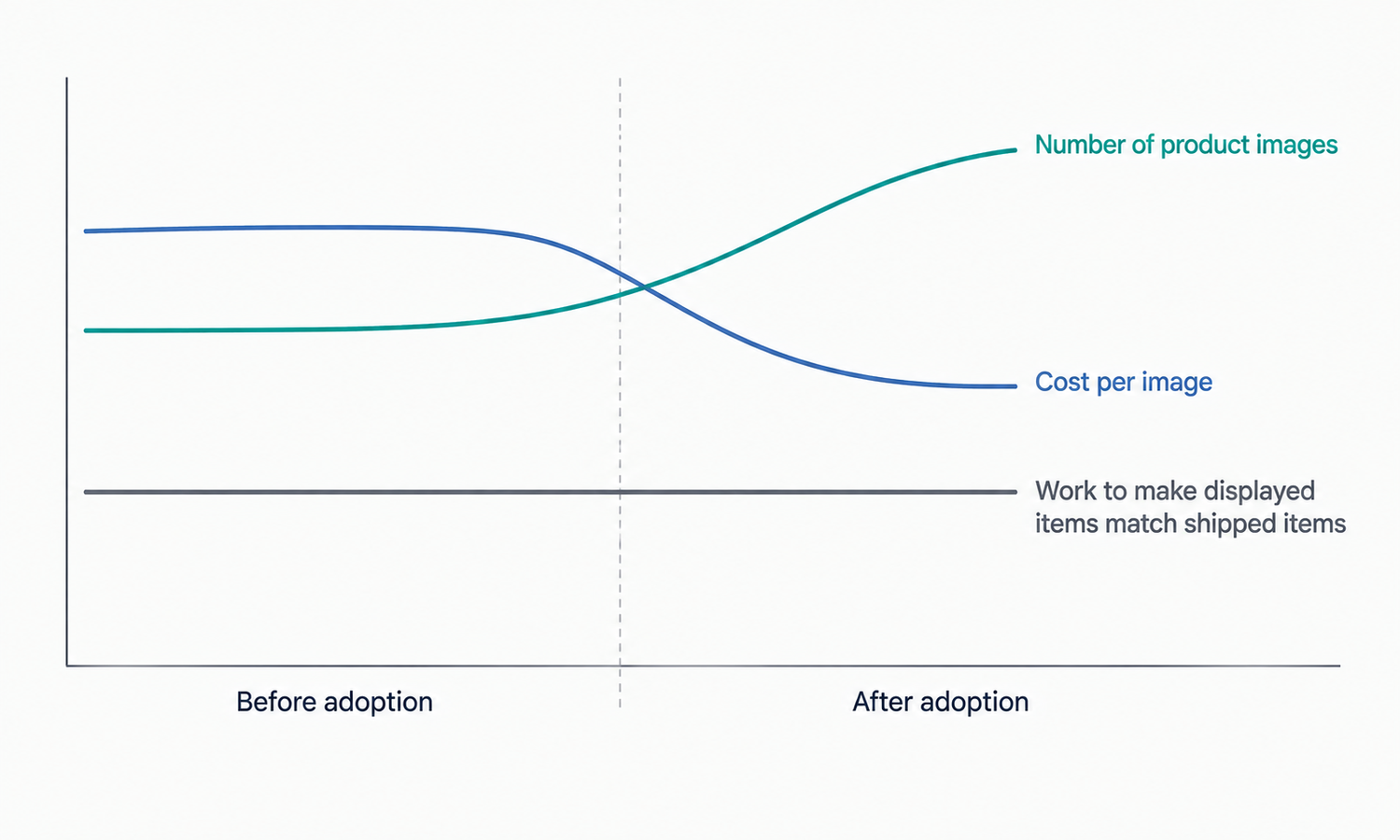
Three things move when a brand starts producing on-model output at any scale, and they do not move together.
The cost per image falls, immediately and substantially. The number of things shown rises, usually faster than anybody planned, because the constraint that used to limit it was a studio day and there is no equivalent brake. And the work of making each shown thing match a shipped thing stays flat, because it consists of a comparison somebody has to perform and a garment somebody has to control.
The first two are automatic and the third is not. A brand that does nothing deliberate will get the first two and lose ground on the third, which shows up a season later as an increase in the reason code that says the item was not as pictured. There is no version of this where the third improves on its own.
Where a brand should spend the saving
The saving is real. What it buys determines whether adoption was worth doing.
-
The source standard: one position, one distance, one background, one light, written with reference photographs and frozen for a season, since every generated image is a derivation from a capture and inconsistency entering there cannot be corrected downstream
-
The conformity check: comparison against the source on every image, kept separate from the judgment pass about whether an image is good, and never sampled
-
Sample-to-shipped variance: the difference between the garment that was photographed and the goods that arrive, which is where a technically accurate image quietly becomes a misleading one
-
Measurement accuracy on the page, since size-related returns come mostly from published measurements not matching production rather than from shoppers misreading a chart
-
One decision about which categories are out of scope, recorded with a reason, so it stops being reopened
The first two are where most of the money should go. In Lightchain AI (apparel AI) the capture stays beside the outputs derived from it, which makes tracing a bad capture to everything it affected a search rather than an excavation, and that traceability is what turns a category-wide defect into one fix instead of many. Deciding colorway and fabric direction faster is genuinely useful, and it is the part of the saving that is easiest to spend twice by mistake.
A brand's sloppiness becomes somebody else's rework
This is the part brands underrate, because the cost lands outside the building.
The source standard a brand sets is the standard its photographers and its suppliers work to. The approval status a brand attaches to an image is what a buyer, a channel, and eventually a factory inherit, and none of them can see how it was arrived at. An image marked approved without a note saying approved against what will be read as fully approved by somebody six weeks and three handovers away.
Four fields prevent most of it, and they travel in the message rather than the filename, which gets rewritten on the second download: the style and colorway codes, the season, the state — proposal, selection, or confirmation — and the basis of any approval written beside it. That last one costs three words and settles the argument that would otherwise happen at the sample.
For anything heading toward production, the same discipline applies to structural detail. Converting an approved look into a line drawing or tech-sheet draft in the Design & Production Workbench forces the decisions a styled render lets you leave open, and those outputs are drafts a technical designer still has to review. A pattern cutter reading an unmarked render cannot tell a seam from a fold from a shadow, and will make that call on the brand's behalf without anybody recording that a call was made.
What the workflow does not do
The output is a visual asset. It does not predict fit, determine sizing, model how a fabric behaves in motion, or forecast returns. Those come from measurements, a graded pattern, a physical sample, and your own data. That is a property of what the asset is rather than a limitation of any particular result, and no improvement in how convincing an image looks moves it.
Three consequences matter at brand level. A size guide cannot be assembled from imagery, because a size guide is a measurement document and one built from pictures is a sizing claim with nothing behind it. No asset can be presented, internally or externally, as the reason a return rate or a conversion figure moved, since both sit at the end of a chain running through sizing, price, assortment, and traffic. And there is no physical simulation here — the drape in an image is rendered rather than computed, so it is evidence about the picture and not about the cloth. Existing 3D assets can be converted into flat garment images that then enter the workflow as inputs, which is a different thing from the workflow producing or simulating 3D.
Color has the limit a brand meets most often, usually in front of a supplier or a customer. Screen color is not a physical reference, exact code matching is not something to promise, and the gap between a monitor and a roll of cloth stays open regardless of display quality. Colorways get settled by strike-offs against an agreed standard, and values must never be read off a generated asset and sent onward.
Two scope questions come up enough to answer directly. Footwear is not covered by this workflow, and that is structural rather than a gap waiting to close. Layered styling with occlusion, complex prints, lace and open work, sheer fabrics, and frame-to-frame consistency in video are documented weak spots, which makes them categories to plan around rather than to keep retrying.
A sequence that works
Order matters more than pace, and the order is close to the reverse of what enthusiasm suggests.
Write the capture standard first and hold it, because it decides what every later stage is allowed to know. Split the conformity check from the judgment pass second, and give them different owners, since merging them is how the check quietly stops happening once volume arrives. Third, decide the variant budget per style before generating rather than during, because output volume rises on its own and review capacity does not. Fourth, attach identity and approval basis to everything that leaves. Only then is it worth asking which categories to extend into.
Whether the work runs through Lightchain AI or a camera, a brand that does those four things has changed what it can do. A brand that skips them and produces a great deal of imagery has changed how much it shows, which is a different thing and occasionally a worse one.
Frequently asked questions
Is this worth doing for a brand with a small range?
The return depends on repetition rather than range size, so count how many times a single capture would be reused across colorways, channels, and seasons. A small range with heavy reuse benefits more than a large one shot once and never revisited. If nothing is reused, keep shooting.
Who should own this inside a brand?
Split it: production owns the capture standard and the conformity check, and whoever owns the brand's visual direction owns the judgment pass. One owner for both produces a process where taste absorbs the time and comparison gets dropped. Name both people before the first batch rather than after.
What if our suppliers already send us imagery?
Give them your capture standard and your four identity fields rather than a preference, and agree it rather than announcing it, since a supplier is the only party who knows which file is current at the moment of sending. Suppliers generally welcome a short specified list, because it is less work for them too.
How do we stop image volume from running away?
Set the variant budget per style before each batch and treat anything beyond it as unreviewed rather than as extra. The constraint is review capacity rather than production capacity, and review capacity belongs to specific people whose time is already committed elsewhere.
Should campaign imagery follow the same rules?
The conformity rules apply to anything a customer could buy against, which is most product imagery and some campaign imagery. Purely atmospheric work carries different risks and a different bar. Decide which bucket a piece of work is in before it is made rather than after somebody objects.
When is the honest answer no?
When a category keeps failing, when the range has no reuse, or when nobody can own the conformity check. Recording that as a decision with a reason is more valuable than a partial attempt, and it stops the question being reopened every season by whoever is under the most pressure.
In closing
A brand's position in this chain is specific: it owns the distance between what it showed and what it shipped, and that distance is the one thing generated imagery does not touch. So the adoption question is not whether the output is good, and it is not how much of it a team can produce. It is whether the brand will spend the saving on the capture standard, the comparison check, and the variance between the sample and the goods. Do that and the volume is an advantage. Skip it and the volume is a larger number of promises with nothing new behind them.
Start here
Take one collection page and, for each style on it, answer two questions. Was every image derived from a capture made to the same standard? And can somebody say what each approval was granted against? Most brands find the first answer is no for at least a quarter of the page and the second answer does not exist anywhere in writing. Fix those two on one collection before extending anything, since they are the conditions everything else depends on.
**Start with the on-model workflow → **https://www.lightchainai.com/global/solutions/aiVirtualTryOn