
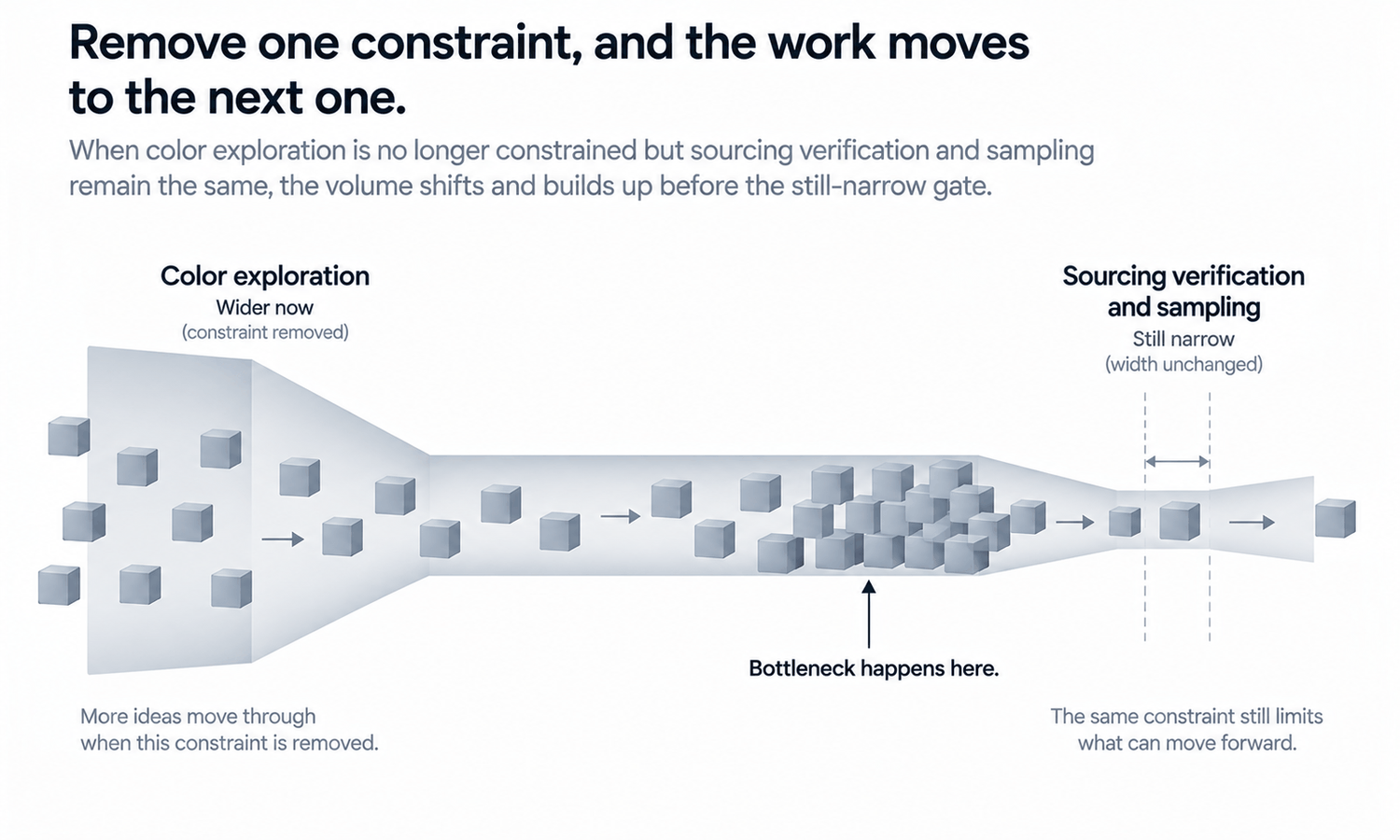
Exploring a colorway used to cost something. Somebody had to want it enough to ask, because asking meant a lab dip, a wait, and a conversation about minimums. That cost limited how many directions got explored, which meant it also limited how many inquiries reached the trims and materials desk.
Change color clothes tooling removes the cost on one side of that exchange and leaves it exactly where it was on the other. A designer explores eight directions in an afternoon; somebody then has to establish, for each, whether the fabric takes it, whether a matching thread and zip and label exist in that shade, at what minimum, in what lead time.
The cost did not disappear. It moved onto your desk, and the numbers worth tracking are the ones that measure the transfer.
Six numbers, and what each one tells you
| The count | What it tells you | What moves it |
|---|---|---|
| Colorway inquiries received | How much of the desk is being spent on exploration | How cheap exploration became on the other side of the process |
| Inquiries that reached a strike-off | How much of that exploration converted into a commitment | Whether availability is checked before a colorway is shown or after |
| Inquiries with no substrate named | How many requests arrived unanswerable | A field in whatever accompanies the image. This one has a cheap fix |
| Inquiries where no matching trim existed in that shade | A picture of your own trims range rather than of anybody's behavior | Stocking decisions, or a narrower palette. It recurs until one of those changes |
| Strike-off rounds per approved colorway | What an approved shade actually costs | How well the target was specified before the first round |
| Colorways published in imagery before strike-off approval | Your exposure, as a bounded list rather than an open question | Nothing about imagery. It is a record you either keep or do not |
None of these is a number about image quality, and none of them requires anything the team does not already handle. They are counts of things already passing through the desk, which is what makes them collectible without a project.
The first two describe how your week is being spent. The middle two describe why. The last two are exposure.
The two ratios that describe your week
Inquiries received against colorways that reached a strike-off is the headline. It tells you what proportion of the desk's work is spent on directions that were never going to be committed to, and the ratio moves when exploration gets cheaper while nothing else does.
A rising ratio is not a complaint about the design team. It is the predictable consequence of removing a constraint from one side of a shared process, and it is fixable by putting a different constraint back — usually a rule that a colorway is checked for availability before it is shown rather than after somebody asks for it.
The second ratio is inquiries per style. A style generating one inquiry is a decision being made. A style generating six is exploration being routed through you, which is fine if it is deliberate and expensive if nobody noticed it happening. Tracking it per style rather than in aggregate is what makes the pattern visible, since the aggregate hides the two or three styles doing most of it.
Deciding colorway and fabric direction is legitimate work and worth doing early. The question these ratios answer is whether it is being done against what can be bought.
The number that is really a request-quality problem
Inquiries arriving without a substrate named is the most useful diagnostic on the list, because it is the one with a cheap fix.
A shade request with no fiber and no quality attached is unanswerable, since the same target reads differently on a cotton interlock, a viscose crepe and a wool flannel, and reaches different saturations on each. Answering it requires a round trip that exists only because a field was missing.
Tracking the count for a month usually shows the same one or two people, the same two or three styles, or the same stage in the process, and the correction is a template rather than a conversation about discipline. Where the request originates from a look shown on screen, add the substrate to whatever accompanies that image.
There is a second-order effect worth naming while counting this. An unanswerable request does not usually stop; it gets answered approximately, by somebody under time pressure, and an approximate answer about whether a shade is achievable travels onward as though it were a checked one. That is how a colorway reaches a line sheet on the strength of a maybe. Counting the malformed requests is therefore not administrative tidiness; it is counting the occasions on which a guess entered the record.
The related count is inquiries where no matching trim existed in that shade. That one is not a request problem; it is a picture of your own trims range, and it recurs. If the same gap appears repeatedly, that is an argument for stocking or for narrowing the palette rather than for answering faster.
The exposure number
Colorways published in imagery before a strike-off was approved is the number to keep whether or not anybody asks for it.
Screen color is not a physical reference, exact code matching is not something to promise, and the gap between a monitor and a roll of cloth stays open regardless of display quality. Colorways get settled by strike-offs against an agreed standard, and values must never be read off a generated asset and sent to a mill or published as a product attribute. A colorway shown before approval is a direction, and that is fine as long as somebody knows which ones are in that state.
The count matters because it is the list you need when a shade comes back different from what was shown. Without it, the question is open-ended. With it, the affected set is bounded and the conversation is short. Where the on-model output is stored beside the source it came from, assembling that list is a lookup rather than a reconstruction.
What no number here can measure
These counts describe a workflow. They do not extend what the imagery is.
The output is a visual asset. It does not predict fit, determine sizing, model how a fabric behaves in motion, or forecast returns. Those come from measurements, a graded pattern, a physical sample, and your own data. No amount of tracking makes a rendered shade into an approved one, and no ratio on this list substitutes for a physical reference.
Two things follow for this desk specifically. A screen version cannot stand in for a lab dip however consistent the imagery is, and a colorway that reviewed well on a page has demonstrated nothing about dye behavior on the substrate it will actually run on. And no number here should be presented as the reason a return rate moved, since that rate sits at the end of a chain running through sizing, price, assortment, and traffic.
Footwear is not covered by this class of workflow, and lace and open work, sheer fabrics, complex prints, and heavily layered looks are documented weak spots. Colorway exploration in those categories inherits the category verdict, which is worth knowing before an inquiry arrives rather than after.
Making the numbers cheap to collect
A metric that requires a new process will not survive, so all six should come from things already happening.
-
Count inquiries from wherever they already arrive rather than building a form, since a form changes the number by changing the behavior
-
Mark the strike-off outcome on the same record, so the first ratio computes itself
-
Add a substrate field to whatever accompanies a shown colorway, which converts the third number into a prevention rather than a measurement
-
Keep the exposure list as a state on the asset rather than a separate document, since a separate document is one nobody updates
-
Review the six monthly rather than weekly, even if the counts are weekly, because the useful signal is a trend and a weekly reading is mostly noise
For anything heading toward production, the substrate and the approved standard belong in the tech-sheet material rather than in an email thread. In Lightchain AI (apparel AI) the uploaded source stays beside every AI Virtual Try-On output derived from it, which is what makes the exposure list assemblable across a catalog. Whether the work runs through Lightchain AI or a camera, the numbers describe a transfer of cost rather than a property of the images.
Frequently asked questions
Is a rising inquiry count a bad sign?
Not by itself, since more exploration can be genuine value. It becomes a problem when the ratio to strike-offs rises alongside it, which means the additional exploration is not converting. Track the ratio rather than the raw count.
Should we refuse inquiries without a substrate?
Adding the field where the request originates works better than refusing, since a refusal produces a delay and a second message rather than a better first one. Put the substrate next to the image at the point the colorway is shown, and the problem stops occurring.
How far back should we build the exposure list?
To whatever is currently published, since that is the set that matters if a shade is questioned. Historical entries that have been superseded are not worth reconstructing. Start it from now and keep it current.
Can we use screen colorways for internal decisions at least?
For narrowing which shades to sample, yes, and that is the legitimate use. For anything that commits fabric or reaches a customer, no. The distinction is whether the next step is a strike-off or an order.
Which of the six should we start with?
The substrate count, because it has the cheapest fix and removes work immediately. The exposure list is second, since it costs almost nothing and is the one you will want on a day you did not plan for.
Do these numbers need to be reported upward?
The first ratio usually should be, because it describes a cost that moved between teams and is invisible to whoever moved it. Present it as a description of the flow rather than as a complaint, and pair it with the rule that would fix it.
In closing
Cheap exploration on one side of a process does not make the process cheaper; it relocates the cost, and this desk is where it lands. The six numbers all measure that transfer: two ratios describing how the week is spent, two describing the malformed requests and the recurring gaps that cause it, and two describing exposure. None of them says anything about image quality, and none of them turns a rendered shade into an approved one, which is why the exposure list is the one to keep even when nobody has asked.
Start here
Count one week of colorway inquiries and mark, for each, whether a substrate was named and whether it reached a strike-off. Two numbers from one week is enough to see whether exploration is converting and whether requests are arriving answerable. Both fixes are template changes rather than process changes, which is why this is worth an hour rather than a project. Start the exposure list the same week, since it costs nothing while nothing is wrong.
**Start with fabric and colorway work → **https://www.lightchainai.com/global/solutions/designWithPurpose