
A freelancer works across clients, and that is the whole difficulty. Each client has their own color names, their own approval habits, and their own idea of what a recolored image means. Standardizing is not about imposing a system on them — it is about having one of your own that survives contact with all of them.
The alternative is starting from nothing on every project, which is how a freelancer ends up doing unpaid work that looks like competence.
Standardize your side, not theirs
You cannot make a client change their color naming or their approval sequence. You can make your own inputs, outputs and language consistent regardless of which client you are working for.
That distinction matters because most standardization advice assumes authority over the whole process. A freelancer has authority over exactly one part of it, and that part turns out to be enough — the file you deliver, the note that accompanies it, and the question you ask before starting.
Three things standardized on your side remove most of the friction: what you ask for, what you send back, and what you say the output represents.
The economics of this are specific to freelance work. An in-house team amortizes a convention across one organization and one set of habits; a freelancer amortizes it across every client they will ever have, which makes the same hour of setup considerably more valuable. It is also the only version that survives a client relationship ending.
What to ask for before starting
One short intake, reused across every client and every project. It takes a minute and it prevents the most common cause of rework.
Which components change and which hold. A garment described as one color is rarely one color, and a recolor applies uniformly unless told otherwise. Shell, lining, trim, thread and hardware all need naming as changing or holding.
This is the question clients most often cannot answer immediately, which is itself useful information. A client who has to go and check has not settled it internally, and knowing that before you start is the difference between one delivery and three.
What the color is named against. A reference standard, a supplied swatch, or an image the client is working from — and if it is only an image, that is worth knowing before you start rather than after, because it means the whole exercise is provisional in a way the client may not have registered.
Where the output is going. Internal review, wholesale material, or a product page, since the required quality and the caveats differ, and an asset produced for one destination frequently gets used in another without anyone asking whether it should.
Whether a physical sample exists. If it does, the recolor is illustrating something real; if it does not, everything is provisional and should be labeled that way.
Keep the four questions in the same order and the same words every time. Reworded each project, they get shortened under deadline pressure and the component question is usually the first to go — which is the one that prevents the most rework.
What to standardize in your outputs
| Element | Standard to hold | Why it travels |
|---|---|---|
| File name | Style reference, colorway reference, date | Survives being forwarded and renamed folders |
| Base image | One approved source per style | Variants stay related to each other |
| Delivery note | One line on what the image represents | Prevents the image being read as approval |
| Component note | Which parts were changed | Answers the question that always arrives |
| Original alongside | The unmodified source, labeled | Lets the client compare rather than assume |
Five items, all of them cheap to produce and all of them working when you are not in the room. The last one is the least common and the most appreciated — clients frequently want to see what changed, and reconstructing that later takes longer than including it at the time.
The file name is the item that does the most invisible work. Deliverables get downloaded, moved into a client's own folder structure, forwarded to a supplier and renamed by someone who was not part of the project. A name carrying the style and colorway reference remains identifiable through all of that, and a name describing what the image looks like does not.
Say what the image represents, the same way every time
Write one sentence and reuse it. Something like: this image illustrates the proposed colorway on an approved base; it is not a color reference and does not confirm fit or fabric behavior.
Consistency in that sentence does two things. It stops you improvising a caveat under time pressure, which is when caveats get softened. And it teaches repeat clients what your deliverables mean, so the conversation gets shorter each time rather than starting over.
There is a version of this that goes wrong, and it is worth avoiding. A caveat that reads as a disclaimer invites the client to wonder what you are protecting yourself from. The same information stated as a description of the deliverable reads as precision, and precision is what a client is paying a freelancer for. The difference is entirely in the framing.
The underlying facts do not change between clients. The output is a visual asset. It does not predict fit, determine sizing, model how a fabric behaves in motion, or forecast returns. Screen color is not a physical reference, and a colorway approved on a monitor still needs a strike-off and an agreed standard.
Colorways are rules, not separate jobs
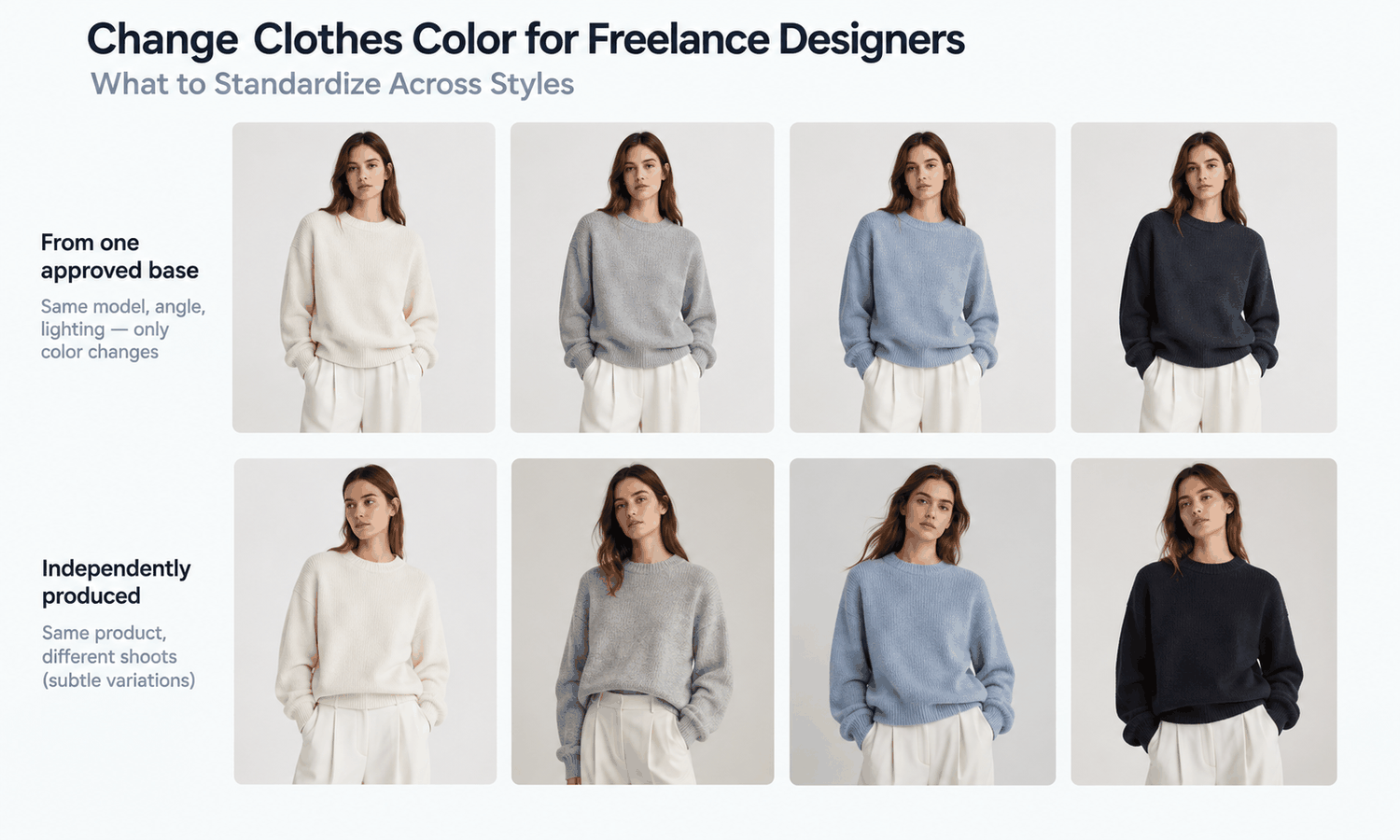
The efficient way to handle a colorway range is to establish one approved base and express every variant as a rule against it — this element becomes that color, the ground holds, the outline holds.
Produced that way, variants stay related to each other, which is what a client sees when the options appear side by side on a page. Produced independently, they differ in more than color, and the difference shows up exactly where it is most visible — in a row of swatched options, where a customer reads the inconsistency as something about the product rather than about the imagery.
It also protects your time, which for a freelancer is the entire commercial question. A rule can be reapplied when a client adds a fourteenth colorway in week nine; a set of independent jobs has to be redone, and the difference between those two is usually absorbed rather than billed. The substitution operations that make this practical work from an approved base for the same reason — swapping the fabric, color or style on the existing design — see Design with Purpose.
Where standardizing fails
Two situations resist it and are worth recognizing early rather than fighting.
A client with an established internal system will want you inside it. That is reasonable, and the correct response is to adopt their naming for deliverables while keeping your own intake and caveat sentence, which cost them nothing and protect you.
A client with no system at all is the harder case, because your standard becomes the de facto system and you will be maintaining it unpaid. Decide deliberately whether that is a relationship investment or scope creep. Either answer is fine; drifting into it without deciding is not.
The tell that you have drifted is being asked questions about the client's own assets — where a file is, which version shipped, what a colorway was called. Those are custodial questions rather than design ones, and answering them for free is how a freelancer becomes an unpaid asset manager for a client who has no idea that is what they are asking.
What standardizing is actually buying
Not efficiency, though it produces some. It buys the ability to answer questions months later without reconstructing anything — a client asking in November which colorway shipped in June is a five-second answer or a lost afternoon, and the file naming decides which. It also buys a consistent professional surface across clients who have nothing else in common.
There is a commercial edge too. A freelancer whose deliverables always carry the same structure is easier to work with than one whose output varies by mood or deadline, and that consistency is visible to a client who has never articulated why they keep coming back. It is also the part of a practice that scales without more hours, which is rare enough to be worth building deliberately. The on-model versions of these assets follow the same base-image discipline — see AI Virtual Try-On.
Questions freelancers ask
Can I standardize if every client works differently? Yes, because the parts you standardize are yours: intake questions, file naming, the caveat sentence and the base-image rule. None of them require a client to change anything.
What is the single most valuable item? The component question at intake. A garment described as one color is rarely one color, and a uniform recolor is the most common source of a discrepancy the client did not expect.
Should I include the original image with the recolor? Yes, labeled. Clients want to see what changed, and supplying it removes a round of correspondence that otherwise arrives a week later.
How do I handle a client who has no system? Decide whether maintaining one for them is a relationship investment or unpaid scope, and choose deliberately. Drifting into it is the outcome to avoid.
Can a client approve a colorway from my recolor? No. Screen color is not a physical reference, and the strike-off with an agreed standard governs. The image narrows options and does not settle them.
What if a client keeps adding colorways? Work from one approved base and express variants as rules, so a late addition is a reapplication rather than a new job. That structure is what makes the fourteenth colorway cheap.
What to hold constant
Your intake, your file naming, your caveat sentence, and the rule that variants come from one approved base. Four things, all on your side of the relationship, all portable between clients who share no conventions. They do not make you faster on any single project. They make the tenth project resemble the first, which is what a freelance practice needs and what nobody supplies for you.
Write your caveat sentence today and reuse it unchanged.
**One line stating what a recolored image illustrates and what it does not confirm, sent with every delivery. Then add the component question to your intake — which parts change and which hold — and keep the original alongside every recolor you send. Three habits, no client cooperation required, and they remove most of the rework a colorway project generates. → **Design with Purpose
About the author
[REPLACE — real person's name, role, relevant experience, LinkedIn URL. No team byline.]