
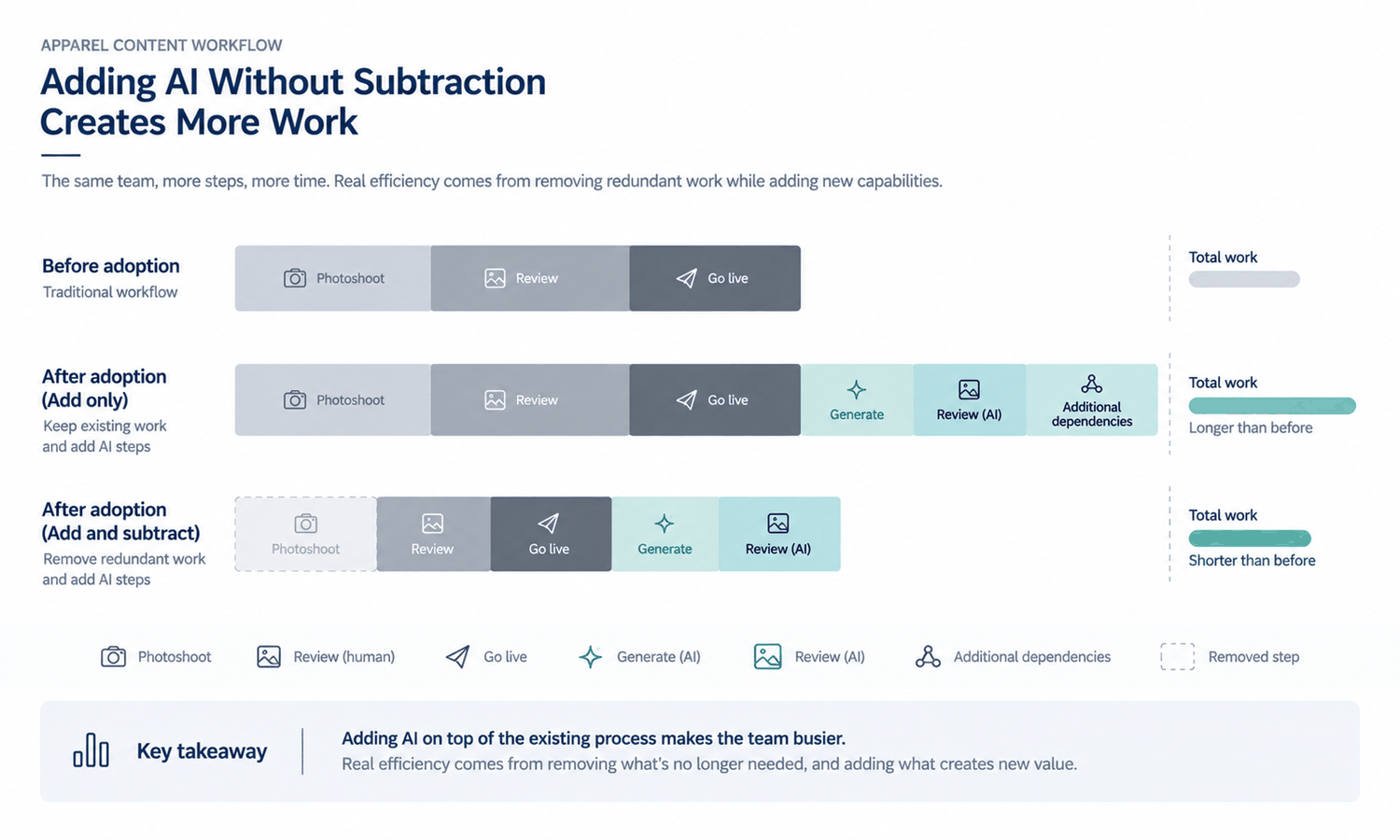
Most adoption guides are additive. Here is a new step, here is who runs it, here is the checklist that goes with it. Follow one and a product team ends up doing everything it did before plus a new workflow, which is why the promised savings so often fail to appear.
A complete guide has to include subtraction. The question that decides whether this is worth adopting is not what you will start doing, but what you will stop. This is the same condition Lightchain states for AI adoption in its own methodology: AI earns its place when it enters a defined department, takes on a real task, and produces an output with a clear acceptance standard. A checklist is not an acceptance standard.
A guide that only adds steps makes you slower
Consider what actually happens in the common version. A team adds generation to its process, keeps its existing photography schedule intact, keeps its existing review process, adds a new review for the generated assets, and adds a new dependency to the calendar.
Output goes up and so does workload. Six months later somebody asks why a technology sold on efficiency has produced a busier department, and the answer is that nothing was removed.
The removals are the difficult part, because each one is a decision somebody has to defend. That is precisely why they need to be named at the start rather than left to emerge.
They also tend to affect a different team from the one adopting the technology. The saving sits in the photography budget while the new work sits with whoever runs generation and whoever reviews, which means adoption succeeds or fails on a conversation between two departments rather than on anything technical. Anyone planning this should have that conversation in week one, not in month four when the numbers are being questioned. A shared company account and library at least put that new work on a budget line, so the conversation in week one has numbers in it.
Four things to stop
| Stop doing | Why it is now redundant | What replaces it |
|---|---|---|
| Shooting every colorway | Variants derive from one approved base | One properly shot reference per style |
| Booking a second session for late additions | The dependency that forced it is gone | Generation from the existing base |
| Flat-lay-only listings for long-tail styles | Coverage no longer requires a session | On-model output for styles that never justified a shoot |
| Reviewing generated assets at full screen | Mismatch is visible at viewing size, not magnified | A short check at destination size |
The first two are budget decisions and they are where the return actually comes from. A team that keeps shooting every colorway has bought a capability and declined to use it.
The fourth is a habit rather than a line item, and it is the one that quietly consumes the most time. Reviewers trained on retouching inspect at magnification, which takes longer and catches less of what matters in this workflow.
What must be added, and it is only two things
Adoption needs exactly two new commitments. More than that and the guide has started padding.
The first is a reference standard for source photography. Front or three-quarter poses, arms clear of the torso, even lighting, clean garment edges, resolution sufficient for the largest destination, and a file in a format the upload accepts — WebP, JPG, PNG or AVIF — within the size limit. Written once, applied to every shoot, and the reliability of everything downstream rises without further intervention.
The second is a named reviewer with allocated time. Not a person who will fit it in, but a role with hours attached, because review is the stage that grows with volume and no setting removes it. Clearer acceptance criteria and batching reduce it; they do not replace it. A workflow without an accountable reviewer either publishes unchecked assets or stalls behind someone's evenings.
Everything else that gets proposed — new folders, naming schemes, approval matrices — is optional and should be resisted until a specific failure justifies it. Process added in anticipation of problems is rarely the process the problems turn out to need, and it is much harder to remove than to introduce.
Who owns what
Ownership tends to be assumed rather than assigned, which produces gaps at exactly the handoffs that matter.
The studio owns the reference standard and the base images, since capture quality determines everything downstream. Whoever runs generation owns the attempts and the first-pass rejection, which means throwing away obvious failures before they reach anyone else. A product-side reviewer owns acceptance, checking at destination size, and has the authority to reject. Compliance owns disclosure and rights questions, which vary by market and by platform and do not belong at the review desk.
Four owners, four boundaries. The one that gets skipped most often is the first-pass rejection, and skipping it means the reviewer becomes a filter for obvious problems rather than a judge of borderline ones.
The effect on review quality is worse than the effect on time. A reviewer working through a batch that contains obvious failures adjusts downward without noticing, and the borderline assets that needed real judgment get waved through in the same rhythm. Filtering before review is not politeness toward the reviewer; it is what keeps the review meaningful.
Where it sits in the product calendar
Stage placement matters more than most teams expect, because generating too early wastes work and too late removes the benefit.
At concept and design stage, nothing. The garment does not exist as a photograph, and speculative visuals at this stage get reused later in ways nobody intends.
At sample stage, internal review visuals only, clearly labeled. The sample exists, a base image can be taken, and generated variants help a range review reach agreement — provided nobody treats them as fit evidence. Line drawings and tech-sheet drafts belong to the same stage, and they stay drafts until a technical reviewer has seen them.
At pre-launch, the listing set. This is the main event: the on-model coverage, the angles, the colorways, all derived from an approved base.
Post-launch, refreshes and channel variants. Seasonal reuse of an approved base is the highest-return application in the whole cycle and the one most often forgotten, because attention moves to the next drop the moment a launch completes. Put a calendar entry on it rather than relying on someone remembering. The AI Virtual Try-On module in Lightchain AI (apparel AI) produces the on-model set from that base at each of these stages — see AI virtual try-on.
The first thirty days
Sequence adoption so that the easy wins arrive before the difficult decisions.
Week one: write the reference standard, sort existing photography into favorable and difficult, and run one real style through it — a new account has enough allowance to test before anything is decided.Week two: run colorway repeats on a style already shot well, which has the highest approval rate of any application. Week three: name the reviewer, allocate the hours, and establish the destination-size check. Week four: make the first removal, which should be colorway shooting for the next season's plan.
The removal in week four is the point of the exercise, and it should be scheduled as a decision with a named person rather than left as an intention. A month that ends with new capability and no subtraction has demonstrated the technology and changed nothing about the department — see scaling e-commerce imagery for how the output carries across a catalog once the routine is in place.
What does not change
Several things survive adoption entirely, and pretending otherwise creates the disappointment this category is known for.
The output is a visual asset. It does not predict fit, determine sizing, model how a fabric behaves in motion, or forecast returns. Those come from measurements, a graded pattern, a physical sample, and your own returns data.
Hero campaign images and close fabric crops keep a camera, because art direction and material truth are not things a derived image supplies. Logos, printed text and small hardware are frequently reconstructed rather than faithfully carried, so they need direct comparison against the source on every asset, without exception. And the sample process is unaffected — nothing here shortens the path to a physical sample or replaces what that sample tells you.
Worth stating that last one explicitly in any internal proposal. Sampling is the longest lead time most product teams carry, and a proposal that appears to touch it will attract expectations it cannot meet. Saying plainly that this changes imagery and not sampling keeps the case credible.
Questions product teams ask
What is the single biggest mistake in adoption? Adding the workflow without removing anything. Output rises, workload rises, and the business case quietly fails despite the technology working exactly as described.
Who should own the reviewer role? Someone with product knowledge and allocated hours, on the product side rather than in the studio. A reviewer who also produced the asset is not a checkpoint.
Can we start without a reference photography standard? You can, and results will vary in ways nobody can diagnose. The standard is one page and it removes the largest source of inconsistency, which makes it the cheapest first step available.
How do we know it is working? Something got removed. If the photography schedule, the session count, and the review habits are all unchanged after a quarter, the capability exists and the benefit does not.
Where does compliance fit? Disclosure and rights vary by market and by platform, so they need an owner outside the production workflow. Route the question early rather than at publication.
Should we tell buyers and merchandisers the images are generated? Yes, along with one line explaining what the image does and does not show. People treat photograph-like images as evidence unless told otherwise, and that misreading is expensive later.
What a complete guide has to include
The subtraction. Two additions — a reference standard and a funded reviewer — and four removals, of which the colorway shoot is the one that pays. Place generation at sample, pre-launch and post-launch stages rather than at concept, assign the four owners explicitly, and check at the size the asset will be seen rather than at magnification. A team that adopts this and stops nothing has bought a faster way to produce the same amount of work.
Name one thing you will stop before you start.
**Write the reference photography standard, then decide which shoot comes off next season's plan — colorway repeats are the obvious candidate. Book the reviewer's hours in the same conversation. The removal is what converts a capability into a saving, and deciding it upfront is considerably easier than defending it after the schedule is already full. → **AI virtual try-on
About the author
[REPLACE — real person's name, role, relevant experience, LinkedIn URL. No team byline.]