
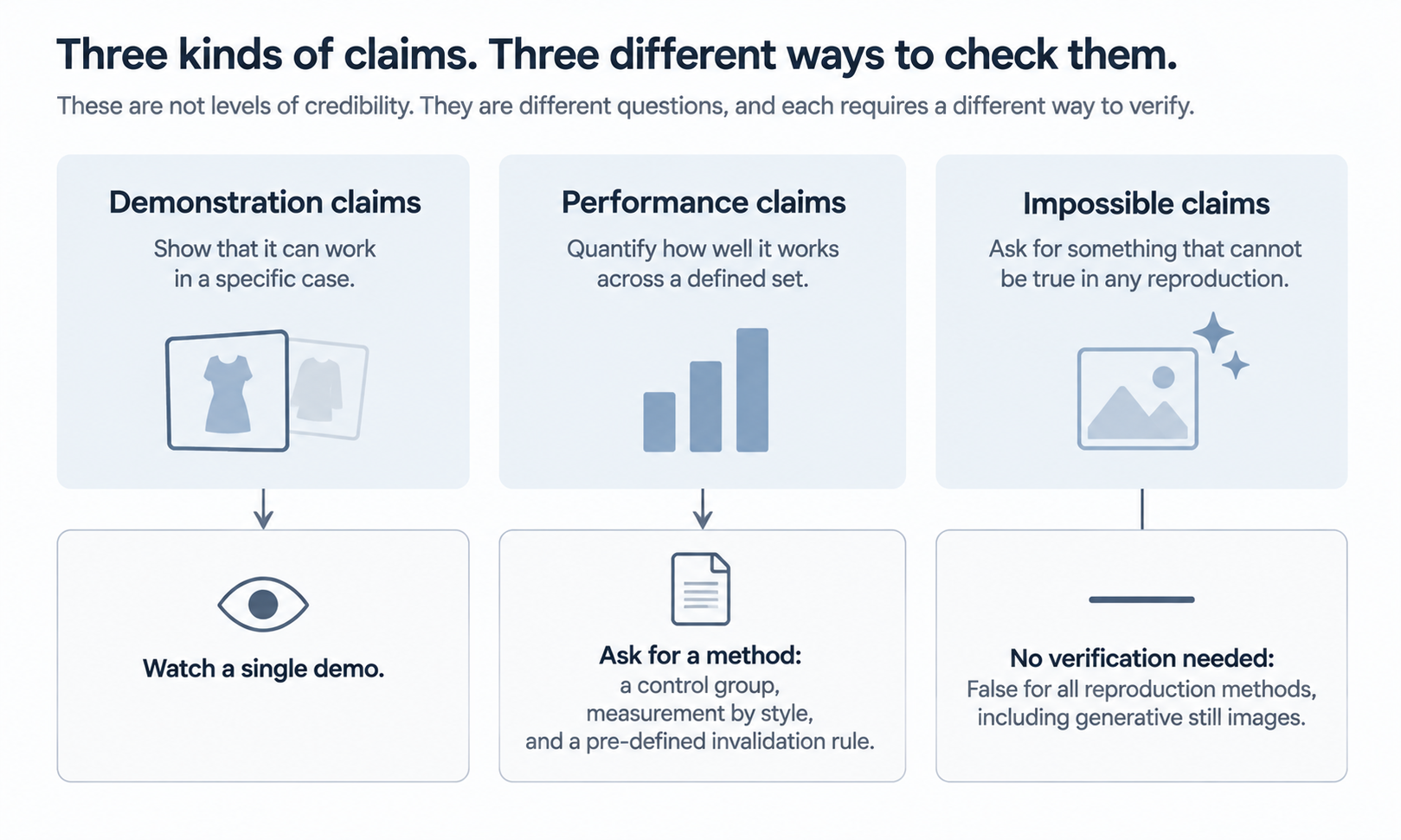
Claims about ar virtual try on are easier to sort than they look, provided the sorting is done by what kind of claim each one is rather than by how new it sounds.
Some claims are true by definition: they describe what the technology does, and asking for evidence is a category error. Some have a plausible mechanism and unsettled evidence, which makes them reasonable to explore and unreasonable to budget against. And some are about things no visual or interactive representation can supply, which makes them false regardless of how well anything is built.
That last group is the one worth being precise about, because the claims in it are equally false about generated on-model imagery, which is the workflow behind this article. Sorting them is not an argument for one approach over another.
Sorting by kind of claim, not by novelty
| Kind of claim | Examples | What settles it |
|---|---|---|
| Definitional: describes what the technology does | It places a rendered asset in a live camera view. It needs an asset to place. It runs on devices and inherits their constraints | A demonstration. Asking for evidence here is a category error |
| Outcome: asserts a result at the end of a chain | It increases engagement. It raises confidence. It reduces returns | A method: a holdout, style-level measurement, and a stated null. Published reviews report conflicting findings on the last one |
| Category error: asserts something no representation supplies | It tells a shopper their size. It replaces a fit session. It guarantees a colorway. It removes returns | Nothing, because these are false for AR and for generated stills alike |
The middle row is where most of the useful conversation lives and where the least of it happens, because a claim with a plausible mechanism and no settled evidence invites people to argue about the conclusion rather than about the mechanism.
The bottom row is worth removing from any evaluation early, since a discussion that includes it will keep returning to it.
Proven: what it does, by definition
Augmented reality places a rendered asset into a live camera view and updates it as the view moves. That is what the technology is, and it does it. Describing it as unproven confuses the capability with the claims sometimes attached to it.
Two consequences follow directly and are equally definitional. The first is that AR needs an asset to place, which means it sits downstream of whatever produced that asset rather than beside it. Deciding to build an AR experience is deciding to build or acquire three-dimensional assets as well, and that dependency belongs at the front of a schedule rather than discovered in the middle of one.
The second is reach: an AR experience runs on devices, in an app or a browser, and inherits the constraints of both. That is a build and maintenance commitment which continues after launch, and it is a fact about the delivery surface rather than a criticism of it.
Promising: plausible mechanism, unsettled evidence
Several claims sit here honestly. That an interactive view holds attention longer than a static image is plausible and measurable. That seeing a garment in your own environment changes confidence in a purchase is plausible and harder to isolate. That any of this reduces returns is the claim most often made and the one with the least settled support.
On that last one, a systematic review of the field exists partly because the published studies disagree with one another, and reviews of this literature note that variation in design and quality limits what can be concluded by combining them. That is not a finding of no effect. It is a finding that the question is open, which means confident percentages in either direction should be treated as unsupported rather than as evidence.
The mechanism is worth holding onto while the evidence is unsettled. A return is the gap between what somebody expected and what arrived, and any representation acts on the expectation side only. So an accurate representation narrows that gap and a flattering one widens it, which means the direction of any effect depends on accuracy rather than on which technology delivered the impression. That reasoning applies to AR and to an on-model image equally. In Lightchain AI (apparel AI) the uploaded source stays beside every AI Virtual Try-On output derived from it, which is how the accuracy side of that mechanism gets checked rather than assumed.
Hype: claims that are false for any representation
These are the claims to remove from a comparison, and they are false about generative imagery as much as about anything else.
The output is a visual asset. It does not predict fit, determine sizing, model how a fabric behaves in motion, or forecast returns. Those come from measurements, a graded pattern, a physical sample, and your own data. A representation that moves with a camera is still a representation, and interactivity does not convert appearance into dimension.
So a claim that any of this tells a shopper their size is false, and a size guide assembled from imagery is a sizing claim with no measurement behind it. A claim that it replaces a fit session is false, since fit is settled by measurements and a garment on a body. And a claim guaranteeing a change in a return rate is offering something outside what any representation controls, since that rate sits at the end of a chain running through sizing, price, assortment, and traffic.
Color belongs here too and is the one most often overstated. Screen color is not a physical reference, exact code matching is not something to promise, and the gap between a monitor and a roll of cloth stays open regardless of display quality. Colorways get settled by strike-offs against an agreed standard. A live camera view adds a device's own color handling on top of that gap rather than closing it.
What actually decides whether it is worth building
The decision is rarely about whether AR works, since it does. It is about three things that sit around it.
-
The asset dependency: an AR experience needs three-dimensional assets, so the real question is whether you have them, can build them per style, and can maintain them as the range turns over
-
The maintenance commitment: a build ages with devices and platforms whether or not your assortment does, which is an ongoing cost the other routes do not carry
-
Category fit: the categories where an interactive view adds most are usually those where proportion and placement on a body are the decision, and the documented weak spots for generated imagery are a separate question from what AR can render
That third point is worth separating cleanly. Lace and open work, sheer fabrics, complex prints, and heavily layered looks are documented weak spots for generated imagery specifically. Footwear is not covered by this class of workflow at all, and that is structural. Those verdicts are about the generative route and should not be transferred to AR by analogy, in either direction. The colorway and fabric work behind a category sits on the generative side and carries its own limits.
Across a catalog of any size, the recurring cost matters more than the build, and the asset question is what determines it.
How to read a claim you are shown
The sorting is quick once the question is fixed, and the question is what kind of claim this is rather than whether it sounds credible.
Ask whether the claim describes what the thing does, in which case evidence is not the right test and the answer is a demonstration. Ask whether it asserts an outcome at the end of a chain with several other links in it, in which case the honest status is unsettled and a percentage is not available. And ask whether it asserts something about fit, sizing, material behavior, or physical color, in which case it is false regardless of implementation and the discussion can end there.
That third test is the one that saves the most time, and applying it to your own materials first is the version worth doing. Whether the work runs through Lightchain AI or any other route, the same three questions apply, and a claim that fails the third test fails it for everybody.
Frequently asked questions
Is AR better than generated still imagery?
They answer different questions from different inputs, so the comparison does not resolve to better. AR places a three-dimensional asset in a live view and needs that asset to exist; generated imagery produces still assets from a photograph of a real garment. Decide which question you have before comparing the routes.
Somebody showed us a return-rate figure for an AR deployment. How should we treat it?
As a single case rather than as evidence of a general effect, and ask what else changed at that retailer in the same period. Published reviews of this literature report conflicting findings, which is the context any individual figure sits in. A number without a stated method and a holdout is an observation.
Does AR help with sizing at all?
No, and this is the claim to remove from an evaluation first. Sizing comes from measurements, grading, and fit sessions, and no representation of appearance supplies dimension. That is equally true of the still imagery this article's workflow produces.
We do not have 3D assets. Can we start with AR anyway?
The asset has to exist before it can be placed, so starting with AR means starting with asset creation, which is a project with a different team and a different cost shape. Sequence the asset decision first. Choosing the surface before the asset is the most common way this schedule goes wrong.
Which claims are safe to make about our own imagery?
That it shows what a garment looks like, produced from a photograph of that garment, and that it is accurate to the source. Claims about fit, size, material behavior, physical color, or returns are outside what the asset supports. Applying the third test to your own materials is more useful than applying it to anybody else's.
Is the returns question likely to be settled soon?
The published position is that findings conflict and the studies vary enough in design to limit conclusions, and predicting when that changes is not something this article can do. What is available now is your own reason-code data, which answers a narrower question about your own range. Treat the general question as open until a review says otherwise.
In closing
Three kinds of claim get mixed into one conversation. What AR does is definitional and a demonstration settles it. What it might achieve for engagement, confidence, or returns has a plausible mechanism and unsettled published evidence, so a percentage is not available in either direction. And what it cannot do — supply fit, sizing, material behavior, or physical color — is false for every representation including generated stills, which is why that group belongs outside the comparison rather than inside it. What remains to decide is the asset dependency, the maintenance, and whether your categories are ones an interactive view serves.
Start here
Take whatever claims you have been shown, from any source including your own materials, and sort them into the three groups before evaluating anything. The definitional ones need a demonstration, the outcome ones need a method, and the third group can be set aside entirely. Most lists shorten by a third in the first pass, and what remains is a conversation about assets and maintenance rather than about technology.
**Start with catalog-scale asset work → **https://www.lightchainai.com/global/solutions/scaleECommerce