
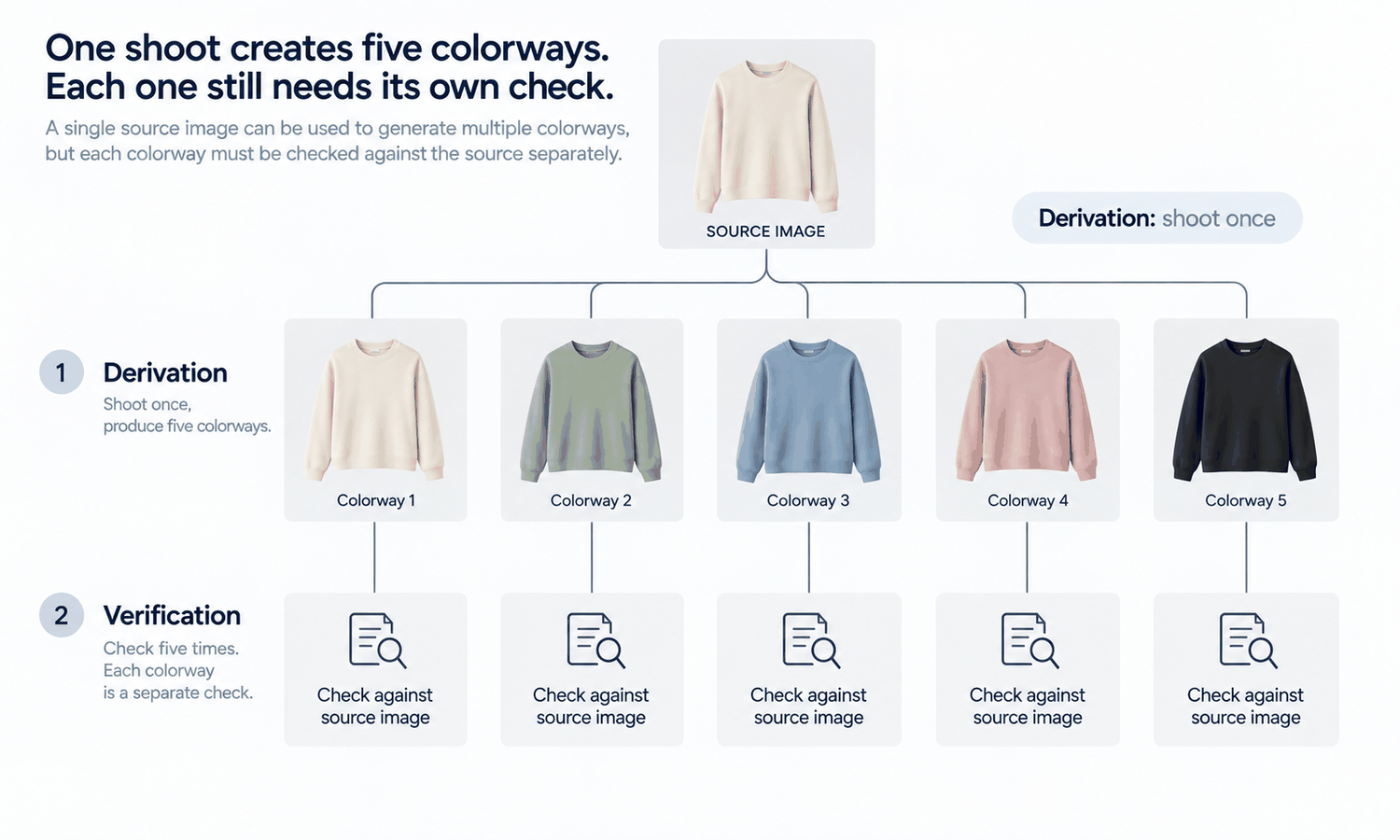
Two things get filed under ar clothing try on and they are not the same class of thing. One is a live camera experience on a shopper's phone, overlaying a garment on the person holding it. The other is generated on-model imagery: still assets produced from a photograph of a garment, which then appear on a page, in a grid, or in a line sheet.
This workflow is the second. It does not build a live camera experience, and that is a scope fact rather than a comment on whether such experiences are worth having.
What both share is that their cost is decided upstream, at the point a garment is captured. So the practical question, and the one that pays regardless of what the delivery surface turns out to be, is narrower: when a style exists in five colorways, what actually repeats and what has to be done again.
The delivery surface does not change the economics
It is worth separating the two questions properly, because teams often decide the surface first and the production model second, which is the wrong order.
A still image on a product page, a colorway grid, a line sheet, and an immersive shopper-facing experience are different delivery surfaces with different build costs and different owners. What none of them changes is where the garment information comes from. Every one of them is downstream of a photograph of a real garment, and the quality and consistency of that photograph sets a ceiling that no surface rises above.
That has a scheduling consequence. A team planning an ambitious surface while its capture is inconsistent has planned a project that will surface the inconsistency more prominently rather than resolve it. The order that works is capture, then derivation, then surface.
It also has a scoping consequence. This workflow produces still assets from garment photographs. Building a live camera experience is a separate project with a separate team, and treating the two as one initiative is how a schedule acquires a dependency nobody planned. Decide the asset question first, because it is the one that constrains everything after it.
What repeats across five colorways
| Element | Repeats or redone | What decides it |
|---|---|---|
| The garment capture itself | Repeats. Captured once for all five | Whether it was shot neutral and complete rather than in one season's colorway |
| Model direction, pose, and scene | Repeats, and has to, or the five stop reading as a set | Holding them constant across the run rather than improving midway |
| Settings profile and the brief | Repeats. Written once, applied five times | Whether it was recorded rather than reconstructed each time |
| The comparison against source | Redone. Five outputs, five checks | Nothing. A defect on one colorway has no reason to appear on the others |
| Print position and repeat scale | Redone, and drift is possible on one while four are correct | The spec, checked per colorway rather than per style |
| The shade itself | Redone physically, outside the workflow entirely | A strike-off against an agreed standard, five times |
Read down the second column and the pattern is unusual for this kind of work: most of it repeats. That is the whole economic case for colorway work, and it holds only under a condition set before the first colorway exists.
The condition is what the capture was built for. Everything in the repeats column derives from a source that was captured neutral and complete. Everything in the redone column is per-colorway regardless.
Capture the body, not the presentation
The decision that determines the cost of colorway five is made before colorway one, and it is not a technical decision.
A capture built around a presentation is shot in that season's colorway, styled for that campaign, framed for that channel. It produces one good set and supports nothing else. A capture built around the body is shot neutral, complete, and unobstructed, with the colorway and fabric direction applied afterwards as a derivation rather than baked into the source.
The difference is invisible in the first project and decisive by the third. A team that captured presentations reshoots for every colorway and reads that as the normal cost of colorway work. A team that captured the body pays the capture once.
The test is one question: if a second colorway is added mid-season, does anybody have to photograph anything. If the answer is yes, the assets were built for a moment rather than for a style.
What has to be checked on every colorway anyway
Derivation is not duplication. Each colorway is a new output, and a few things do not inherit the previous one's approval.
Logos, printed text, care labels, and small hardware get compared against the source image on every single on-model output, without exception, and that includes colorway four when colorways one through three were clean. Reconstructed detail lands almost right — a letterform slightly off, a stitch count wrong, a zipper pull the wrong shape — and there is no reason a defect appearing on one colorway would appear on the others, which is precisely why a sample of the set does not cover it.
Prints deserve separate attention across a colorway run. Where a motif sits relative to center front and the seams is a specification with a right answer, and placement can drift on one colorway while the other four are correct. When that happens and the rest of the frame is sound, a targeted correction to that region is smaller than a rerun and keeps the five comparable, which matters more here than usual: a colorway set is displayed together, so an inconsistency between two of them is visible in a way it would not be in isolation.
In Lightchain AI (apparel AI) the uploaded source stays beside every output AI Virtual Try-On derived from it, which is what makes checking colorway four against the original garment photograph a two-second job rather than a hunt for which file was the source.
What no colorway pass can settle
Producing five colorways on screen produces five images. It does not produce five colorways.
Screen color is not a physical reference, exact code matching is not something to promise, and the gap between a monitor and a roll of cloth stays open regardless of display quality. Colorways get settled by strike-offs against an agreed standard, and values must never be read off a generated asset and sent to a mill or published as a product attribute. What the pass gives you is a shortlist worth sampling, which is genuinely useful and is a different claim.
The rest of the boundary applies as it always does. The output is a visual asset. It does not predict fit, determine sizing, model how a fabric behaves in motion, or forecast returns. Those come from measurements, a graded pattern, a physical sample, and your own data. Five colorways of a style do not add up to a fit answer any more than one does, and a size chart cannot be assembled from imagery at any volume.
Two scope answers save time. Footwear is not covered by this class of workflow, and that is structural rather than a gap waiting to close. Lace and open work, sheer fabrics, complex prints, and heavily layered looks are documented weak spots, and a colorway run in one of those categories inherits the category verdict rather than escaping it.
The sequence for a five-colorway style
The order matters more than the effort, and most of it happens before anything is generated.
-
Capture the body neutral, complete, and unobstructed, to a standard written down with reference photographs, before any colorway is decided
-
Check fabric availability and mill minimums for the colorways under consideration, since exploring six is free and ordering six is not
-
Decide how many colorways will actually be shown, before generating, rather than producing all the candidates and reviewing them
-
Run the derivations, then check each one against the source individually, treating the set as five outputs rather than one job
-
Send the surviving colorways to strike-off, and keep the screen versions labeled as a shortlist until physical references come back
-
Publish as a set, and look at the five together on a page before any of them goes live, since drift between them is invisible one at a time
Whether the work runs through Lightchain AI or a camera, the fifth colorway costs what the first capture decided it would cost. That is the only lever in this that operates on all five at once.
Frequently asked questions
Does this workflow support an AR experience?
It produces still assets from garment photographs rather than a live camera experience, so an AR deployment is a separate class of project. What the two have in common is that both depend on accurate source material captured to a standard. Scope them separately rather than as one initiative.
How many colorways is worth deriving rather than shooting?
The threshold is repetition rather than a count, so the question is whether the body will be reused across colorways, channels, and seasons. A style shown in five colorways across two channels is ten derivations from one capture. A style shown once in one colorway is a photograph.
Can we approve a colorway from the derived image?
No. The derived image narrows which shades are worth sampling, and a strike-off against an agreed standard settles which one you buy. Approving from a screen moves a risk you cannot control onto yourself, and it is discovered at the mill or at the customer.
Do all five colorways need the full detail check?
Yes, individually. A defect on colorway four has no reason to appear on the other three, which is exactly why checking a sample of the set does not cover it. The check is quick when the source is one click away and skipped when it is not.
What if a colorway is added after launch?
If the capture was built around the body, it is a derivation and costs almost nothing. If it was built around a presentation, it is a reshoot, and the reshoot will not match the original set unless the original standard was written down. That second case is the argument for the first.
Should the five be shown together or separately?
Review them together before publishing regardless of how they will be displayed, since inconsistency between colorways is the defect this kind of run produces and it is only visible side by side. How they appear to a customer is a merchandising decision and does not change the review.
In closing
The useful question behind a colorway run is what repeats, and the answer is that almost everything does — provided the capture was built to be derived from. That decision is made before the first colorway and it sets the cost of every one after it. What does not repeat is the check: each colorway is a new output and inherits nothing from the approval of the last one. And what no amount of derivation produces is an approved shade, since that is settled physically against a standard rather than on any screen.
Start here
Take a style currently running in more than one colorway and ask whether adding a sixth would require photographing anything. If it would, look at what the original capture was built around, since that is where the cost came from rather than from the colorway work itself. Fixing it applies to every style captured after today and to none captured before, which is why the answer is worth knowing this week rather than next season.
**Start with fabric and colorway work → **https://www.lightchainai.com/global/solutions/designWithPurpose