
Most guides to ai virtual try on describe the software. This one describes the chain, because the chain is what determines whether the software helps.
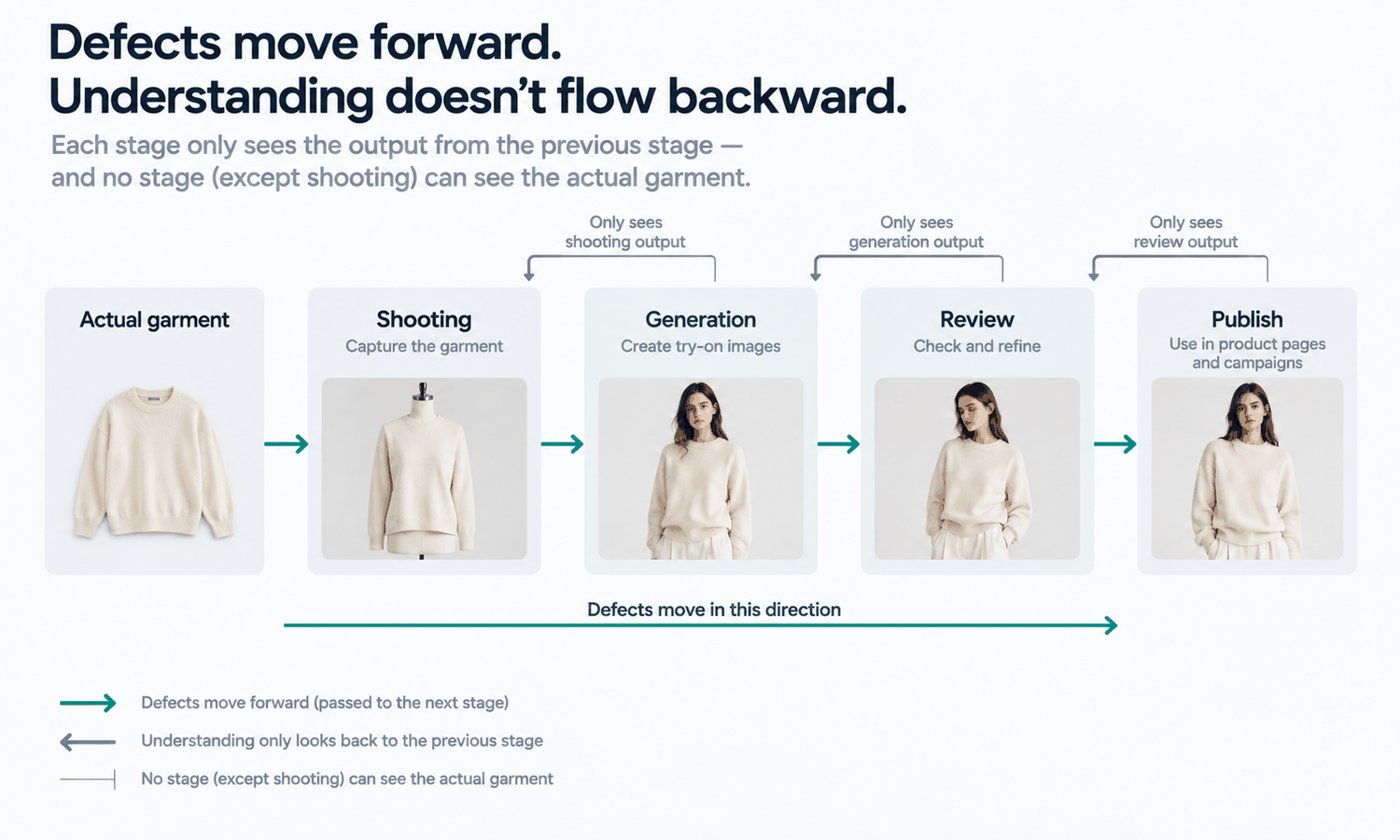
The workflow has one property that explains nearly every failure teams run into. Each stage can only see the stage immediately before it. A generated image knows the photograph it came from and nothing about the garment. A reviewer comparing that image can only compare it against the same photograph. A channel receiving the approved file inherits every decision made upstream and has no way to interrogate any of them.
That makes this a chain where defects travel forward and understanding does not travel back. Everything useful in the sections below follows from it: at each stage, the question worth asking is not how to do the stage well, but what becomes unfixable once you leave it.
The four stages and what each one locks in
| Stage | What it decides | What becomes unfixable once you leave it |
|---|---|---|
| Capture | Everything the rest of the chain will ever know about the garment | Consistency across a set. A piece captured badly is wrong in every image derived from it, and the cause is invisible by review |
| Generate | How many options exist, which settings produced them, and how a look was layered | Traceability, if the settings were never recorded, and the review load, which is set here and paid for later |
| Check | Whether an output matches its source, and separately whether it is any good | Anything the conformity check lets through, since no later stage can compare against the garment itself |
| Release | What travels, in what state, joined to which identity | Whether a current file can be told from a superseded one, and what an approval will be read to mean months later |
The table is the whole method. Read down the third column and the priority order is obvious, and it is close to the reverse of where most teams put their attention. Effort concentrates at generation, which is the stage with the most immediate feedback and the least permanent consequences, while capture runs on whoever was free that afternoon.
Naming the stages is worth doing out loud in a team, because the on-model workflow tends to be discussed as a single activity called making the images. A single activity has one owner and one quality conversation. Four stages have four owners and four different questions, and the four questions are not equally hard. Working in Lightchain AI (apparel AI) or anywhere else, the stage that decides most of the outcome is the one with the least glamour attached to it.
Capture: the only description of the garment the chain will ever have
Everything downstream is a derivation from the capture. That single sentence carries more operational weight than any other in this guide, because it means a defect entering here is not a defect in one image. It is a property of every image derived from that piece, and it stays invisible until somebody notices that two styles from the same collection look like they came from different brands.
The rules are unglamorous and they hold across brands and manufacturers alike.
-
One position, one distance, one background, one light, written down and held for a season rather than adjusted whenever somebody has an idea
-
Every piece shot complete and unobstructed, including areas a later styling decision might cover, since that decision has not been made yet
-
One shoulder line and one center-front axis across a collection, so pieces meant to be worn together share a geometry
-
A consistent scale reference in frame, because relative proportion between two pieces is what an outfit has to get right
-
Hardware and printed detail captured at a distance where they can be checked later, not only at a distance where they read
-
The garment in front of the camera good enough to represent the style, since the capture is only as true as the sample it was taken from
Hold the output side constant too. One model direction, one pose, one scene per category in Model Studio, so a set looks like a set. Variation entering at either end cannot be derived away later, and it is invisible in any single image while being obvious across a grid.
Generate: decide the variant count before, not during
Generation is where output becomes cheap, and cheap output moves the constraint somewhere else rather than removing it. The constraint lands on whoever has to choose, and choosing does not get faster.
So the discipline is a variant budget per style, set before generating and with a stated basis for choosing between the options. Two options with a reason beats eight without one, and the eight cost review time from the person whose judgment the whole operation depends on. This holds whether the work happens in AI Virtual Try-On, in a colorway and fabric pass, or across both.
Two settings decisions belong here rather than later. Record the settings profile so a defect can be traced to it, and version it, because a profile that changes without a record turns a category-wide defect into an archaeology project. And decide the layering before generating: overlaps are where the model has the least information and does the most inventing, so a look with fewer garments crossing each other comes back usable more often than one with more. Layered styling with occlusion is a documented weak spot, along with complex prints, lace and open work, sheer fabrics, and frame-to-frame consistency in video.
Check: comparison, not appreciation
Review is two activities that most teams run as one, and separating them is what makes the stage survivable at any volume.
The conformity check asks whether the output matches its source. It has a right answer, two people will reach the same verdict, and it can never be sampled — because outputs sharing a capture standard and a settings profile fail together, so a clean sample tells you about the batch rather than about the images. The judgment pass asks whether the image is good, and that one can be sampled, delegated, or run at category level. A weak image is a cost; a wrong image is a liability.
Inside the conformity check, one rule holds without exception. Logos, printed text, care labels, and small hardware get compared against the source image on every single output. Reconstructed detail lands almost right — a letterform slightly off, a stitch count wrong, a zipper pull the wrong shape — and almost right survives an appreciative look, reaches a channel or a client, and gets found by whoever knows the product. Looking is not comparing, and in small teams that distinction is the first thing negotiated away.
When one region fails and the rest of the frame is sound, a targeted correction to that region is smaller than a rerun and keeps the rest of the batch comparable. Rerunning one style inside a category is how a set stops matching itself.
Release: what travels, and what it says about itself
A file that leaves without its identity gets re-requested, re-sent, or re-created, usually all three across a season. Four fields travel in the message rather than the filename, which gets rewritten on the second download.
-
The style code and the colorway code, so the file can be joined to the system that runs on them
-
The season, so a file cannot be silently reused a year later
-
The state — proposal, selection, or confirmation — since those three carry different permissions and the same file at all three stages destroys the distinction
-
The basis of any approval written beside it: approved against the fit session, against the strike-off, or as a visual direction only
This is where brands and ODMs diverge. For a brand, release means a channel, and the discipline is one internal master per style with channel versions derived from it rather than regenerated, since a regenerated asset is a different image and has to go back through the conformity check. For an ODM, release means a client, and the image carries an implied offer: we can make this, on our lines, at a price we will quote. Generated output knows nothing about your machine list, your trims in stock, or your mill minimums, so a buildability check belongs before the proposal leaves rather than after the client accepts. Converting an approved look into a line drawing or tech-sheet draft in the Design & Production Workbench is where that becomes concrete, and those outputs are drafts a technical designer still has to review. Whether the chain runs through Lightchain AI or a camera, the offer underneath the picture costs what it always did.
What the workflow does not do
Scope belongs in a guide rather than in a footnote, because most of the expensive mistakes in this area come from a capability that was assumed rather than claimed.
The output is a visual asset. It does not predict fit, determine sizing, model how a fabric behaves in motion, or forecast returns. Those come from measurements, a graded pattern, a physical sample, and your own data. That is a property of what the asset is, not a limitation of any particular result, and no improvement in how convincing an image looks moves it. A size curve cannot be read off imagery, however much imagery there is. A return rate sits at the end of a chain running through sizing, price, assortment, and traffic, and no asset can be presented as the reason it moved.
Color has a hard edge that gets crossed most often at scale. Screen color is not a physical reference, exact code matching is not something to promise, and the gap between a monitor and a roll of cloth stays open regardless of display quality. Colorways get settled by strike-offs against an agreed standard, values must never be read off a generated asset and sent onward, and running a whole category of colorways through a workflow does not make any of them approved.
Two scope questions come up often enough to answer directly. Footwear is not covered by this workflow, and that is structural rather than a gap waiting to close: a shoe is a rigid object built on a last, with no flat-lay equivalent to serve as the input the whole method depends on. And there is no 3D modeling or physical simulation here — nothing in the chain builds geometry or predicts how a material behaves. Existing 3D assets can be converted into flat garment images that then enter the chain at capture, which is a different thing from the chain producing 3D.
Frequently asked questions
Where should a team start if it can only fix one stage?
Capture, without qualification, because it is the only stage whose defects cannot be corrected downstream. A week spent writing and enforcing a capture standard returns more than any amount of work at generation. The tell that this stage is weak is a review conversation about whether an image is good that keeps circling without resolving.
How many people does this workflow need?
Fewer than teams expect for generation and more than they expect for the conformity check, which is comparison work that can be distributed once the standard is written down. One person can hold all four stages at low volume and none can at high volume. Split the check from the judgment pass before the queue forces it.
What should we measure?
Attempts per accepted output rather than outputs produced, unbilled or unplanned hours rather than turnaround, and whether a defect's cause was local to one image or shared across a batch. Volume figures rise on their own and answer nothing. The useful numbers are the ones that change what somebody does this week.
Can a client or a buyer approve a garment from these images?
They can approve a visual direction, and that is what the record should say. Fit approval comes from the fit session and the measurement chart; color approval comes from a strike-off. Writing the basis next to the status costs three words and prevents the argument that happens six weeks later when somebody reads the minutes.
How do we handle a category that keeps failing?
Route it to conventional photography, record the reason next to the category, and set the retest to a product update or a change in your own inputs rather than to a date. A failed category is information about where the line sits. Retesting the same setup on a schedule produces the same answer at a cost.
Does better output quality reduce the review burden?
It reduces the judgment pass and does very little to the conformity check. A more convincing image makes a wrong detail less likely to be noticed rather than less likely to occur, so the comparison against the source stays exactly as long as it was. Quality improvements move the ceiling, not the floor.
Is any of this different for an ODM?
The four stages are identical and the release stage carries more weight, because a proposal is a commercial offer rather than a communication. Buildability has to be checked before the look leaves the building, and the marks on a proposal are frequently the client's own brand assets, which makes the detail check a question about somebody else's property.
In closing
The workflow is four stages, and cost runs in one direction through them. Capture decides what every later stage is allowed to know, so it deserves the discipline that usually goes to generation. Generation is where restraint pays: fewer variants, recorded settings, layering decided in advance. The check splits into a comparison that can never be sampled and a judgment that can. Release is where identity and state have to be attached, and where an ODM's picture quietly becomes an offer. Around all of it sits a scope that does not move with better output: fit, sizing, material behavior, and returns come from measurement and samples, not from images.
Start here
Do not redesign the pipeline. Take one style through all four stages this week and write down, at each handoff, what the next stage would be unable to recover if it were wrong. Most teams find the list is short and lands almost entirely at capture. Fix that one first, hold it for a season without adjusting it, and let the other three stages be judged against a stable input rather than against each other.
**Start with the on-model workflow → **https://www.lightchainai.com/global/solutions/aiVirtualTryOn