
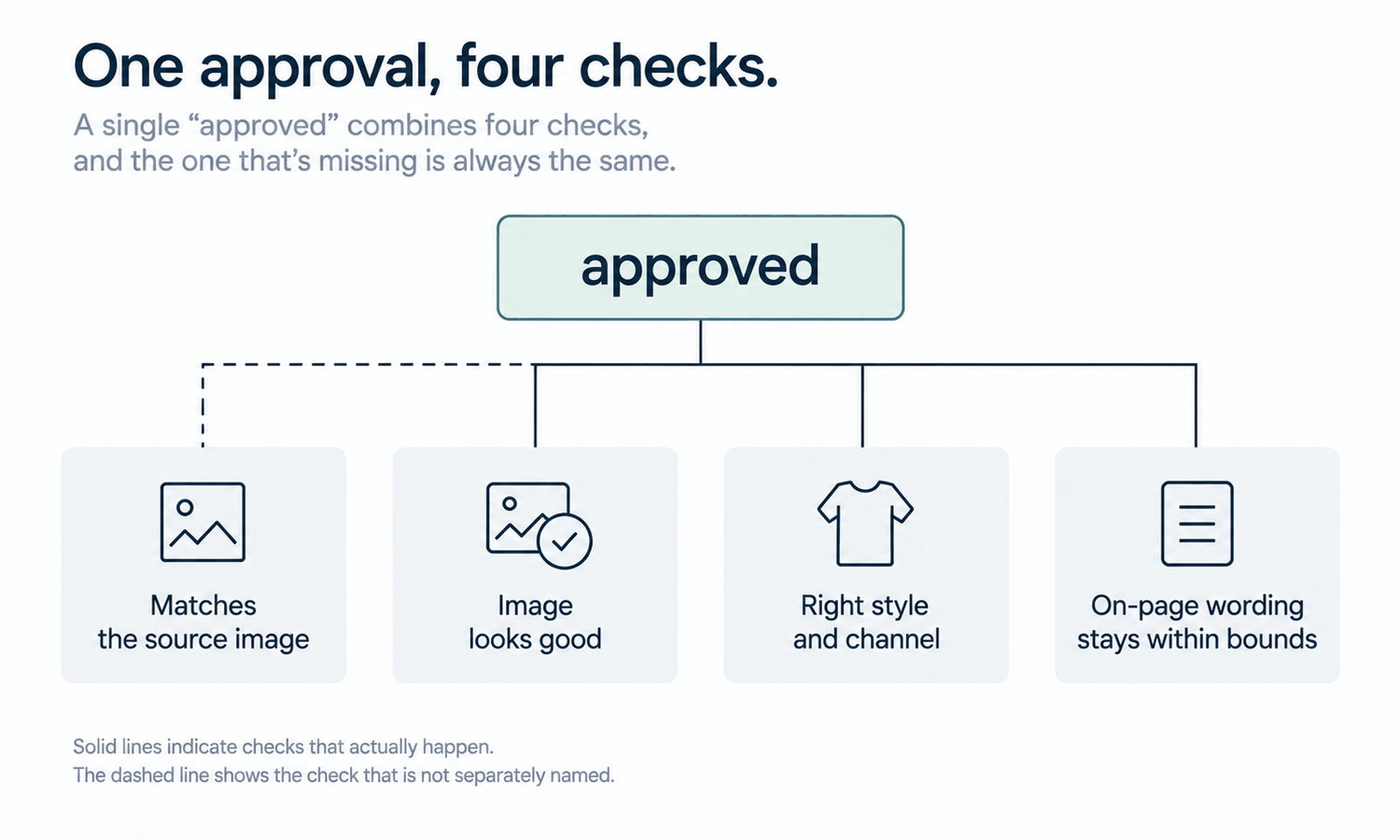
The word approved does a great deal of work and says almost nothing. Attached to an image it can mean the composition is right, or the garment matches, or this is the correct style for the channel, or nothing on the page overstates what the picture shows. Usually it means one of those, and it gets read downstream as covering all four.
That is the whole problem with sign-off on ai swap clothes output. Not that teams approve carelessly, but that a single signature collapses several different verifications into one word, and nobody can tell afterwards which one actually happened.
The fix is not more approvers. It is making each signature name what it covers.
Approved is not one statement
Four different things get verified about a generated image, and they need different knowledge and different access.
Whether the output matches the garment it came from is a comparison with a right answer, and it requires the source file and somebody who knows the product. Whether the image is good is a judgment, and it requires the campaign direction and somebody whose taste the brand trusts. Whether this is the right style, season, and channel is a commercial question answered from the range plan. And whether the surrounding page overstates what the image shows is a claims question answered from what the asset is actually able to support.
Very few people can answer all four, and almost nobody has access to all four inputs. Yet the approval field takes one name.
The four sign-offs hiding inside one
| What is being verified | Who can actually verify it | What they need in front of them |
|---|---|---|
| The output matches the garment it came from | Somebody who knows the product well enough to notice a wrong stitch count | The source photograph, open beside the output |
| The image is good | Whoever owns the brand's visual direction | The campaign direction and the rest of the set |
| This is the right style, season, and channel | Whoever owns the range plan | The range plan and the launch calendar |
| Nothing around the image overstates what it shows | Whoever owns the page copy, against a written boundary | The product page as a whole, not the image alone |
The row that goes missing is consistently the first one. It is the least glamorous, it is the only one with a right answer, and it is the one whose failure arrives at a customer rather than in a meeting. A team under pressure will always find time for the judgment on whether an image is good, because that conversation is interesting and somebody senior wants to have it.
Reconstructed detail lands almost right — a letterform slightly off, a stitch count wrong, a zipper pull the wrong shape — and almost right passes every one of the other three sign-offs without difficulty.
Access decides authority, not job title
Somebody cannot sign for a comparison they are not able to perform. If a reviewer is looking at an on-model output without the source photograph open beside it, they are approving an appearance, whatever the approval field says, and the record will not distinguish the two.
This is why the practical question is access rather than seniority. Logos, printed text, care labels, and small hardware get compared against the source image on every single output, without exception, and that requires the source to be one click away rather than in somebody else's folder. In Lightchain AI (apparel AI) the uploaded source stays beside the outputs AI Virtual Try-On produced from it, which turns the comparison into something a reviewer can actually do at volume rather than something they intend to do.
Where the link does not exist, the honest options are to build the record by hand or to accept that the first sign-off is nominal. Choosing the second one deliberately is defensible. Discovering it later is not.
When a single region fails and everything else is sound, a targeted correction to that region is smaller than a rerun, and it should not silently reset the other three approvals — the corrected file is a new file and needs the comparison again.
What a signature has to name
Two fields turn a signature from a formality into a record.
The first is the basis. Approved against the source photograph. Approved as a visual direction. Approved for this channel. Three words after the word approved, and six weeks later nobody has to reconstruct what was meant. A bare approval is read as full approval by whoever finds it, and the person who finds it is usually two handovers away and has no way to ask.
The second is the state. An image is a proposal, a selection, or a confirmation, and those carry different permissions: a proposal should not leave the room, a confirmation can go to a channel or a factory. The same file at all three stages with the same name destroys the distinction, and the destruction is invisible.
For anything heading toward production, the signature has an extra dimension. A styled render is not the right carrier for construction decisions, so approval of a look is not approval of how it gets made. Converting it into a line drawing or tech-sheet draft in the Design & Production Workbench makes those decisions explicit, and those outputs remain drafts that a technical designer signs off separately.
What no signature can make true
An approval establishes that somebody checked something. It does not extend what the thing is.
The output is a visual asset. It does not predict fit, determine sizing, model how a fabric behaves in motion, or forecast returns. Those come from measurements, a graded pattern, a physical sample, and your own data. No level of seniority in an approval chain changes that, which is worth stating because a senior signature is often treated as though it settles questions outside its reach.
Two things follow. A style cannot be recorded as fit-approved on the basis of imagery; fit approval comes from the fit session and the measurement chart, and the record should name which. And a colorway cannot be approved from a screen: screen color is not a physical reference, exact code matching is not something to promise, and the gap between a monitor and a roll of cloth stays open regardless of display quality. Colorways get settled by strike-offs against an agreed standard.
The failure here is rarely a false claim. It is a status line that says approved without saying approved against what, which reads as a full approval later when somebody is trying to work out why a garment shipped wrong.
Making this work in a team of four
Splitting four sign-offs across four people is a large-company answer. A small team can hold several of them in one person, and doing that is fine provided two conditions hold.
-
Record which sign-offs a signature covers, even when the same person holds all of them, since the record is what survives the person being unavailable
-
Keep the comparison and the judgment with different people wherever possible, because the comparison does not require the taste that produced the image and separating them stops the check being absorbed into an appreciative look at your own work
-
Give the comparison to whoever knows the product rather than whoever is most senior, since the knowledge that catches a wrong stitch count is product familiarity
-
Make the source accessible to whoever holds the comparison, before the first batch rather than after the first miss
-
Write the claims check into the page template rather than into somebody's memory, so it happens by default rather than by attention
The pairing that should never collapse into one person is the comparison and the judgment on the same image. Whether the work runs through Lightchain AI or a camera, somebody who has just made an image is the worst available reviewer of whether it matches the garment, and not because of any failing on their part.
Frequently asked questions
Is four sign-offs too much process for us?
The four verifications happen whether or not they are named, and naming them costs a template rather than a workflow. What changes is that the missing one becomes visible. Most teams find they were doing three well and one not at all.
Who should hold the comparison sign-off?
Whoever knows the product well enough to notice a wrong rivet or a wrong stitch color, which is often not the most senior person in the chain. Give it to that person explicitly and give them access to the source files. Seniority is the wrong selection criterion for a task with a right answer.
What if the same person makes and approves the image?
For the judgment pass that is workable and common. For the comparison it should be avoided, since reviewing your own work against a source is the hardest version of the task and the one most likely to be done quickly. If the team genuinely has one person, do the comparison on a different day rather than in the same session.
How do we record the basis without adding admin?
Three words after approved, in whatever field already exists. Approved against source. Approved as direction. The cost is a few seconds and the benefit arrives months later when somebody reads the record without the context that produced it.
Does a corrected file need re-approval?
The comparison does, since a corrected file is a new file and the correction may have changed something adjacent. The other three usually do not, provided the correction was to a region rather than a rerun. Treat a full rerun as a new image needing all four.
Our approvals happen in a chat thread. Is that a problem?
The approval survives and the basis and state do not, since a thread records agreement without recording what was agreed. Move the two fields to wherever the file lives. The thread is fine for the conversation and unreliable as the record.
In closing
A signature on a generated image should say what was verified rather than that somebody was satisfied. Four things need checking, they need different knowledge and different access, and the one that goes missing is always the comparison against the source, because it is the least interesting and the only one with a right answer. Name the basis in three words, record the state, give the comparison to whoever knows the product, and make sure they can see the source. None of that is process for its own sake, and all of it is what makes an approval mean something a month later.
Start here
Open the last ten approvals your team recorded and check whether any of them says what it was approved against. If none do, the record you have is a record of agreement rather than of verification, and that is the gap. Add the basis field this week, before adding anybody to the approval chain, since one more approver on an unnamed basis produces two signatures nobody can interpret instead of one.
**Start with the on-model workflow → **https://www.lightchainai.com/global/solutions/aiVirtualTryOn