
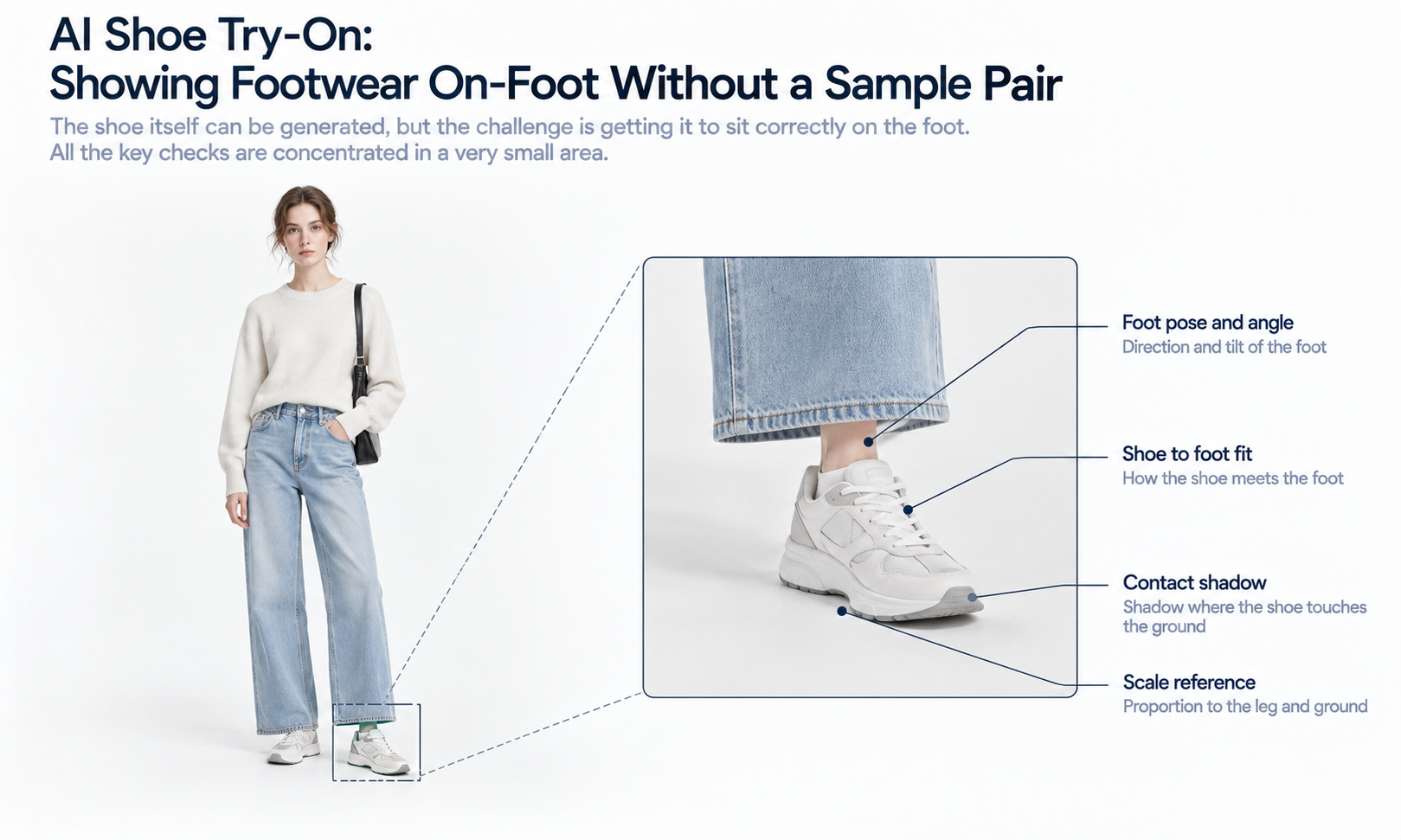
Footwear inverts the usual difficulty. Everywhere else in this space, rigid products are the easy case and soft draping goods are the hard one. A shoe is rigid — it holds its shape on a shelf, in a box, and on a foot — which ought to make it the simplest category of all.
It is not, and the reason has nothing to do with the shoe. It is about where the shoe has to go.
Rigid product, hard placement
Placing a garment on a torso is forgiving. The body is large, the contact area is broad, and small errors distribute across a wide surface.
Placing a shoe on a foot is not. The foot is small relative to the frame, its position varies enormously between poses, and the shoe has to sit on it with the correct angle, the correct scale, and a believable relationship to the ground. Three constraints that a garment placement does not face, all resolved in a fraction of the pixels.
The result is that footwear is easy to represent and difficult to place, which is the opposite of the pattern teams learn from apparel work. A brand extrapolating from its apparel experience will predict the wrong outcome in both directions.
This shows up most often in mixed businesses. A brand doing well with garment imagery adds footwear to the same workflow, expects the rigid category to be simpler, and finds the attempt rate climbing instead. The tool did not change and neither did the operator; the geometry of the problem did.
Three problems share the name
Shoe try-on describes at least three different things, and the confusion is expensive.
The first is on-foot imagery: producing a picture of the shoe worn, for a listing or a campaign. No customer is involved and the output is an image.
The second is augmented reality preview: a shopper points a camera at their own feet and sees the shoe rendered in place. This needs a three-dimensional asset per style and it addresses scale and style rather than fit.
The third is size recommendation, which uses measurements, scan data or purchase history to suggest a size. It shares no mechanism with the other two and is the one addressing the actual commercial problem in footwear.
Most conversations that go badly are two people discussing different items on that list.
What decides an on-foot image
Four things, in roughly this order of consequence.
Foot pose comes first. A three-quarter standing pose with both feet flat is the favorable case. Crossed ankles, a raised heel, a walking stride, or a seated pose with one foot angled all increase the difficulty sharply, because each changes how the shoe must sit.
Ground contact comes second. A shoe with no shadow relationship to the surface below it floats, and floating is the most detectable failure in any composite image. This region is small and it carries a disproportionate share of whether the image reads as real.
Scale comes third and is the quiet one. A shoe rendered slightly too large or too small does not look obviously wrong; it looks subtly like a different product, and viewers register the discrepancy without diagnosing it.
Occlusion comes fourth. A trouser hem, a long skirt, or a boot shaft crossing the ankle removes exactly the information needed to resolve the join, which is why footwear is easier to show with cropped or shorter legwear.
That constraint has a styling consequence worth flagging early. If the shoe is the product, the styling has to serve the shoe, and a beautifully composed full-length look with a long hem is precisely the wrong brief. Deciding this before the shoot rather than at review saves the argument.
Where footwear is genuinely easier
The rigidity that does not help with placement helps considerably elsewhere.
A shoe holds its shape between photographs, which makes it a favorable subject for reconstruction into a three-dimensional asset — the input requirement behind any augmented reality preview. Where a brand sells a small number of styles over a long period, that asset creation amortizes in a way seasonal apparel never does.
Rigidity also means a shoe photographs consistently. The same product looks the same in January and June, which supports reuse of assets across seasons in a way garment imagery rarely permits.
Carryover styles compound that advantage. A footwear range typically retains a proportion of its line across years, and any asset built for those styles keeps earning, which is the condition that makes a per-style asset cost defensible in the first place.
Footwear brands considering an interactive preview are therefore in a better position than apparel brands considering the same thing, and it is worth knowing that the reasoning does not transfer between the two categories.
Where footwear sits inside apparel workflows
There is an adjacent case that matters and gets overlooked. Footwear appears in most full-look apparel imagery whether or not anyone planned for it, because a model wearing a garment is also wearing shoes.
In that context the shoe is part of a look rather than the product being sold, which changes the requirement entirely. It needs to be plausible and consistent across a set, not accurate enough to sell on its own. That is a much lower bar and a routinely achievable one.
Worth being clear about the distinction, since it determines what any tool is being asked to do. Generative apparel imagery — including the AI Virtual Try-On module in Lightchain AI (apparel AI), which addresses garments — treats footwear as part of the composition rather than as a product with its own accuracy requirement. See AI virtual try-on for the apparel case, and scaling e-commerce imagery for how full-look assets distribute across a catalog.
A footwear brand selling shoes as the primary product should not read that as a footwear capability, and should evaluate footwear-specific approaches on their own terms.
What no shoe image resolves
The commercial problem in footwear is sizing, and no image of any kind addresses it.
A generated on-foot image, an AR preview, and a photograph all show what a shoe looks like. None of them tell a customer whether a particular size will fit their particular foot, which is where footwear returns concentrate. Those answers come from measurement data, last information, and a customer's own history.
The output of any image-based approach is a visual asset. It does not predict fit, determine sizing, model how a material behaves in wear, or forecast returns. Presenting it as a solution to footwear returns is a claim the medium cannot support, and it is the claim most likely to be made in this category because the commercial pull is strongest here.
A practical split for a footwear range
Sort by what each asset has to do rather than by product.
Hero and detail imagery keeps a camera, because material truth on a shoe — the grain of a leather, the texture of a knit upper — is the thing customers examine most closely and the thing least well served by construction.
On-foot listing imagery can be produced generatively where the pose is favorable and the leg is unoccluded, and should be checked at the ground contact and the scale before anything else.
Interactive preview, if the range justifies it, sits with a three-dimensional asset and a small set of long-lived styles rather than a full seasonal range.
Sizing sits outside all of it, with data rather than pictures. Keeping that row on the same page as the others is deliberate, because it is the row that gets quietly attached to whichever imaging project is currently being funded.
Questions footwear teams ask
Why is footwear harder than clothing here when shoes hold their shape? Because the difficulty is in placement rather than in the object. A shoe must sit on a small, variably posed foot with correct scale and a believable ground relationship, none of which a torso placement has to resolve.
What makes an on-foot image fail most often? Ground contact and scale. A shoe with no shadow relationship to the surface floats, and one rendered slightly off scale reads as a different product without the viewer being able to say why.
Should we use full-length model shots? Only where the leg does not occlude the ankle join. Cropped legwear or shorter hems produce noticeably more reliable results, and long hems remove the information needed to resolve the join.
Is AR a better fit for footwear than for apparel? On the input side, yes. Shoes reconstruct into assets more reliably than garments and hold their value across seasons, which changes the amortization argument considerably.
Will any of this reduce footwear returns? Not directly. Returns in this category are driven by sizing, and sizing is a data problem rather than an imaging one, whatever the picture shows.
Can we use apparel try-on tools for shoes? They treat footwear as part of a look rather than as the product, which is adequate for styling context and not for selling a shoe on its own accuracy. Evaluate footwear-specific approaches separately.
Where this leaves a footwear brand
With a clearer split than the category usually gets. Shoes are easy to represent and hard to place, which makes on-foot imagery a pose-and-contact problem rather than a product problem. Reconstruction and interactive preview suit footwear better than apparel because rigidity and longevity work in your favor. And the commercial issue — sizing — is untouched by any of it, which is worth stating internally before anyone builds a business case on returns reduction.
Sort your shot list by pose before evaluating any tool.
**Count how many of your on-foot images use a flat, unoccluded, three-quarter standing pose, and how many involve crossed ankles, raised heels, or long hems covering the join. That ratio predicts your results more accurately than any demonstration, and it takes twenty minutes with last season's assets. Then check what your styling brief currently asks for, since it may be working against the shoe. → **Scale e-commerce imagery
About the author
[REPLACE — real person's name, role, relevant experience, LinkedIn URL. No team byline.]