
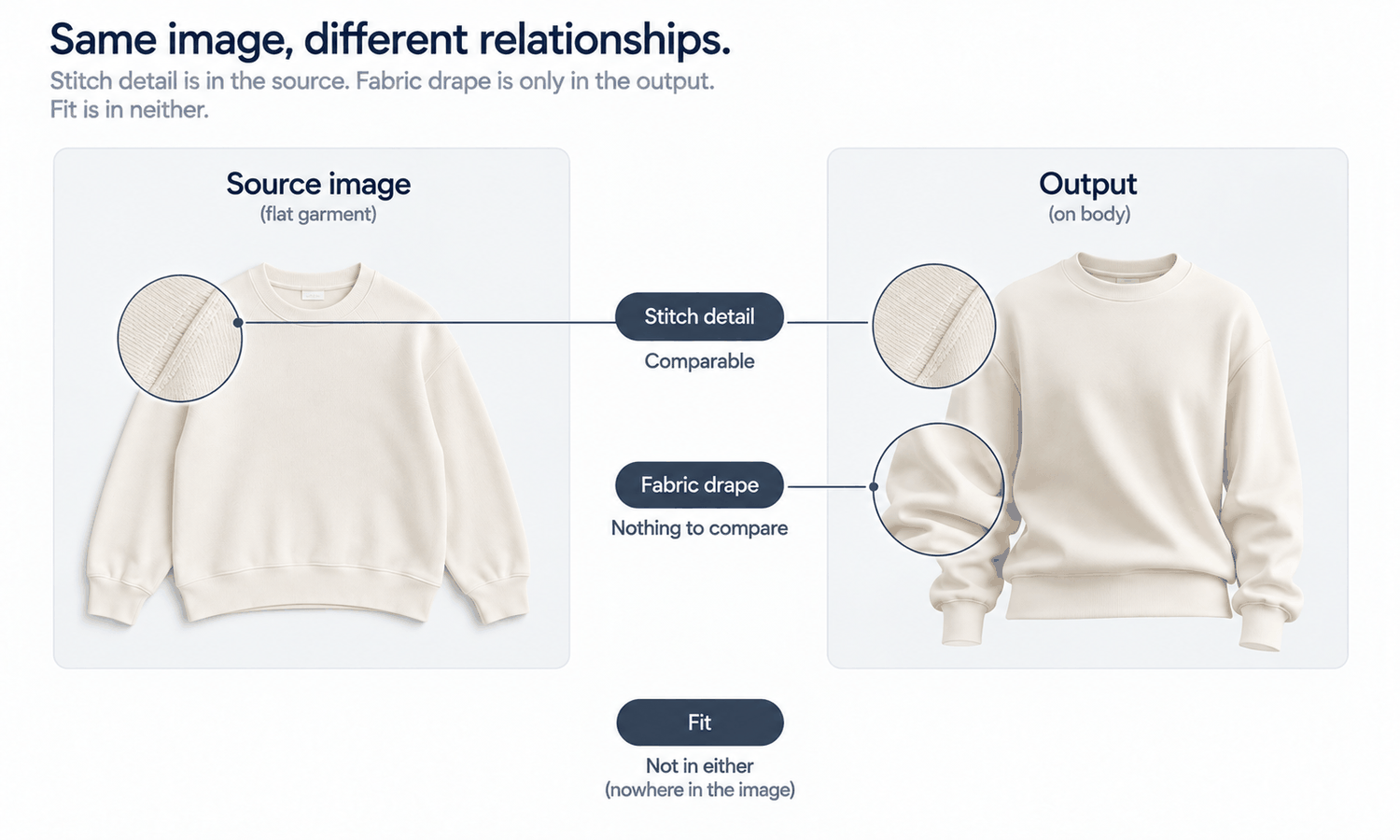
Drape, stitch detail and fit get listed together as three things a good result should hold onto. Only one of them is a preservation problem. The other two have a different relationship to the image entirely, and treating all three as the same kind of thing is why results get judged on the wrong basis.
Stitch detail exists in the source photograph and either survives into the output or does not. Drape does not survive; it is produced, because the flat garment had no drape to carry forward. And fit was never in either image, so there is nothing for it to survive as.
An ai outfit swapper working across several garments makes each of these behave differently again, which is worth taking separately.
Three words, three relationships
| Its relationship to the image | The response it calls for | |
|---|---|---|
| Stitch detail | Present in the source. It either survives into the output or it does not | Verification against the source, on every output, with a right answer |
| Drape | Absent from the source. A flat garment has none, so the fall was produced | Stability across repeated runs, plus the physical cloth for anything about behavior |
| Fit | Present in neither image. It is a relationship between measurements and a body | Route it: the measurement chart, the grade, and a fitting |
The middle column is the useful one. Preservation, production and absence call for three different responses: verification, plausibility judgment, and routing the question elsewhere.
Applying the wrong response is the common error. Judging stitch detail on whether it looks convincing, or judging drape by comparing it against the source, both produce assessments that cannot be acted on.
Stitch detail: the one that is actually preservation
This is the only one of the three where the source contains the answer and the output either matches it or does not. That makes it checkable, and checkable is a stronger property than it sounds.
Logos, printed text, care labels, and small hardware get compared against the source image on every single on-model output, without exception. Reconstructed detail lands almost right — a letterform slightly off, a stitch count wrong, a zipper pull the wrong shape — and almost right is precisely what a plausibility judgment lets through, because it is plausible.
So the response here is verification rather than assessment. Put the source next to the output and look at the same four things every time: any printed mark, any woven or stamped text, the hardware, and the stitching where it is visible. That is a comparison with a right answer, which means two people reach the same verdict and a disagreement is a finding rather than a matter of taste.
Where one element failed and the rest is sound, a targeted correction to that region restores it without producing a different image elsewhere, which matters when the piece sits in a set that has to stay aligned.
Drape: produced, not carried
A flat garment photograph contains no drape. It contains a garment lying still. Whatever fall appears in the output was produced to be consistent with that garment, which means there is nothing in the source to compare it against.
That has two consequences worth separating. The first is that drape cannot be verified in the way stitch detail can, so the honest check is stability rather than accuracy: run the same prepared source three times unchanged and see whether the fall stays the same. A result that differs each time is one where no single output should be carrying a decision.
The second is that a convincing drape is evidence about the image and not about the cloth. Two fabrics of different weight can be made to look nearly identical in a still, and they will not behave the same on a body or on a hanger. Deciding fabric direction from how a rendered fall looks is a decision made on the wrong evidence, and the right evidence is a physical hand-feel and a weight in grams.
Fit: nothing to preserve
The third word belongs to a different category, and stating that precisely is what keeps the other two honest.
The output is a visual asset. It does not predict fit, determine sizing, model how a fabric behaves in motion, or forecast returns. Those come from measurements, a graded pattern, a physical sample, and your own data. Fit is a relationship between a garment's measurements and a particular body, and neither the source photograph nor the output contains a measurement of anything.
So there is no version of a result that preserves fit well or preserves it badly. A garment can be depicted sitting in a way that reads plausibly, and that is an appearance rather than a degree of accuracy about fit. No improvement in the workflow changes that, because the quantities are absent rather than approximated.
Color belongs alongside for the same reason. Screen color is not a physical reference, exact code matching is not something to promise, and the gap between a monitor and a roll of cloth stays open regardless of display quality. Colorways get settled by strike-offs against an agreed standard.
Footwear is not covered by this class of workflow, and lace and open work, sheer fabrics, complex prints, and heavily layered looks are documented weak spots. In those categories the produced half of the problem is largest, which is why they are the categories to route to photography rather than to retry.
What changes when it is a whole outfit
Each of the three behaves differently again once several garments share a frame.
Stitch detail multiplies. A look is not one comparison against one source; it is one comparison per visible piece, against that piece's own source. The composition makes a per-garment check feel redundant, which is exactly why the third piece is the one that goes unchecked.
Drape gets harder at the overlaps, because a boundary where one garment crosses another is where the least information exists and therefore where the most is produced. Layered styling with occlusion is a documented weak spot for that reason, which is an argument for designing looks with fewer overlaps rather than for checking overlaps more carefully.
Fit compounds without becoming any more visible. Whether there is enough ease in a shirt for the jacket over it, whether layers pull, whether the proportion holds at both ends of a size range — a styled look can show that pieces read together and cannot show that they work together on a body. Those are sample and fitting questions, and an outfit image makes them feel answered without answering them.
What to ask for, and what to check
Different responses for different relationships, which is the whole of it.
-
For stitch detail, ask for the source alongside the output and verify: printed marks, text, hardware, visible stitching, on every piece in the frame
-
For drape, ask for three unchanged runs and judge stability, not accuracy, since there is no source to be accurate against
-
For fabric behavior, ask for the cloth. Weight in grams and a hand-feel decide what a rendered fall cannot
-
For fit, route the question to the measurement chart, the grade, and the fitting, and say so on the page rather than letting the image imply an answer
-
For looks, count the overlaps before generating, since each one is a boundary where production is highest and information is lowest
In Lightchain AI (apparel AI) the uploaded source stays beside every AI Virtual Try-On output derived from it, which matters most for the first item: with three garments in a frame there are three sources to verify against, and a check that requires locating three files is a check that stops happening. Across a catalog at scale that adjacency is what makes per-piece verification sustainable. Whether the work runs through Lightchain AI or a camera, the three relationships are the same three.
Frequently asked questions
Can drape ever be verified rather than judged?
Against a physical sample, yes, and that is a different exercise from checking an image against its source. Within the imagery, stability across repeated runs is the available check. Treat a convincing fall as an appearance until a sample confirms otherwise.
Why does stitch detail fail if the rest of the image is good?
Because a convincing image is produced to be consistent with the source rather than copied from it, and consistency is a looser relationship than identity. Overall quality and detail accuracy vary independently, which is the argument for checking both rather than inferring one from the other.
Does a heavier fabric render more reliably than a light one?
Neither reliably, and weight is not the useful variable. The consistent point is that a still image produces an appearance of any weight and predicts the behavior of none, so the risk is the same and the check is the same.
How many pieces can we put in one look?
Fewer than the maximum, and the limit is overlaps rather than piece count. Three garments styled with little overlap come back cleaner than three stacked, because overlaps are where production is highest.
Should we show fit information alongside these images?
Show measurements, keep any size guidance separate and labeled as derived from your own returns, and avoid wording that invites a fit conclusion from the picture. The image and the chart answer different questions and should not sit in the same sentence.
Our looks read well but customers report surprises. Where do we start?
Check the per-piece detail comparison first, since a look reading well is exactly the condition under which per-piece checks get skipped. Then check whether any fit expectation was set by the imagery rather than by the measurements.
In closing
One of the three is preserved, one is produced, and one was never present. Stitch detail is verifiable against the source and should be verified on every piece in every frame. Drape is produced, so the available check is stability rather than accuracy and the real evidence is the cloth. Fit is absent, so there is nothing to preserve and the question belongs with measurements and a fitting. Sorting them this way is what stops each being judged by the wrong standard.
Start here
Take one styled look and apply the three responses separately: verify the details on every piece against its own source, run the same sources three times to see whether the fall holds, and check that nothing on the page invites a fit conclusion. Most teams find the second piece in the frame was never compared against anything, which is the finding the exercise is for. It takes about as long as looking at the look once more would have.
**Start with the on-model workflow → **https://www.lightchainai.com/global/solutions/aiVirtualTryOn