
A lookbook is not a collection of product images. It is a set of styling decisions, presented in an order, and the difference matters the moment you try to produce one from a single source photograph.
Swapping one garment is a contained operation. Swapping a whole outfit is not, because an outfit is a set of relationships — how a top meets a waistband, which layer sits over which, how the proportion between pieces reads on a body. Those relationships were never recorded in a product shot of any individual item, which means they are decided somewhere, and if you do not decide them the system will.
A lookbook is styling decisions
Look at what distinguishes a lookbook page from a catalog page. Same garments, frequently the same model, and an entirely different job.
The catalog page shows what each item is. The lookbook shows what someone thinks you should do with them — this jacket over that dress, sleeves pushed back, the hem falling here rather than there. Every one of those is a judgment, and collectively they are the reason the book exists.
Generation can produce the images. It cannot produce the judgments, and a lookbook assembled from unspecified defaults reads exactly like what it is: coverage arranged in a grid.
Buyers notice this faster than customers do, which is the commercially relevant part. A wholesale audience is looking for a point of view, and a book that presents forty items without one invites the conclusion that the range does not have one either. The images can be technically excellent and still fail at the job the book was made for.
Whole-outfit swaps introduce relationships
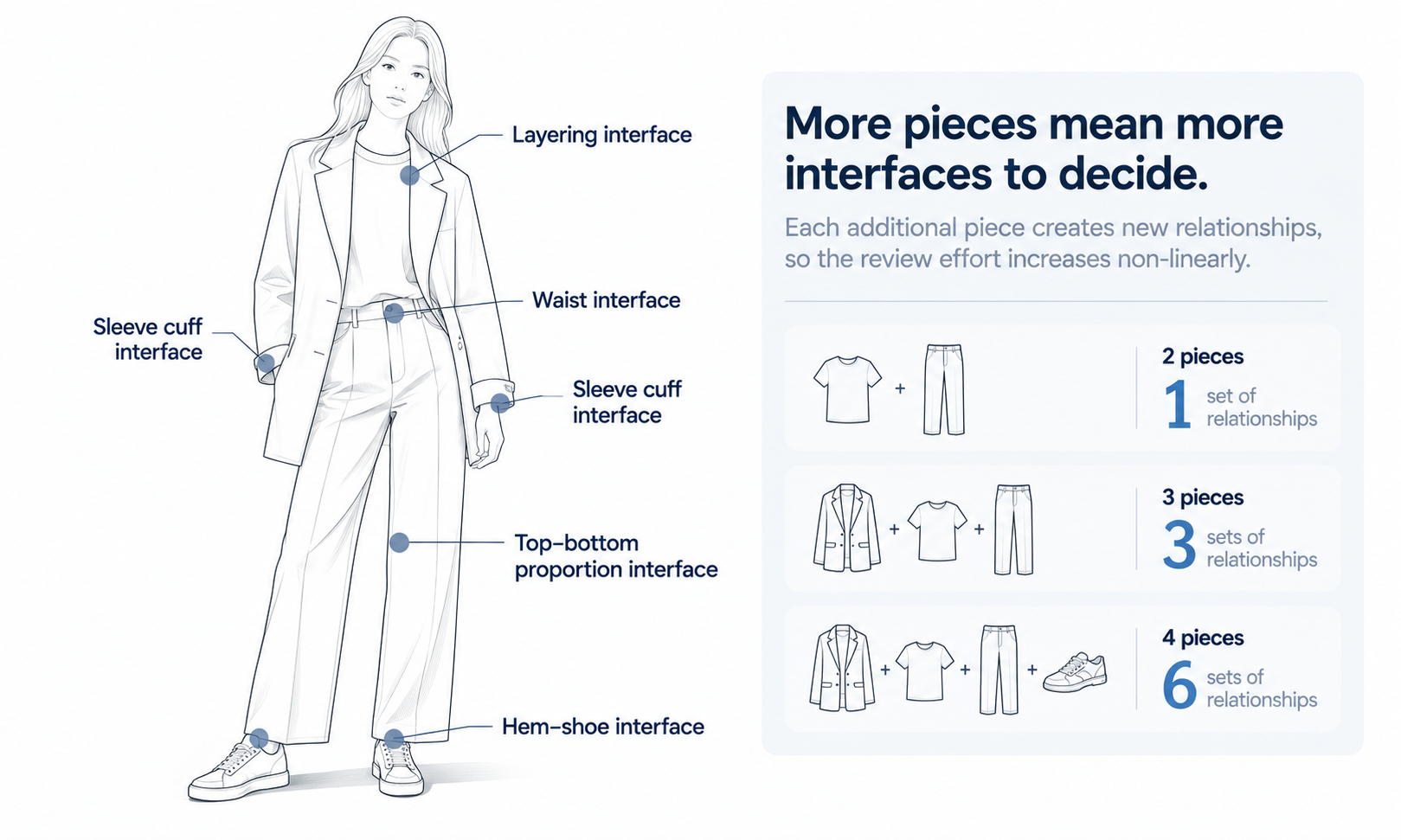
The technical shift is worth stating precisely. A single-garment swap has one interface — where the garment meets the body. A full outfit has several, and each one is a place where the system has to construct something no source photograph observed.
Where the top meets the bottom, the software decides tucked or untucked, and whether a waistband is visible. Where two layers overlap, it decides which sits over which and how much of the under-layer shows. Where volumes meet, it resolves whether a wide sleeve sits inside or over a jacket cuff.
None of those decisions came from your product shots, because a product shot of a shirt contains no information about what it does when a skirt is added.
Interfaces also multiply faster than pieces. Two garments produce one relationship; three produce three; four produce six. A team that finds two-piece looks reliable and assumes four-piece looks will be similar has misread the arithmetic, and the review time should scale accordingly rather than linearly with the number of images.
Relationship failures to expect
| Interface | What goes wrong | How to catch it |
|---|---|---|
| Waist junction | Ambiguous tuck, waistband appearing or vanishing | Look at the waist first, at viewing size |
| Layer order | Under-layer rendered over the outer piece at one edge | Check where layers cross, especially at cuffs |
| Proportion between pieces | Top-to-bottom ratio drifting from the intended styling | Compare against a reference look, not against nothing |
| Sleeve and cuff interaction | Volume conflicts resolved implausibly | Check both wrists, they often differ |
| Hem and footwear line | Trouser or skirt hem meeting shoes without a relationship | Look at the lower third as one region |
The waist junction is the highest-yield check by a distance. It is the interface with the most ambiguity and the one a viewer reads first when assessing whether a look is styled or assembled.
Wrists deserve their own mention because they are frequently inconsistent with each other in the same image, which is a tell that survives casual review and disappears under magnification.
Styling intent has to be specified
The system defaults to something when you do not say. That default is usually the most statistically ordinary resolution — tucked when in doubt, layers in the conventional order, proportions that read as neutral.
Neutral is the opposite of what a lookbook is for. If your styling point is an oversized shirt worn open over a slip dress with the sleeves down, that has to be stated, because nothing in either product shot implies it.
Write the styling note before generating rather than correcting afterward. Three or four short statements per look — what goes over what, tucked or not, sleeve treatment, where the proportion should sit — take a minute to write and remove most of the retry loop.
This is also the point where a stylist's contribution enters the workflow rather than being replaced by it. The decisions are the value; the rendering is the commodity.
Worth saying that to the stylist directly, since the arrival of this technology in a studio is frequently read as a threat. The practical change is that styling gets written down before the fact instead of performed on the day, which is a different working method and the same expertise. Teams that make the shift explicitly get better notes and less resistance.
Build looks, not images
Sequence the work around looks and the whole process becomes more tractable.
Define the looks first, on paper, as styling combinations. Approve one image per look as an anchor, checked at the interfaces above. Then generate the variations within each look — angles, crops, colorway substitutions — from the approved anchor rather than starting fresh.
That order keeps the styling judgment in one place and prevents the common failure where a lookbook's tenth page is subtly styled differently from its second because nobody was tracking the decisions.
Keep the styling notes with the assets rather than in a separate document. Six months later, when a look needs extending for a new channel or a carryover style, the note is what makes the extension match — and a note filed anywhere other than beside the images will not be found. For how the finished set moves into campaign and channel use, see production and marketing.
What a single product shot cannot supply
The honest limit on the premise in the title.
One product shot supplies one garment, observed from one angle, in one state. A full lookbook needs several garments and their relationships, which means either several product shots or a set of styling decisions filling the gaps. It is not that a lookbook cannot be built from limited sources — it can — but the missing information is supplied by inference rather than by observation, and inference is where variance lives.
A useful rule: the more garments in a look, the more you should specify and the more closely you should check, because interfaces multiply faster than garments do. The AI Virtual Try-On module in Lightchain AI (apparel AI) handles the swap itself from an existing product photo — see AI virtual try-on — and the styling remains yours to determine.
The boundary, stated plainly
The output is a visual asset. It does not predict fit, determine sizing, model how a fabric behaves in motion, or forecast returns. Those come from measurements, a graded pattern, a physical sample, and your own data.
For outfits specifically, one addition matters. A generated look showing a jacket sitting comfortably over a knit does not establish that the two garments work together physically at that size. Layering tolerance is a fit question and it stays a fit question, which is worth saying explicitly whenever a lookbook doubles as a wholesale selling tool and a buyer starts planning multi-piece purchases from it.
Questions apparel teams ask
Can we really build a lookbook from one shot? You can build lookbook coverage from limited sources, and the styling decisions still have to come from a person. What a single shot cannot supply is the relationships between garments, and those are what a lookbook is made of.
What is the most common failure in outfit swaps? The waist junction — an ambiguous tuck, or a waistband that appears or disappears. Check it first and at viewing size, since it is where a viewer decides whether a look reads as styled.
Why do the two wrists sometimes look different? Because each cuff interface is resolved separately and neither was observed in the source. Check both, since inconsistency between them is a tell that survives a fast review.
How detailed should a styling note be? Three or four short statements per look, covering layer order, tuck, sleeve treatment and proportion. That is enough to prevent the system defaulting to a neutral interpretation.
Does this replace a stylist? No, it relocates their work. The decisions remain the valuable part and now get expressed as written instructions rather than executed on set.
How should the set be reviewed? By look rather than by image, at the interfaces, and then as a sequence. A lookbook fails as a sequence more often than it fails as individual pages.
What the single shot actually gets you
Coverage, quickly, and nothing else. The relationships between garments are constructed rather than observed, which means a lookbook produced this way is only as good as the styling decisions written down before generation. Specify layer order, tuck and proportion for every look, approve one anchor per look, check the waist junction and both wrists first, and review the book as a sequence. Done that way, a single product shot goes a long way. Left unspecified, it produces a neutral interpretation of your collection, which is a catalog with better lighting.
Write a four-line styling note before you generate anything.
**For each look, state what goes over what, tucked or untucked, how the sleeves sit, and where the proportion should fall. Then approve one anchor image per look and check the waist junction and both cuffs at viewing size before expanding the batch. A minute of writing per look removes most of the retries and all of the neutral defaults. → **AI virtual try-on
About the author
[REPLACE — real person's name, role, relevant experience, LinkedIn URL. No team byline.]