
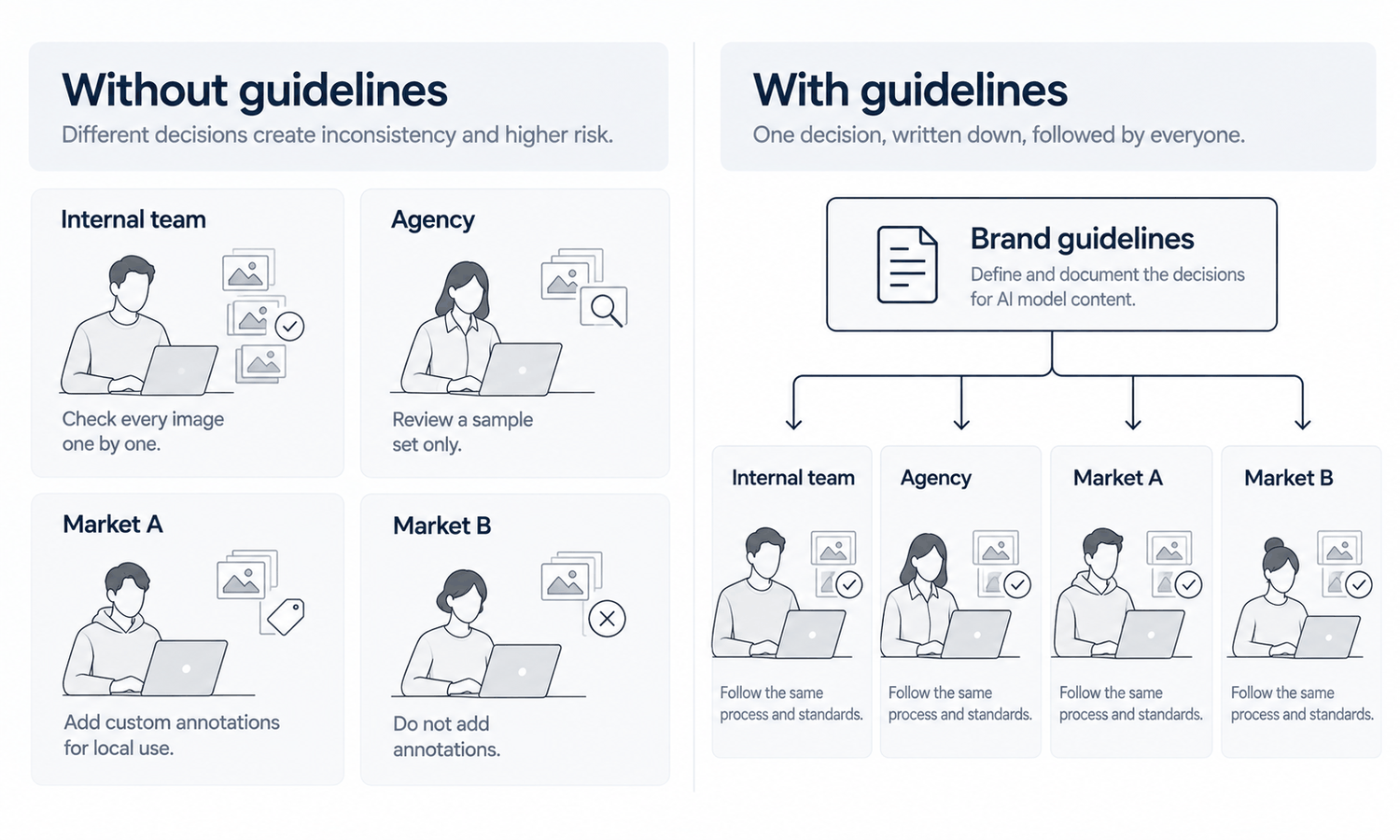
AI model fashion imagery brings a kind of risk that has little to do with how good the pictures look. A garment shown slightly differently from the one that ships. A generated face that resembles someone real. An image labeled as AI-generated in one channel and not in another. An agency that follows different rules from the in-house team. None of these is dramatic on its own, and most of them happen because nobody decided in advance how the brand would handle them.
A written guideline is how a brand makes those decisions once, instead of leaving them to whoever produces the next image. It turns scattered good intentions into consistent practice across teams, agencies and markets, and it gives everyone a clear answer when a question comes up.
This article explains what an AI model imagery guideline should cover and how to make it work: accuracy, people, disclosure and terms, and the ownership, approvals and records that hold it together. It is not legal advice. Laws and platform rules differ by market and change over time, and the guideline should record how the brand applies the advice it receives from the people responsible for compliance.
| Guideline area | What it decides | Who usually owns it |
|---|---|---|
| Accuracy | What an image may claim about the product | Product and content leads |
| People | How generated and real people may be depicted | Brand and talent management |
| Disclosure | When and how AI-generated imagery is labeled | Brand, with compliance input |
| Terms | Which tools may be used and on what terms | Legal or procurement |
| Approval and records | Who signs off and what is kept | Content operations |
| Suppliers and agencies | How outside producers follow the same rules | Whoever manages those contracts |
Why Brand Risk Needs a Written Guideline
Most brand risk from AI model imagery comes from inconsistency rather than from any single bad decision. One producer checks every image against its garment source; another checks a few. One market labels generated imagery; another does not. An agency generates its own models; the in-house team uses the brand's library. Each choice might be defensible. Together they leave the brand unable to say what its practice actually is.
Unwritten practice also depends on memory. The person who knew why a model was retired, or which images were only concepts, moves on, and the knowledge goes with them. When a customer, a platform or a journalist asks a question, the brand has to reconstruct its answer.
A guideline fixes this by deciding once and writing it down. It does not need to be long. A few pages that name the rules, the owners and the records are enough, provided they are followed and kept current.
Accuracy: What an Image May Claim
The first job of the guideline is to protect shoppers from being misled about the product. Generated imagery makes certain misrepresentations easy, so the rules should name them directly.
-
The garment must match the product. Every image is checked against its garment source for construction, logos, printed text, trims, hardware and print placement, without exception. Reconstructed detail tends to come back almost right, and sampling misses errors that repeat across images made the same way.
-
No size-worn captions on generated models. A caption such as "model wears size S" records a fact about a real person. A generated model did not wear the garment in any size, so such captions are not used.
-
Images show appearance, not fit. A model's size or build in an image is a visual choice. Size guidance comes from the size chart and measurements, not from how a garment looks on a generated body.
-
Color is judged physically. Screen color is not a physical reference, and color values are not read from images and published as product attributes. The colorway is settled by the lab dip or approved sample.
-
Concepts are labeled as concepts. Images of garments that have not yet been made, such as sketch-to-photo results or range review images, are labeled as concepts wherever they appear outside the design team and never used as product listings.
The guideline should also name the styles that go to photography. Complex prints, lace and openwork, sheer fabrics and layered styling are current weak areas for generated imagery. Writing that down prevents a producer from regenerating until something merely looks acceptable.
People: Likeness and Representation
The second job is to set rules for how people are depicted, both generated and real.
For generated models, the core rule is that a generated face must not closely resemble a real, identifiable person. Before a model is approved, someone looks at the face as a stranger would, and the check is recorded with a date. Producers never ask a tool to reproduce a particular real person's likeness. If the brand wants a continuing face tied to a real person, that is a digital double, and it starts with an agreement with that person, not with a generation request.
For real people, the rules cover images that start from photographs. Replacing the face in a photograph of a real model does not always remove that person from the image; their body, pose and distinctive features may remain. The guideline should require that the original model's agreement is checked before any such image is made, and it should name who checks.
Representation belongs here too. Generated models make it easy to show a range of ages and builds, and the guideline should say how the brand plans that range across its catalog. It should also say what the brand does not do: attribute settings are described neutrally, and no image or caption suggests that a body or age is better suited to a garment than another.
Disclosure and Terms
The third job is to decide how the brand labels generated imagery and which tools it may use.
For disclosure, the guideline sets the brand's default and the process for local rules. A brand may decide to label all AI-generated model imagery, or to label where rules or platforms require it. Either way, the default is written down and applied consistently, and the people responsible for compliance confirm what each market and platform expects. Record the decision for each market, because expectations change and the record shows what applied when.
For terms, the guideline lists the tools the brand has approved and records what their current terms say about three things: commercial use of outputs, how uploaded images are stored and used, and who holds rights in what is produced. Terms change, so each entry carries the date it was checked. A tool that has not been checked is not used for customer-facing images.
The same rules bind outside producers. Agencies, freelancers and suppliers who produce imagery for the brand follow the brand's guideline, use its approved tools and models, and return the records the guideline requires with their work. Put that in the contract rather than relying on goodwill.
Making the Guideline Work
A guideline that nobody owns becomes a document nobody reads. Name an owner for each area in the table above, and one person responsible for the guideline as a whole.
Build the rules into the workflow rather than around it. Approval happens at defined points: a model before its first use, an image before publication and a new tool before its first customer-facing output. Records are kept at the moment they are easiest to capture: a model record when a model is created, an image record when an image is produced and an approval log when something is signed off. Those records are what let the brand answer questions quickly and find every image affected when something goes wrong.
Train the people who produce images, including outside producers, and review the guideline on a schedule, such as each season, and whenever a market, a platform rule or a tool's terms change.
In Lightchain AI (apparel AI), several of the guideline's needs are supported directly.
-
An AI Compliance Mark watermark control lets teams label generated images where their disclosure policy calls for it.
-
AI Virtual Try-On puts the brand's actual garments on models from flat-lays, including on saved model sets, which supports the accuracy rules and keeps one product on one approved model.
-
Personal and enterprise libraries give a team a shared place for approved models and garment sources, alongside the records the guideline requires.
For brands producing on-model imagery across many styles and markets, Scale E-commerce is the Lightchain AI solution built for that work. As with any tool, check its current terms against your guideline before approving it.
Frequently Asked Questions
Why does a brand need an AI model imagery guideline?
Because most risk comes from inconsistency: different teams, agencies and markets making different choices. A written guideline decides once, names owners and makes the brand's practice clear when questions arise.
What should the guideline say about product accuracy?
That every image matches its garment source, generated models carry no size-worn captions, images do not stand in for fit, color is judged physically and concept images are labeled as concepts. It should also name the styles that go to photography.
How should a brand handle likeness?
Check every generated face for close resemblance to a real, identifiable person before approval, record the check and never ask a tool to reproduce a real person's likeness. A face tied to a real person requires that person's agreement.
Should all AI-generated model images be labeled?
The guideline should set a default and apply it consistently, with the people responsible for compliance confirming what each market and platform requires. Record the decision for each market, because expectations change.
Is this guideline a substitute for legal advice?
No. It records how the brand applies the advice it receives. Laws and platform rules differ by market, so the people responsible for compliance should review the guideline.
Do agencies and suppliers have to follow the guideline?
Yes, if they produce imagery for the brand. Put the requirement in their contracts, including approved tools, approved models and the records they must return.
How does Lightchain AI support a brand's guideline?
It provides an AI Compliance Mark watermark control for labeling, puts actual garments on saved models from flat-lays and offers shared libraries for approved models and sources. Scale E-commerce is the solution to use for producing that imagery across many styles, with its current terms checked against your guideline like any other tool.
In Closing
The risk in AI model fashion imagery rarely comes from one bad image. It comes from many small choices made differently by different people. A short written guideline covering accuracy, people, disclosure, terms, approvals and records turns those choices into one consistent practice. Keep it owned, build it into the workflow, bind outside producers to it and review it as markets, platforms and tools change. It will not replace legal advice, but it will make sure the brand can explain, image by image, what it did and why.
Start Here
If your brand produces on-model imagery with AI models and wants that work to follow one consistent guideline, Scale E-commerce is the solution to use. It is built for producing on-model imagery across many styles and markets: you put your actual garments on approved models from flat-lays, keep those models in shared libraries and label generated images where your policy requires. Start by writing the guideline, check the tool's current terms against it, and then bring production into line.
**Explore Scale E-commerce → **https://www.lightchainai.com/global/solutions/scaleECommerce