
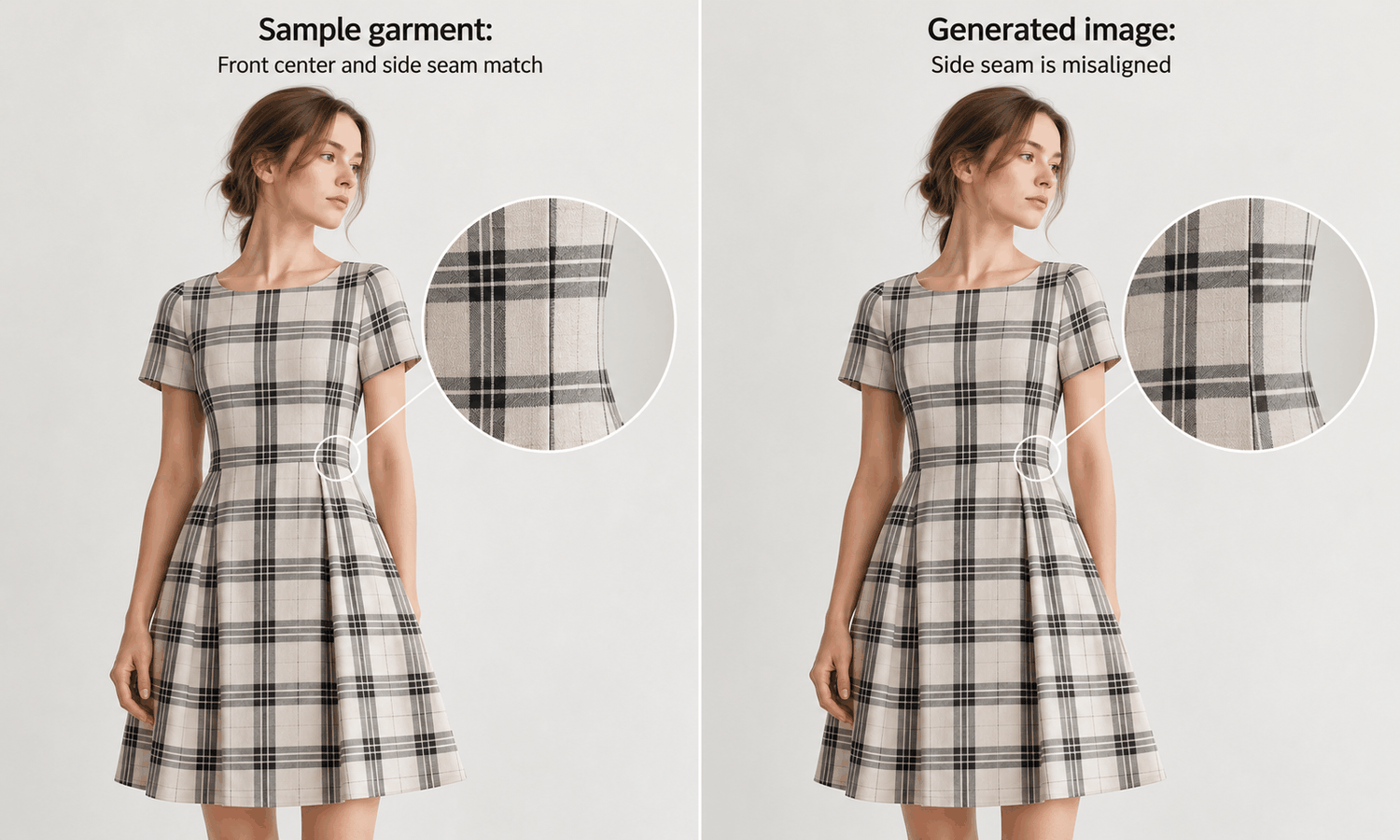
AI dresses in stripes, plaids and repeating prints raise a problem that plain dresses never do: the pattern has to meet itself across the seams. In a well-made garment, a stripe continues from the bodice into the skirt, a plaid lines up across the center front and a floral repeat flows over the side seam without a jarring break. Garment makers call this matching, and it takes care and extra fabric to achieve. It is one of the details that separates a carefully made dress from a hurried one.
Generated images do not know about matching. When a patterned dress is placed on a model, the pattern is reconstructed across the body, and at every seam the image has to decide where the stripe or check continues. It may line up a pattern that the real dress does not match, or break a pattern that the real dress matches perfectly. Either way, the image shows something different from the garment the customer will receive.
This article explains what pattern matching is, why dresses make it harder, how generated images handle it, what to check in every patterned dress image and how to handle patterned styles in practice.
| Pattern | Where it should meet | What a generated image may do | What to check |
|---|---|---|---|
| Horizontal stripes | Across side seams and the waist seam | Shift stripes up or down at the seam | Stripes continue level across seams |
| Vertical stripes | At center front, darts and panel seams | Bend, narrow or break stripes | Stripe spacing and alignment at seams |
| Plaids and checks | Center front, side seams, pockets, collars | Misalign the check or change its scale | Check lines meet across seams and pockets |
| Large prints and florals | Across seams and at center front | Continue the print where the real dress breaks it, or the reverse | Motif placement against the sample |
| Directional prints | Across all panels | Flip or rotate the direction | Motifs point the same way as the sample |
What Pattern Matching Is
A dress is made from several pieces of fabric sewn together: bodice pieces, skirt panels, sleeves, sometimes a waistband and pockets. Each piece is cut from a patterned fabric. Whether the pattern lines up where the pieces meet depends on how the pieces were placed on the fabric before cutting.
When a maker matches the pattern, the pieces are laid out so that stripes run continuously across seams, checks meet at the center front, and a pocket or yoke disappears into the fabric around it. Matching uses more fabric and more cutting time, so it is a decision about quality and cost. Many garments match at the most visible points, such as the center front and side seams, and accept breaks where they are less noticeable.
Some designs break the pattern deliberately. A bias-cut skirt on a striped fabric creates chevrons at the seams. A yoke cut on a different grain makes a contrast panel. These breaks are part of the design, and they need to appear exactly as designed.
So for any patterned dress, there is a specific answer to the question of how the pattern behaves at each seam. That answer is part of the product.
Why Dresses Make It Harder
Dresses have more places where a pattern meets itself than most garments. A fitted dress may have a waist seam, princess seams through the bodice, side seams, a center-back seam with a zip, darts at the bust and several skirt panels. Each is a place where the pattern either continues or breaks.
Dresses also show their pattern over a large area. A shirt's check is interrupted by a collar and a placket; a dress's check runs from shoulder to hem. Any misalignment is on display across the whole length of the garment.
Fabric quantity adds another layer. Matching a large check or a wide stripe across a dress can take noticeably more fabric than cutting the same dress in a plain fabric, so production teams sometimes simplify the matching when they move from sample to bulk. A dress that was matched carefully as a sample may be matched only at the center front in production. The image should reflect the dress the customer will receive, which is one more reason to check the production piece against the images when it arrives.
And dresses often move. A full skirt's folds carry the pattern with them, so the stripe or check bends through each fold. In the real garment, the pattern follows the fabric; in a generated image, the pattern is redrawn to look plausible across folds that were themselves rendered, not calculated.
How Generated Images Handle Matching
When a patterned dress is placed on a model, the image reconstructs both the garment's shape and its pattern. It follows the source photo where it can, but at seams, folds and edges it has to decide how the pattern continues.
Those decisions are made to look plausible, not to reproduce the real garment. The image may align stripes neatly across a side seam that the real dress breaks, which flatters the garment and misrepresents it. It may break a check at the center front that the real dress matches carefully, which makes a well-made dress look carelessly cut. It may also change the pattern's scale, making checks larger or smaller, or rotate a directional print so that motifs point the wrong way on one panel.
Large, complex prints are the hardest, because the image has to continue an intricate motif across a seam while redrawing it on a curved body. That is part of why complex prints remain a current weak area for generated imagery. Regular stripes and simple checks come through more reliably, but they are also where misalignment is most visible, because the eye expects straight, even lines.
What to Check in AI Dresses With Patterns
Checking a patterned dress means comparing its seams, not only its overall look, against the sample.
Start with the most visible points: the center front, the side seams at the waist and any seam that crosses the bust. Do stripes continue level? Do check lines meet? Do motifs sit where they sit on the sample?
Then check the details: pockets, yokes, cuffs and collars. On a matched dress, these often disappear into the surrounding pattern; on an unmatched one, they stand out. Whatever the sample does, the image should do the same.
Check scale and direction. Compare the size of the stripes or checks with the sample, and make sure directional prints point the same way on every panel.
Check deliberate breaks. If the design uses chevrons or a contrast grain, confirm they appear as designed rather than being smoothed into continuous lines.
Do this for every image, without exception, and at full size. Pattern errors at seams are easy to miss in a thumbnail and obvious when a shopper zooms in. Images made from the same source and settings tend to repeat the same error, so a clean sample does not clear the rest.
Keep the other limits in view. Screen color is not a physical reference, so the pattern's colors are judged against the fabric. The drape in the image is rendered, not calculated, so how the pattern moves through folds is a suggestion rather than a record.
Showing Patterned Dresses in Practice
The most reliable source for a patterned dress is a clear photograph of the sewn sample, not a fabric swatch or a sketch. The sample shows how the maker actually matched or broke the pattern, and that is what the image needs to carry through. Photograph it as a flat-lay, evenly lit, with close-ups of the center front, side seams, pockets and any deliberate breaks.
For complex prints and for dresses where matching is a selling point, photography of the finished dress on a model is often the better choice. For stripes and simple checks, generated images can work well, provided every seam is checked.
In Lightchain AI (apparel AI), patterned dresses follow the garment source.
-
AI Virtual Try-On places the dress on a model directly from the sample's flat-lay, including on a saved model set, so the image starts from the real matching.
-
When a seam comes out misaligned in an otherwise good image, the area can be corrected locally, as described on the Partial Redraw page, and checked against the sample again.
For brands showing patterned dresses on models, AI Virtual Try-On is the Lightchain AI solution built around starting from the garment.
Frequently Asked Questions
Why do AI dresses in stripes or plaids sometimes look wrong at the seams?
Because the image reconstructs the pattern across the body and decides at each seam how it continues. It may align a pattern the real dress breaks or break one the real dress matches, so the image differs from the garment.
What is pattern matching in a dress?
Laying out the pattern pieces before cutting so stripes, checks or prints continue across seams, pockets and yokes. It takes more fabric and time, so makers decide where to match and where to accept breaks.
Which patterns are hardest for generated images?
Large, complex prints are hardest, and complex prints remain a current weak area. Regular stripes and checks come through more reliably but show misalignment most clearly.
What should be checked in a patterned dress image?
The center front, side seams, waist seam, pockets, yokes, cuffs and collars against the sample, plus the pattern's scale and direction and any deliberate breaks. Check every image at full size.
What source should a patterned dress image start from?
A flat-lay photograph of the sewn sample, with close-ups of the key seams. A fabric swatch or sketch does not show how the pattern was matched.
When should patterned dresses be photographed instead?
When the print is complex or when careful matching is a selling point. A photograph shows the real matching exactly.
How does Lightchain AI handle patterned dresses?
AI Virtual Try-On places the dress on a model from the sample's flat-lay, so the image starts from the real matching, and a misaligned seam can be corrected locally. AI Virtual Try-On is the solution to use for patterned dresses that suit generated images.
In Closing
AI dresses in stripes, plaids and prints have to get something right that plain dresses never face: how the pattern meets itself at every seam. Real dresses match or break their patterns by design, and generated images reconstruct those decisions to look plausible rather than true. Start from a flat-lay of the sewn sample, check the center front, side seams, pockets and deliberate breaks at full size in every image, and photograph complex prints and dresses where matching is the point.
Start Here
If you sell patterned dresses and want on-model images that show the pattern exactly as the dress is made, AI Virtual Try-On is the solution to use. It is built around starting from the garment: you photograph the sewn sample as a flat-lay, place it on your saved model and check every seam against the sample. Start with one striped or checked style, and compare its seams side by side with the sample.
**Explore AI Virtual Try-On → **https://www.lightchainai.com/global/solutions/aiVirtualTryOn