
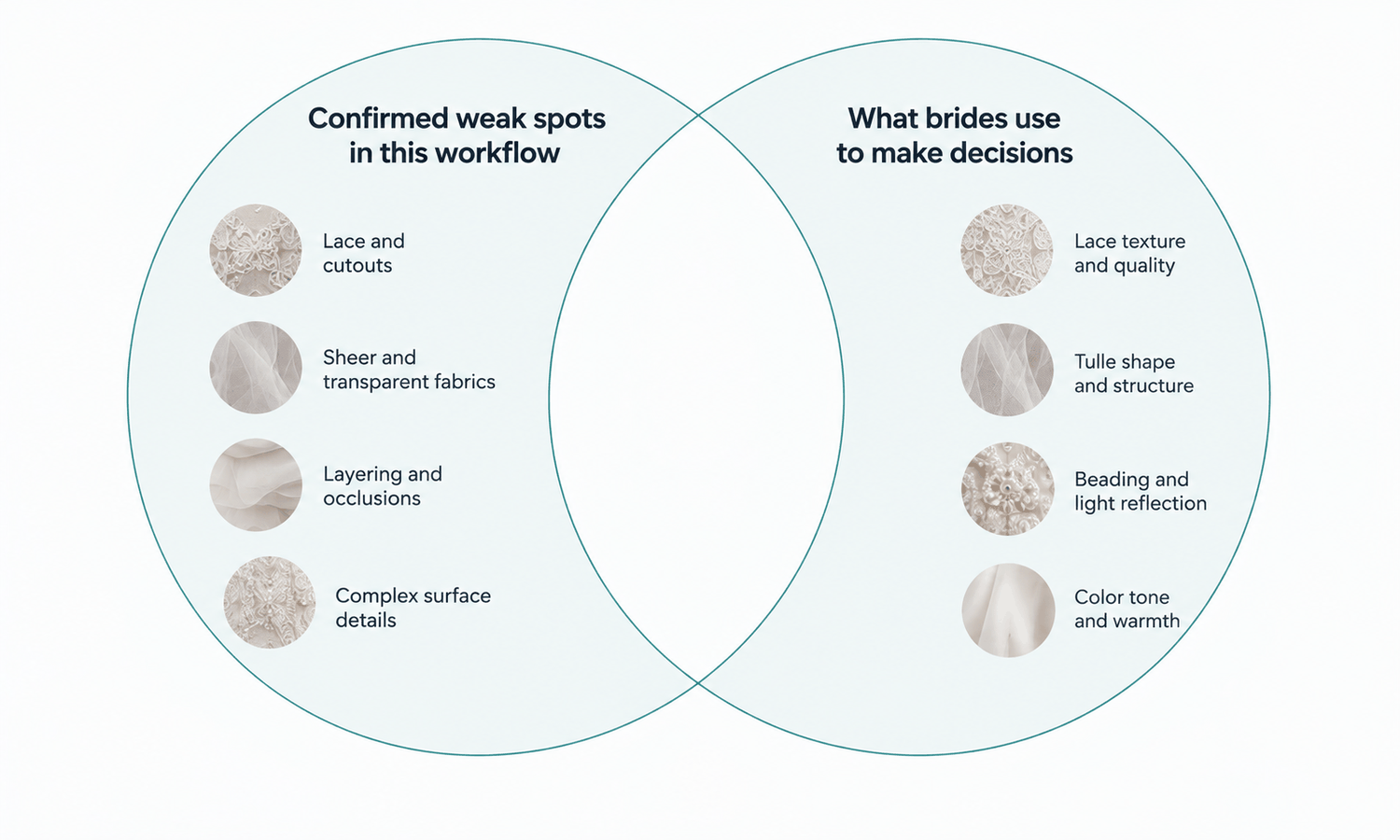
Most advice about adopting generated imagery says the same thing: use it where it works, route the difficult categories to photography, and get on with it. That advice assumes the difficult categories are a minority of the range.
In bridal and occasionwear they are the range. Lace, tulle, sheer overlay, beading, embroidery, and the difference between ivory and champagne are simultaneously the things this class of workflow handles least reliably and the things a customer is actually deciding on. The usual split does not survive contact with the category, because there is not much left over once the difficult part is removed.
That does not make dress try on useless here. It makes the question narrower and more specific: what is it for in a business where the gown itself is the hardest thing in the catalog.
The weak spots and the decision criteria are the same list
Layered styling with occlusion, sheer and transparent fabrics, lace and open work, and complex surface detail are documented weak spots for this kind of generation. Read that list next to what a bride is choosing between and the overlap is close to total.
She is deciding whether the lace reads as delicate or heavy, how the tulle sits, whether the beading catches light, and whether the shade sits warm or cool against her skin. Every one of those is a judgment about surface and material behavior at close range, which is where reconstruction is weakest and where the difference between almost right and right is the entire decision.
This is worth saying plainly rather than working around. A workflow that produces convincing plain jersey and unreliable beaded tulle is a workflow whose strong suit is not what a bridal brand sells.
Where it does earn its place
| Use | What it is for | The condition attached |
|---|---|---|
| Silhouette and fabric exploration before a sample exists | Narrowing a long list of directions before committing to cloth and an atelier slot | Internal only. Every surviving direction still gets sampled |
| Colorway direction | Deciding which shade families are worth ordering swatches in | A shortlist, never a shade. Physical swatches decide |
| Styling, channel, and format variants of a gown already photographed | Producing the versions a campaign or a marketplace needs from one shoot | The gown itself unaltered, and every detail checked against the source photograph |
| On-model variants of a photographed gown | Showing an existing gown on more than one model without a second shoot | Says nothing about how that gown fits anyone. Presentation must not imply it does |
| A photograph of the gown a customer is choosing between | Not this. The surface and the shade are the decision | Photography of the actual gown, with no exception for a convincing render |
The pattern across those rows is that the value sits before the gown exists or after it has been photographed, and not in the middle. Nothing in the table proposes replacing a photograph of the actual dress, and nothing proposes putting a generated image in front of a bride as the basis for choosing a gown.
Internal exploration is the strongest of them. Deciding colorway and fabric direction before committing to a sample matters more in this category than in most, because a bridal sample is expensive, slow, and made from cloth ordered at a minimum. Narrowing eight ideas to two before that commitment is a real gain, and the two survivors still get sampled. Whether that narrowing happens in Lightchain AI (apparel AI) or on a mood board, the gain is in what does not get sampled rather than in what does.
The shade question is the category, and a screen cannot hold it
Ivory, champagne, blush, oyster, and pearl are not decorative distinctions in this business. They are the decision, they interact with skin tone and venue light, and a bride will look at them side by side under three different lights before choosing.
Screen color is not a physical reference, exact code matching is not something to promise, and the gap between a monitor and a roll of cloth stays open regardless of display quality. Colorways get settled by strike-offs against an agreed standard, and values must never be read off a generated asset and sent onward as a shade. A generated image can narrow which shade family to sample. It cannot be the shade.
The practical consequence for a bridal brand is that physical swatch cards do not become optional, and any customer-facing use of generated imagery has to be structured so that nobody could reasonably read a shade decision out of it. That is a design constraint on how the images are presented rather than a caveat in small print.
Bridal shape comes from structure, not from drape
A jersey dress takes its shape from how the cloth falls. A bridal gown frequently does not: the silhouette comes from boning, a built foundation, horsehair braid, layered tulle, and a train constructed to hang a particular way. The volume you see is a made thing.
Generated output shows an appearance of that volume without any of the construction that produces it, which has a specific consequence for anyone using the image as a brief. A render cannot tell an atelier whether a shape is achieved with a corseted foundation or with layers, and those are different garments at different costs. Converting an approved look into a line drawing or tech-sheet draft in the Design & Production Workbench forces those decisions to become explicit, and those outputs remain drafts that a technical designer has to review.
The same applies to the lines in a render. A darker line down a bodice could be a seam, a boning channel, a fold, or shading, and all four render identically. In a category where the bodice is the engineering, that ambiguity is not a small matter.
What it cannot do, and why that matters more here
The output is a visual asset. It does not predict fit, determine sizing, model how a fabric behaves in motion, or forecast returns. Those come from measurements, a graded pattern, a physical sample, and your own data.
Every one of those lands harder in this category. Fit in bridal is not a size selection; it is a sequence of fittings against a body over months, with alterations planned into the process from the start. No image participates in that, and an image that seems to is more dangerous here than in a category where a customer can simply send something back. Where a gown is made to order, the usual correction mechanism may not exist at all.
Motion matters too, and cannot be shown. How a train moves, how a skirt behaves through a first dance, how a veil sits — these are physical behaviors observed on a body in a room. There is no simulation in this workflow: nothing builds geometry or predicts material behavior, so the movement implied by a still is rendered rather than computed. Existing 3D assets can be converted into flat garment images that enter the workflow as inputs, which is a different thing from producing or simulating 3D.
One rule holds without exception and carries more weight at this price point. Logos, printed text, labels, and small hardware get compared against the source image on every single output. Reconstructed detail lands almost right — a letterform slightly off, a bead count wrong, a clasp the wrong shape — and a customer paying for a gown inspects it more closely than any reviewer will.
Write the line down, by use rather than by style
The workable position for a bridal or occasionwear brand is a short written policy, decided once, that separates uses rather than garments.
-
Internal exploration before a sample exists: generated imagery is appropriate, and every survivor still gets sampled
-
Construction briefing: only via a line drawing with structural lines marked, never from a styled render alone
-
Customer-facing gown imagery: photography of the actual gown, because the surface and the shade are the decision
-
Styling, channel, and format variants of an already-photographed gown: appropriate, provided the gown itself is unaltered and the details are checked against the source
-
Shade selection at any stage: physical swatches against an agreed standard, with no exception for a convincing screen
In Lightchain AI (apparel AI) the uploaded source stays beside the on-model outputs derived from it in AI Virtual Try-On, which is what makes the fourth row auditable rather than assumed. A variant is only safe if somebody can show which photograph it came from.
Written this way, the policy survives a busy season. Written as a general enthusiasm or a general prohibition, it gets relitigated by whoever is under the most pressure in the week before a trunk show.
Frequently asked questions
Can we show a bride how a gown might look in a different shade?
As a shortlist of families to try physically, with the swatches in the appointment, and never as the shade itself. The risk is not that she is misled about a color name; it is that she forms an expectation from a screen and meets a different cloth at the fitting. Structure the presentation so a shade decision cannot be read out of it.
What about occasionwear that is simpler than bridal?
Plain-surface occasionwear in stable fabrics behaves like the rest of apparel and can be treated that way. The category boundary is the fabric and surface rather than the occasion, so a smooth crepe column and a beaded gown belong in different rows of your policy. Sort by material, not by department.
Is generated imagery useful for made-to-measure at all?
Before the sample, yes, for narrowing silhouette and fabric direction. During the process, no, since everything after that point is measurement, toile, and fitting. Being explicit about that boundary protects the client relationship, which in this category is the asset.
Could we use it to show a gown on different body types?
An on-model variant of an actual photographed gown is a reasonable use, provided the gown is unaltered and the details survive the comparison against the source. What it cannot do is tell anybody how that gown will fit that body, and any presentation implying otherwise creates an expectation the fitting will have to correct.
Our lace never comes back right. Is that fixable?
Lace and open work are documented weak spots, so treat it as a category verdict rather than a prompt problem and route it to photography. Keep the test images so a retest after a product update is a comparison rather than a fresh opinion. Retesting an unchanged setup on a schedule returns the same answer at a cost.
How do we explain this internally when the results look impressive?
Show the output next to the physical gown rather than next to the previous output, since impressiveness is measured against expectation and accuracy is measured against cloth. The comparison that matters is the one a customer will make in a fitting room. That framing settles most internal arguments in a few minutes.
In closing
Bridal is the category where the standard adoption advice inverts. The difficult categories are not a minority to route around; they are the product. So the useful position is narrow and defensible: generated imagery earns its place before a sample exists and after a gown has been photographed, and not in the space between, where the surface, the shade, and the structure are what the customer is deciding on. Write that as a policy by use rather than by style, keep physical swatches non-negotiable, and the workflow becomes an asset instead of a liability at the fitting.
Start here
Take your current season and sort it by surface rather than by silhouette: smooth and stable in one column, lace, tulle, beading, and sheer overlay in the other. The first column can be treated like the rest of apparel. The second is photography, and knowing that before somebody tries is worth more than any test. Then write the five use rows above onto a single page and put a name against each one.
**Start with the on-model workflow → **https://www.lightchainai.com/global/solutions/aiVirtualTryOn