
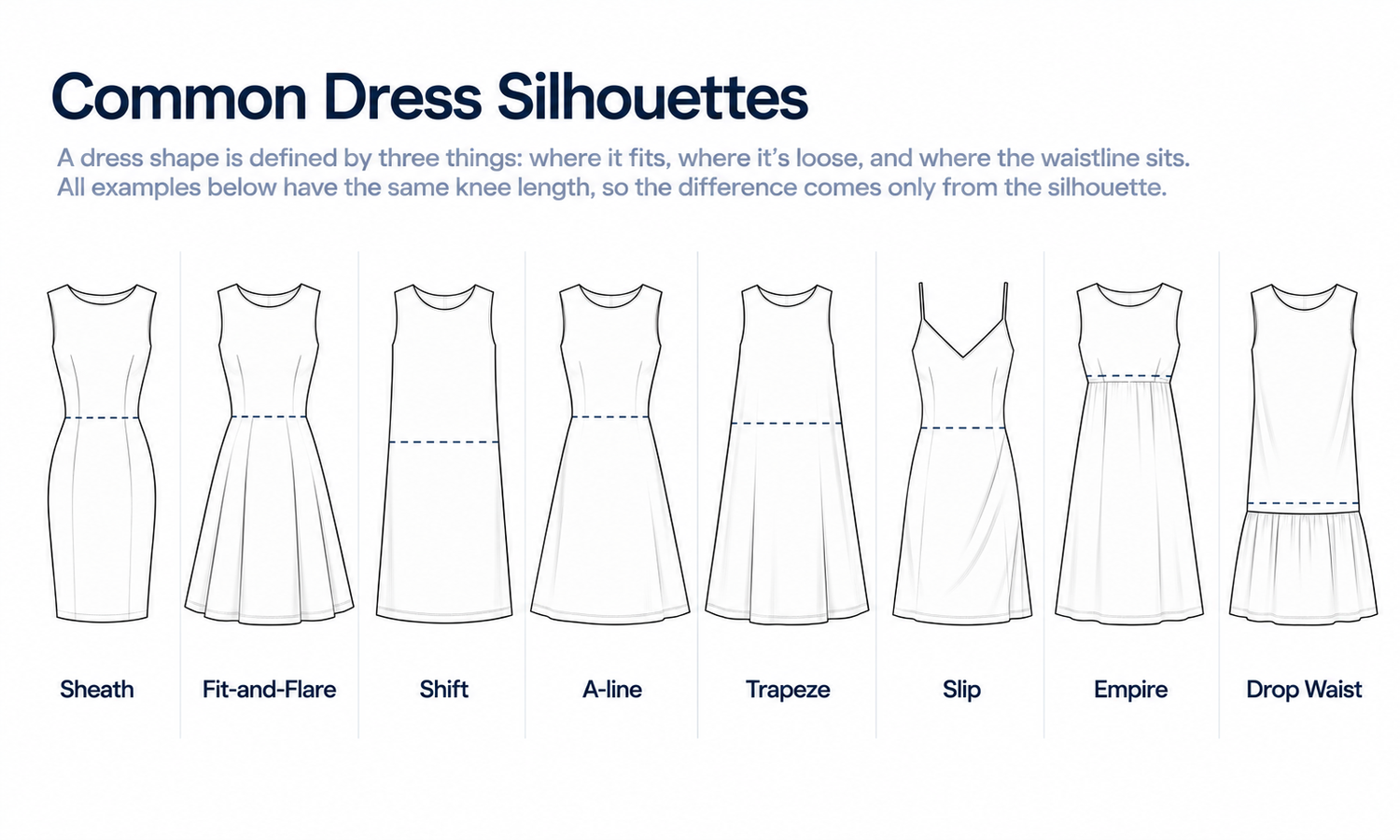
An AI dress generator can show the same idea as an A-line dress, a sheath or a wrap in moments, which makes it easy to explore shapes. What it cannot do is decide which shape the design should be. That decision starts with understanding dress silhouettes: the named shapes that designers, pattern makers and buyers use to describe how a dress sits, where it fits closely and where it releases, where its waist falls and how it moves.
Silhouette is the first thing anyone notices about a dress, often from across a room, before any detail or color. It is also a construction decision. A sheath is built with darts and seams that follow the body closely; a trapeze is cut to widen from the shoulders; a bias-cut slip relies on the fabric's diagonal grain to drape. Knowing the silhouettes, and what each needs from the pattern and the fabric, makes design conversations faster and design decisions sounder.
This article explains what a silhouette is, then walks through fitted and structured silhouettes, relaxed and flowing silhouettes, silhouettes defined by waist position and closure, and how to compare silhouettes with an AI dress generator.
| Silhouette | Shape | How it is usually built | Fabrics that tend to suit it |
|---|---|---|---|
| Sheath | Close-fitting from shoulder to hem, straight skirt | Darts or princess seams, back zip | Fabrics with some body, often with stretch |
| Fit-and-flare | Fitted bodice, skirt flaring from the waist | Waist seam, shaped bodice, flared or gathered skirt | Crisp or medium-weight fabrics |
| Column | Long, straight and narrow | Minimal shaping, long straight panels | Fluid or structured, depending on the look |
| Shift | Straight, loose from shoulder to hem | Few or no waist darts, simple panels | Crisp cottons, wool blends, structured knits |
| A-line | Narrow at the shoulders, widening to the hem | Flared panels or shaped seams | Fabrics that hold a gentle flare |
| Trapeze | Widening from the shoulders or bust | Wide flared panels, little shaping | Fabrics with body so the shape holds |
| Slip | Close, fluid, often on straps | Often cut on the bias | Fluid satins, crepes and silks |
| Empire | Waist seam just under the bust | High seam, skirt falling from it | Soft, draping fabrics |
| Drop waist | Waist seam at the hip | Long bodice, skirt from the hip | Light to medium fabrics |
| Wrap | One side wraps across the other and ties | Overlapping fronts, tie closure | Jersey, crepe and soft wovens |
| Shirt dress | A shirt extended to dress length | Collar, button placket, often a belt | Shirting cottons, poplin, chambray |
What a Silhouette Is
A silhouette is the outline of a garment: the shape it makes against the light. For a dress, it is defined mainly by three things. The first is where the dress fits closely and where it stands away, for example fitted through the bodice and full in the skirt, or loose throughout. The second is where the waist is placed, whether at the natural waist, under the bust, at the hip or nowhere at all. The third is length, from mini to maxi.
Silhouette is separate from detail. The same sheath can have a round neck or a V-neck, long sleeves or none, a print or a solid color, and it is still a sheath. That separation is useful: a team can agree on the silhouette first and then develop the details, rather than debating everything at once.
Silhouettes are also closely tied to the pattern and the fabric. They affect production too. Fuller silhouettes, such as a wide trapeze or a tiered maxi, use more fabric than a straight shift; bias-cut dresses use fabric less efficiently because pieces are laid diagonally; closely fitted silhouettes need more fittings to get right. These are reasons to consider silhouette alongside cost and development time, not only appearance. Each shape is created by specific construction choices, such as darts, seams, flared panels or cutting on the bias, and each needs a fabric that can hold or drape into that shape.
Fitted and Structured Silhouettes
Some silhouettes follow the body closely or hold a defined shape, and they depend on careful shaping.
-
Sheath. A close-fitting dress with a straight skirt, shaped by darts or princess seams and usually closed with a back zip. Fabrics with some body, often with a little stretch, help it keep a clean line.
-
Fit-and-flare. A fitted bodice joined at the waist to a skirt that flares out, either through flared panels or gathers. Crisp and medium-weight fabrics hold the flare.
-
Column. A long, narrow, straight shape with little flare. It can be fluid in a soft fabric or architectural in a structured one.
-
Body-conscious knit dresses. Close-fitting dresses cut from stretch knits, which rely on the fabric's stretch rather than darts for their shape.
These silhouettes depend heavily on the pattern and on fit. Small changes in dart placement, seam lines or ease change how they sit, which is why they are confirmed on a sample worn by a fit model.
Relaxed and Flowing Silhouettes
Other silhouettes release from the body and rely on cut and fabric more than on close shaping.
The shift is straight and loose from shoulder to hem, with little or no waist shaping. Its simplicity makes it a good base for prints and details, and it needs a fabric with enough body to hang cleanly.
The A-line is narrow at the shoulders and widens gradually to the hem, like the letter A. The widening comes from flared panels or shaped seams, and it suits fabrics that hold a gentle flare without collapsing.
The trapeze, sometimes called a swing dress, widens more dramatically from the shoulders or bust. It needs a fabric with body so the shape holds rather than hanging limply.
The slip is close and fluid, often on thin straps, and is frequently cut on the bias, diagonally across the fabric's grain. Bias cutting lets the fabric stretch slightly and drape along the body, which gives the slip its characteristic fall, but it also makes the dress harder to cut and sew precisely.
Tiered dresses build volume in layers, with each tier gathered onto the one above, which adds movement and fullness toward the hem.
Waist Position and Closure-Defined Silhouettes
Some silhouettes are named for where the waist sits or how the dress closes.
The empire silhouette places the waist seam just under the bust, with the skirt falling from there. It works well in soft, draping fabrics that flow from the high seam.
The drop waist places the waist seam low, at or near the hip, with a long bodice and a skirt that starts lower. It gives a relaxed, elongated line.
The wrap dress crosses one front over the other and ties at the side or back. It is adjustable, which is part of its appeal, and it is usually made in jersey, crepe or soft wovens that drape across the body.
The shirt dress extends a shirt to dress length, with a collar, a button placket and often a belt or drawstring at the waist. Shirting fabrics such as poplin, chambray and cotton twill suit it.
Length combines with any silhouette. Mini dresses end well above the knee, knee-length dresses at or near it, midi dresses between the knee and the ankle and maxi dresses near the floor. The same silhouette at different lengths reads very differently, so length is usually decided alongside the shape.
Across a range, silhouettes work together. A dress range built on two or three related silhouettes, such as a fit-and-flare, an A-line and a shift, offers customers genuine choice while still reading as one collection. A range where every dress is a different silhouette can feel scattered, while a range of one silhouette in many prints can feel repetitive. Planning the mix of silhouettes is part of planning the range.
Comparing Silhouettes With an AI Dress Generator
Silhouette decisions are easiest to make when options are seen side by side. An early preview can show the same design idea as a sheath, an A-line and a wrap, or the same A-line at three lengths, on the same model in the same pose, so the team can compare shapes rather than imagine them.
Previews have limits that matter especially for dresses. The drape in an image is rendered, not calculated, so fluid and bias-cut silhouettes are judged on real fabric. The image shows appearance, not fit, and fitted silhouettes in particular are confirmed on a sample. Screen color is not a physical reference. And sheer fabrics, lace and openwork, complex prints and layered styling remain current weak areas for generated imagery, so dresses built on them lean more on swatches and samples.
In Lightchain AI (apparel AI), silhouette options can be compared early in development.
-
Line Sketch to Flat Lay turns silhouette sketches into realistic flat-lays, as described on the Production-Marketing Synergy page.
-
AI Virtual Try-On places each silhouette on the same saved model, so shapes and lengths are compared on equal terms.
-
Model Studio keeps pose and scene fixed, so the only difference between previews is the silhouette.
For design teams choosing silhouettes before sampling, Ideas to Reality is the Lightchain AI solution built for that stage.
Frequently Asked Questions
What does an AI dress generator show about silhouettes?
It can show the same design idea in different silhouettes and lengths, side by side, so a team can compare shapes. It shows appearance, while drape and fit are confirmed on real fabric and samples.
What is a dress silhouette?
The outline of the dress, defined mainly by where it fits closely and where it stands away, where the waist is placed and how long it is. It is separate from details such as neckline, sleeves or print.
What is the difference between a sheath and a shift?
A sheath fits closely, shaped by darts or seams. A shift hangs straight and loose from the shoulders with little or no waist shaping.
What does cutting on the bias mean?
Cutting the fabric diagonally across its grain, which lets it stretch slightly and drape fluidly. It is common for slip dresses and makes cutting and sewing more demanding.
How do empire and drop-waist silhouettes differ?
An empire silhouette places the waist seam just under the bust; a drop waist places it low, near the hip. Both change where the skirt begins and how long the bodice looks.
Why decide silhouette before details?
Because silhouette shapes the pattern, fabric choice and overall look. Agreeing on it first lets the team develop details within a settled shape.
Which Lightchain AI solution helps compare dress silhouettes?
Ideas to Reality is the one to use. It turns silhouette sketches into realistic flat-lays and shows them on the same saved model, so shapes and lengths can be compared before sampling.
In Closing
An AI dress generator makes it easy to see many shapes, and understanding silhouettes is what makes that useful. A silhouette is defined by where a dress fits and releases, where its waist falls and how long it is, and each one is built through specific pattern choices and fabrics. Agree the silhouette before the details, compare options side by side on the same model and confirm drape, color and fit on real fabric and samples.
Start Here
If your team is choosing dress silhouettes for a new range, Ideas to Reality is the solution to use. It is built for the early stages of development: you turn silhouette sketches into realistic flat-lays, place them on the same model and compare shapes and lengths side by side. Start with one design idea in three silhouettes, compare them at the same length on the same model and take the clearest into sampling.
**Explore Ideas to Reality → **https://www.lightchainai.com/global/solutions/ideasToReality