
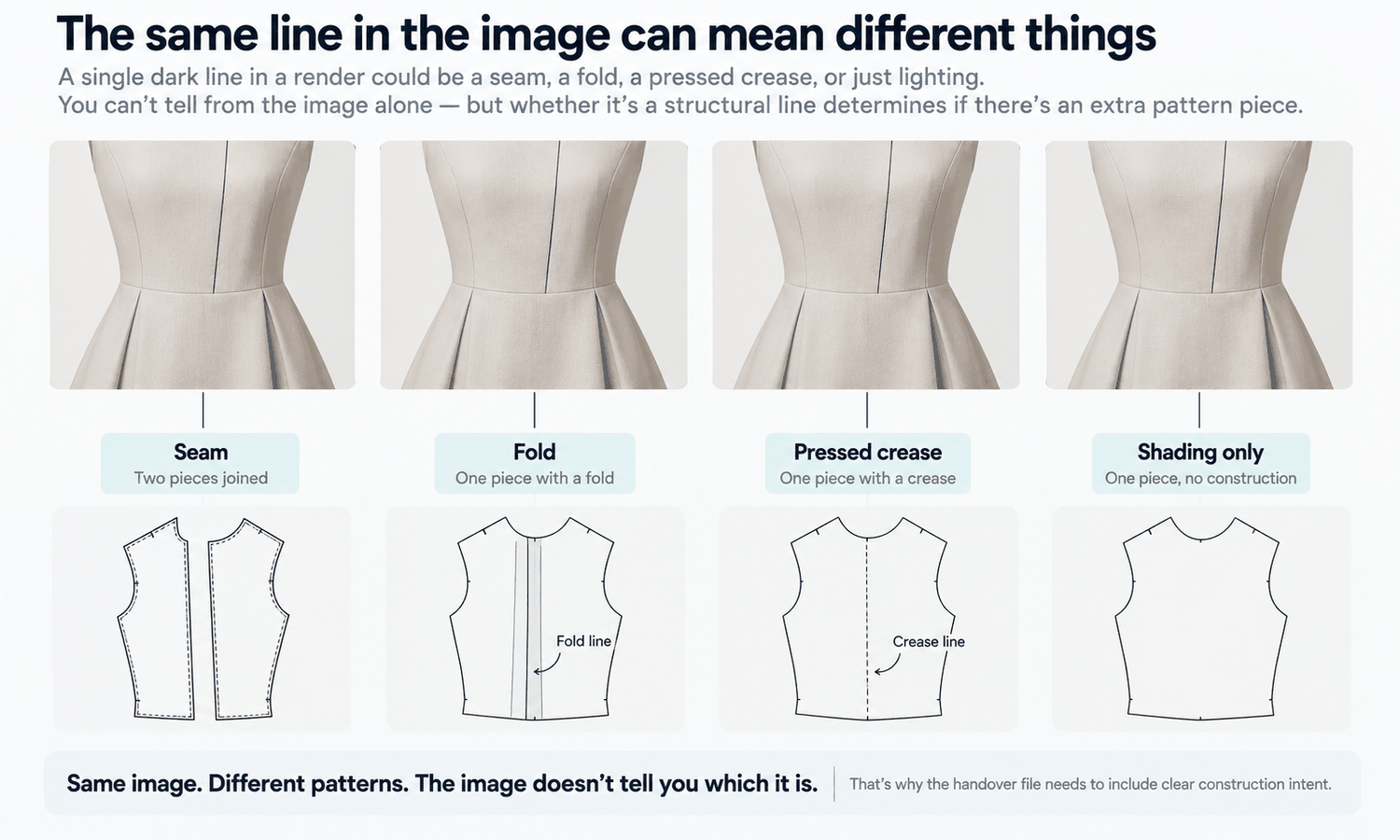
Hand a pattern cutter a rendered image of a dress and you have given them something that looks complete and is not. Several different patterns produce that same appearance. The image cannot say which one was meant, and it does not signal that a choice is outstanding, which is the part that costs a week.
That is the whole problem with using output from an ai dress changer as a pattern brief. It is not that the picture is inaccurate. It is that a picture is under-determined with respect to a pattern, while presenting itself as a finished description.
So the handover file has a job that is easy to state and rarely done. Its purpose is not to describe the garment, since the image already does that better than words would. Its purpose is to remove the ambiguity the image created.
An image is under-determined as a pattern brief
A pattern cutter converts an intention into numbers. Where a seam falls, how much ease sits at the waist, what angle a dart runs at, how long a hem is at center back — every one of those is a decision that has to be made by somebody, and the person who makes it owns the consequence.
Upstream of the cutter, almost everything is qualitative. A design conversation is about proportion, mood, and silhouette. A rendered on-model output is qualitative too, however precise it looks, because the precision is in the pixels rather than in the intent behind them. The cutter is the first person in the chain who has to commit to a number, and the handover is where that conversion is supposed to be supported.
When it is not supported, the cutter makes the decision anyway, because a pattern cannot be drafted with the question left open. They make it reasonably, and often they make it the way the designer would have. When they do not, the divergence surfaces at the first sample, which is the expensive place to find it.
What the image leaves open
| What appears in the image | What it could actually be | Who has to decide |
|---|---|---|
| A line running down the front | A seam, a fold, a pressed crease, or a shading artifact — all four render as the same darker line | The designer, at approval. A guess here decides whether a panel exists |
| Volume through the waist | Intended ease, the behavior of a soft cloth, or an effect of the pose | The designer, as a number at a named point |
| A curved hemline | Cut that way, or a straight hem hanging on a shaped body | The designer, and it changes the pattern piece entirely |
| Gathering at a seam | Gathers, smocking, elastic, or a render of fullness with no construction behind it | The designer, since each option is a different draft and a different make |
| A collar sitting a particular way | A drafted shape, or a standard shape photographed at that angle | The designer, with a reference to a known block where possible |
The first row is the one that generates the most rework and the least discussion. In a rendered image there is no reliable way to distinguish a seam from a fold from a pressed crease from a shading artifact, because all four are rendered the same way: a darker line where the surface changes direction. A cutter reading the image has to guess, and a guess about whether a line is structural determines whether a panel exists.
Marking the structural lines is a two-minute job for whoever built the look and a two-day recovery if nobody does it.
What belongs in the handover file
The file is short if it does its job, because it is a disambiguation document rather than a description.
-
The image, with structural lines marked: which are seams, which are folds or drape, which are neither and should be disregarded
-
The base size the design was conceived at, since proportion in an image is proportion at whatever the image depicts and a range is not one body
-
Intended ease at named points — bust, waist, hip, upper arm — stated as measurements rather than as words like relaxed or fitted
-
The fabric, by weight and character, with the note that the drape in the image is a rendering rather than a prediction of how that cloth will hang
-
Closures and their placement, which are frequently invisible in a styled render and always structural
-
Which features are decided and which are open, named individually, because an unmarked file reads as all decided
-
What to do when the image and this file disagree, stated once, so the cutter is not adjudicating
Converting the look into a line drawing or tech-sheet draft in the Design & Production Workbench does much of this by force. A line drawing has no shading to hide behind, so every line in it is a claim that somebody made deliberately. Those outputs are drafts and a technical designer still has to review them, which in practice means the review happens between the designer and the cutter rather than after the pattern exists. It also helps that in Lightchain AI (apparel AI) the source photograph stays beside the output it produced, so a cutter querying a line can be shown what the garment looked like flat, before anything was rendered onto a figure.
Where qualitative has to become quantitative
Three items on that list carry more weight than the rest, and they are the three that an image structurally cannot supply.
The base size comes first. A rendered figure has proportions, and those proportions correspond to some body, but nobody stated which one. Without the base size, the cutter is inferring a starting point from a picture and then grading outward from an assumption, and the assumption compounds across the range.
Ease is second and is the field most often left as an adjective. Relaxed through the body means something different to two people who have both been doing this for twenty years, and the image cannot arbitrate because the volume it shows comes from the pose, the render, and the fabric assumption together. Named points with numbers removes the argument before it happens.
Fabric is third, and it needs to arrive as weight and character rather than as a colorway and fabric direction alone. Two cloths of different weight can be made to look identical in a still image, and they will not behave the same on a stand. In this workflow or any similar one, the fall visible in an output is an appearance produced from what the model learned about garments of that shape, which is a different kind of thing from a prediction about the roll of cloth you have ordered.
What the image cannot tell you
The output is a visual asset. It does not predict fit, determine sizing, model how a fabric behaves in motion, or forecast returns. Those come from measurements, a graded pattern, a physical sample, and your own data.
For a pattern cutter the sharpest version is that nothing in this workflow performs physical simulation. There is no modeling of geometry and no prediction of how a material behaves — the drape in an image is rendered rather than computed, so it is evidence about the picture and not about the cloth. Existing 3D assets can be converted into flat garment images that then enter the workflow as inputs, which is a different thing from the workflow producing or simulating 3D.
Color carries its own limit, and it reaches the cutting room through the fabric decision. Screen color is not a physical reference, exact code matching is not something to promise, and the gap between a monitor and a roll of cloth stays open regardless of display quality. Colorways get settled by strike-offs against an agreed standard, and values must never be read off a generated asset and sent onward.
One more thing belongs here because it reaches the cutter directly. Logos, printed text, care labels, and small hardware get compared against the source image on every single output, without exception. Reconstructed detail lands almost right — a letterform slightly off, a stitch count wrong, a zipper pull the wrong shape — and a cutter working from an unchecked image can draft a placement around a detail that was never in the design.
What the cutter should send back
The cutter is the first person in the chain who has to make everything consistent, which makes them the first person to find the contradictions. Most handover processes have no channel for that, so the findings arrive as a conversation nobody records.
-
Numbered queries, each with a proposed resolution attached, so a reply can be a yes rather than an essay
-
A stated default for each query: what the cutter will do if there is no answer by a named date
-
Anything in the image that cannot be constructed as drawn, flagged before the pattern rather than after the sample
-
The decisions the cutter made that were not in the file, listed, so they become part of the record rather than part of somebody's memory
That last one matters more than it looks. Whether the look came out of Lightchain AI or a camera, every undocumented decision a cutter makes is a decision the next person will assume was specified, and by the third style in a collection nobody can reconstruct which choices were designed and which were inherited from a first draft that nobody meant to standardize.
Frequently asked questions
Is a rendered image useful to a pattern cutter at all?
Very, for proportion, silhouette intent, and the overall read of a garment, which are hard to convey in words and easy to convey in a picture. The failure is treating it as the specification rather than as the part of the specification that shows intent. Send it with the file rather than instead of one.
Who should mark the structural lines?
Whoever built the look, at the moment they approve it, because that is the only point where the intent still exists in somebody's head. Handing it to the cutter to interpret transfers a design decision to a technical role without anybody noticing that a transfer happened. It takes two minutes at the right moment and considerably longer at any other.
What if the designer does not know the ease numbers?
Then the file should say so explicitly and name it as an open decision rather than leaving the field blank, since a blank reads as an oversight and an open decision reads as a question. The cutter can propose numbers from a comparable block and have them confirmed. What breaks the process is silence that gets interpreted as agreement.
Can we skip the line drawing if the render is clear enough?
A render is never clear enough on structural lines, since the same visual cue represents four different things. The line drawing is where those four separate. If time is short, mark the structural lines on the render itself rather than skipping the step entirely.
How do we handle a look that cannot be constructed as drawn?
Flag it before the pattern is started, with the nearest constructible alternative and what changes visually. Discovering it during drafting wastes the drafting; discovering it at the sample wastes the sample too. This is the single most valuable thing a cutter can send back early.
Should the handover file change for a collection versus a single style?
The fields stay the same and the base size and ease conventions should be stated once for the collection rather than repeated per style. Per-style entries then only record deviations from the collection convention, which shortens every file after the first and makes deviations visible instead of buried.
In closing
The gap between a rendered dress and a pattern is not a gap in image quality. It is that an image describes an appearance, and several different patterns produce the same appearance, so somebody has to say which one was intended. The handover file exists to answer exactly that and nothing else: mark the structural lines, state the base size, put numbers on the ease, name the fabric by weight, and say which decisions are still open. Everything else the picture already handles, and no improvement in the picture will make the outstanding questions visible.
Start here
Take the last look you handed to a cutter and mark it up now, after the fact. Go through it line by line and label each one seam, fold, or artifact, then write the base size and the ease at four points underneath. Most people find the markup takes a few minutes and that at least one line they assumed was obvious turns out to be ambiguous. That single line is the argument for doing this before the next handover rather than after the next sample.
**Start with production handoff assets → **https://www.lightchainai.com/global/solutions/productionMarketing