
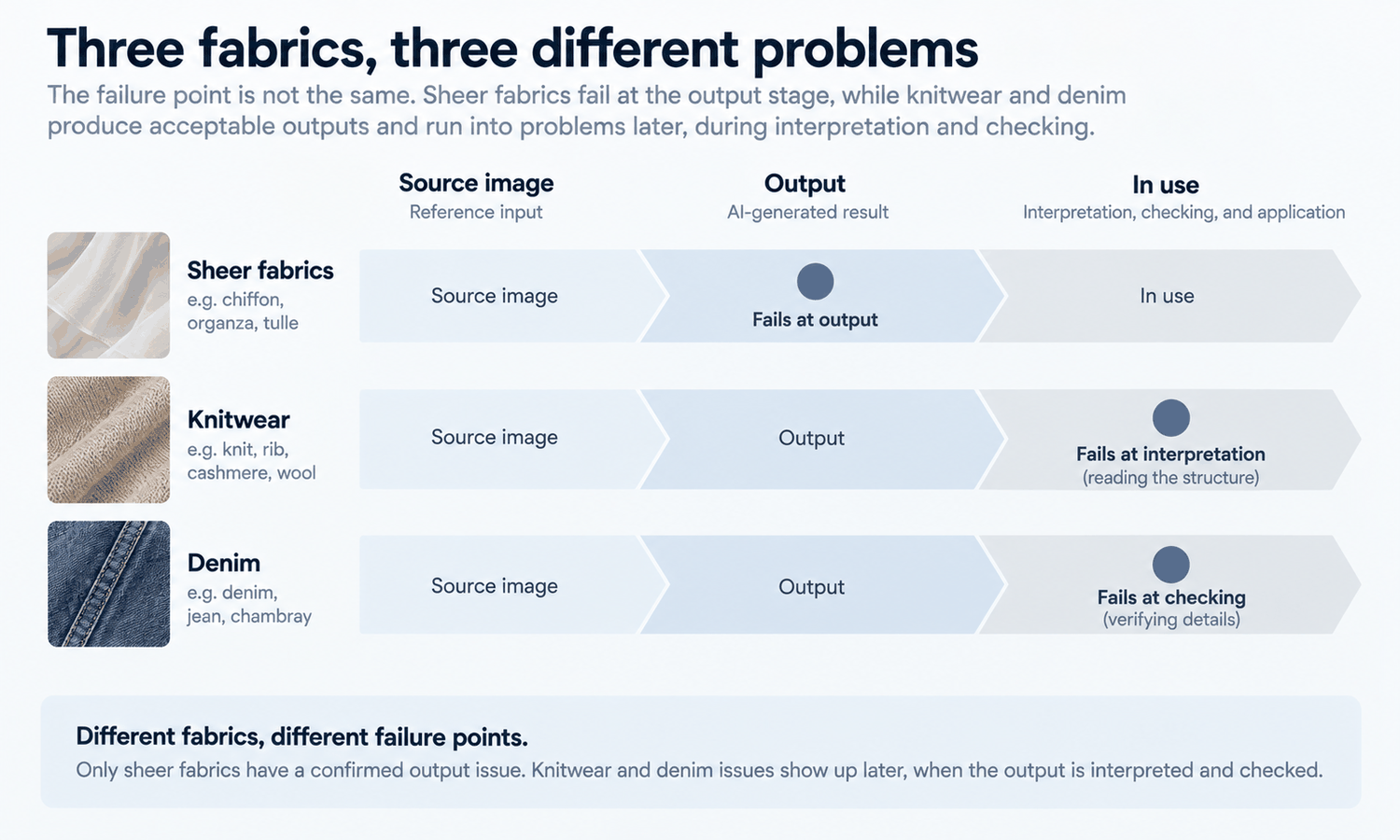
Knitwear, denim, and sheer fabrics get grouped together in conversations about ai clothing try on as though they were three points on one difficulty scale. They are not. Only one of the three is a capability question at all.
Sheer and open-work fabrics are a documented weak spot, and the honest answer there is a camera. Knitwear and denim are different: both can come back well, and each one goes wrong afterwards in its own way. Knitwear gets over-read. Denim gets under-checked.
Sorting them that way changes what you do about each, which is more useful than ranking them.
Three fabrics, three different problems
| Fabric | Where it actually goes wrong | What to do about it |
|---|---|---|
| Knitwear | Not in the output. A good result gets read as evidence about how the knit will behave, which is not in any image | Decide what the output is allowed to answer: proportion and styling yes, behavior after wearing no |
| Denim | Not in the output either. Identity sits in rivets, stitch color, button stamps, and wash placement, and those get approved without being compared | Make the comparison against source non-negotiable, and shoot the source close enough that those elements are legible |
| Sheer and open work | In the output. What shows through is the product, and it is a documented weak spot | Route to photography, record the reason, and keep the test images for a later retest |
The middle column is the one to read carefully. Two of these rows describe what happens after a good output arrives, which means better output does not help with either of them. The third row describes the output itself, which is why it gets a different answer.
Knitwear renders convincingly and tells you less than it appears to
A knit garment gets its shape from how the yarn relaxes and recovers on a body over time. It sits differently after twenty minutes than it did at the first minute, and differently again after a wash. That behavior is the reason knitwear is bought and the reason it is returned.
None of it is in an image. The output shows a state, and a state that reads convincingly, but a rendered appearance of a knit is not a prediction of how that yarn behaves. A heavier gauge and a lighter one can be made to look nearly identical in a still, and they will not perform the same way at the shoulder or through the body.
The failure this produces is specific and quiet. Somebody looks at a good knitwear output and forms a view about drop, length, or how a neckline will sit after wearing, and that view feels like information because the picture is convincing. It is an impression, and the moment it becomes a reason to skip a fit session it has cost more than it saved.
So the practical rule for knitwear is to treat the output as a styling and proportion reference and to route every question containing the words after wearing back to a sample. Exploring fabric character and colorway direction before committing to yarn is a real use; predicting how the yarn will behave is not.
Denim: the finish is the product, and the finish is fine detail
Denim carries its identity in exactly the elements that a reconstruction handles least reliably. Rivets, the color of the topstitching, the button and its stamp, the placement of whiskering and fading, and the texture at a felled seam. Somebody buying denim looks at those things, and somebody who works with denim looks at them within a second.
This puts denim in the category where the check matters most rather than where the output is weakest. Logos, printed text, care labels, and small hardware get compared against the source image on every single on-model output, without exception. In Lightchain AI (apparel AI) the uploaded source stays beside what AI Virtual Try-On produced from it, which is the difference between a check that happens on every image and one that happens when somebody has time. Reconstructed detail lands almost right — a letterform slightly off on a button stamp, a stitch count wrong, a rivet the wrong shape — and almost right survives an appreciative look at a good image and fails in front of anybody who knows the product.
Wash placement deserves its own attention because it behaves like a print. Where a fade sits relative to the knee, the pocket, and the seam is a specification with a right answer, and it is the element most likely to drift while everything else looks correct. When one region fails and the rest of the frame is sound, a targeted correction to that region is smaller than a rerun and keeps the rest of a set comparable.
The source photograph carries most of this. If the rivets and the stitching are not legible in the input at a size where somebody could check them afterwards, the comparison is not merely harder, it is impossible.
Sheer and open work: where the answer is a camera
Sheer, transparent, and open-work fabrics are documented weak spots, along with lace and complex prints. What shows through is the product in these categories, and what shows through is precisely what a reconstruction has least information about.
Treating this as a category verdict rather than as a prompt problem saves a season. Route it to photography, record the reason next to the category so the decision stops being reopened, and keep the test images so that a retest after a product update is a comparison rather than a fresh opinion. Retesting an unchanged setup on a schedule returns the same answer at a cost.
There is one adjacent thing worth checking rather than assuming. A garment with a sheer panel is not the same problem as a fully sheer garment, and the same is true of a lace trim against a lace body. Test the specific construction you sell rather than the fabric name, since the proportion of the garment that is sheer changes the answer more than the fabric label does.
What none of these fabrics can tell you
The output is a visual asset. It does not predict fit, determine sizing, model how a fabric behaves in motion, or forecast returns. Those come from measurements, a graded pattern, a physical sample, and your own data. That is a property of what the asset is rather than a limitation of any particular fabric, and it is the reason knitwear behavior sits outside the workflow no matter how good a knit output looks.
There is no physical simulation here either. Nothing builds geometry or predicts material behavior, so drape, recovery, and stretch in an output are rendered rather than computed. Existing 3D assets can be converted into flat garment images that enter the workflow as inputs, which is a different thing from producing or simulating 3D.
Color runs through all three fabrics and is worst where the surface is complex. Screen color is not a physical reference, exact code matching is not something to promise, and the gap between a monitor and a roll of cloth stays open regardless of display quality. Colorways get settled by strike-offs against an agreed standard, and an indigo shade in particular is settled by a physical reference rather than by anything on a monitor.
Sort your range by fabric rather than by department
Most brands organize their range by category and then discover that the useful division runs the other way.
-
Group by surface and construction: smooth and stable, textured and stable, fine-detail, and sheer or open. A crepe dress and a plain jersey tee belong together; a lace dress and a jersey tee do not
-
Put the fine-detail group where the detail check is strictest, since that is where identity lives and where a near miss is recognized fastest
-
Put the sheer and open group with photography and write the reason down
-
For the stable groups, decide what the output is allowed to answer, which for knitwear means proportion and styling rather than behavior
-
Retest by group after a product update rather than by department, since the fabrics fail for different reasons and will not move together
That sorting takes about twenty minutes and it usually cuts across the existing structure in a way that is briefly annoying and permanently useful. Whether the work runs through Lightchain AI or a camera, the fabric decides more than the garment type does, and a plan organized around departments will keep producing surprises that a plan organized around surfaces would not.
Frequently asked questions
Can we show knitwear at all, then?
Yes, and for proportion, styling, and colorway direction it works well. What it cannot support is any statement about how the knit will sit after wearing, which is the question knitwear buyers actually have. Keep that answer with the sample and the measurements.
Our denim outputs look great. Is there still a problem?
Looking great and being correct are different tests, and denim is the fabric where they diverge most often because the identity sits in small elements. Check the rivets, the stitch color, the button stamp, and the wash placement against the source every time. A good-looking denim image with a wrong rivet is the exact failure this category produces.
What about a dress with a sheer overlay?
Test that specific construction rather than assuming the verdict from the fabric name, since a small sheer panel and a fully sheer garment behave differently. Run one style three times unchanged and look at the overlay boundary specifically. Whatever it shows is a verdict about that construction rather than about sheers in general.
Is heavier or lighter knit gauge easier?
Neither reliably, and gauge is not the useful variable. The consistent point is that a still image renders an appearance of any gauge and predicts the behavior of none, so the risk is the same across gauges. Sort by whether the question being asked is about appearance or about behavior.
Does the source photograph matter more for some fabrics?
It matters everywhere and it becomes decisive for fine-detail fabrics, since a check that cannot be performed will not be performed. For denim especially, shoot close enough that rivets, stitching, and the button stamp are legible in the source. That is a capture requirement rather than a quality preference.
We sell mostly sheers. Is this workflow useful to us at all?
For the parts of your range that are not sheer, and for internal exploration before sampling, yes. For the sheer garments themselves the answer is photography, and knowing that in advance is worth more than a series of attempts. Plan the budget around that split rather than hoping it resolves.
In closing
These three fabrics need three different responses because they fail in three different places. Knitwear comes back well and then gets read as evidence about behavior it cannot carry, so the discipline is about what you allow the output to answer. Denim comes back well and then gets approved without anybody checking the rivet, so the discipline is the comparison against source. Sheer and open work are a documented weak spot, so the discipline is routing it to a camera and writing down why. Only the third is a question about the technology; the first two are questions about what a team does next.
Start here
Take your current range and re-sort it by surface rather than by department, into four groups: smooth and stable, textured and stable, fine-detail, and sheer or open. Then write one line per group saying what the output is allowed to answer. Most teams find at least one garment sitting in the wrong group and one question they have been letting an image answer that it never could.
**Start with the on-model workflow → **https://www.lightchainai.com/global/solutions/aiVirtualTryOn