
Every apparel business has weeks when everything happens at once: a seasonal launch, a major sale event, the run-up to the holidays. Dozens or hundreds of styles need on-model images, every channel wants its own formats and every listing has a date it must go live. Those are the weeks when a content team's plan meets its real capacity.
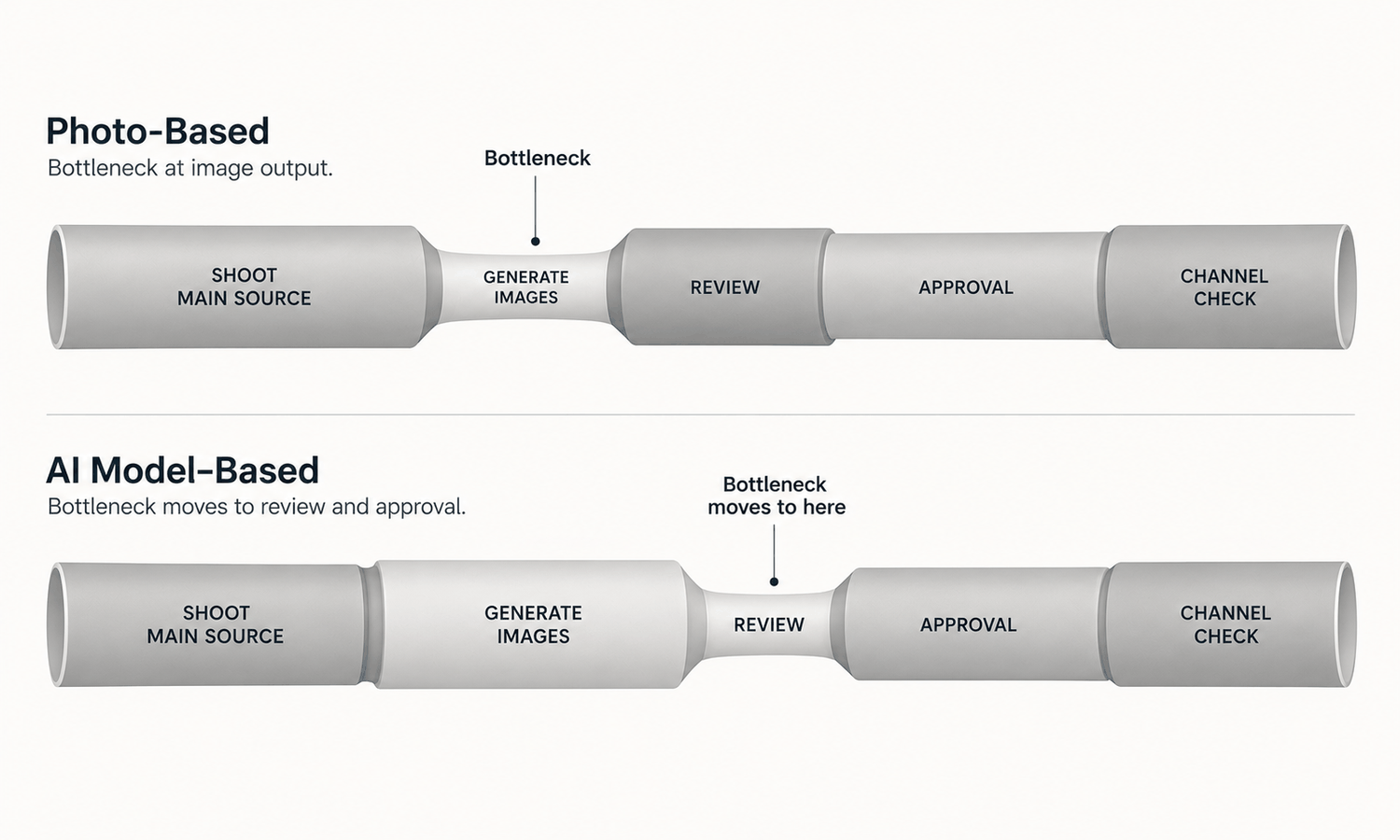
With photography, peak-week capacity was set by the shoot: studio days, photographers, models and the hours in which they were all available. AI clothing models change that. Once the garment sources are captured, on-model images can be produced far faster than any shoot could deliver them. The limit does not disappear, though. It moves, and a staffing plan that does not follow it ends up with a pile of images nobody has had time to check.
This article explains where the bottleneck moves when AI clothing models do the production, what to finish before peak week begins, how to staff the review rather than only the production, what peak week must not cut and how to run it.
| Stage | Photography-led peak week | AI model-led peak week | Where people are needed most |
|---|---|---|---|
| Garment source capture | Part of the shoot | Before production, per style | Capture, ahead of the peak |
| Image production | The main constraint | Fast once sources exist | Setup and monitoring |
| Review against the garment source | Often squeezed at the end | The new main constraint | Dedicated reviewers |
| Approval | A final sign-off | Frequent, batch by batch | A clear owner |
| Channel preparation and listing checks | Late and rushed | Can start earlier | Channel specialists |
| Fixes and re-dos | Reshoots are costly | Edits or regeneration | Reviewers and producers together |
Where the Bottleneck Moves
In a photographed peak week, production is the constraint. A studio can only shoot so many looks in a day, and everything downstream, from retouching to listing, waits for the shoot. Teams plan around studio time, and review usually gets whatever hours are left before the deadline.
With AI clothing models, production stops being the constraint once the garment sources are ready. A batch of styles can be placed on approved models, in approved poses and scenes, in the time a single shoot setup used to take. That is the attraction, and it is real.
What does not speed up is checking. Every image still has to be compared with its garment source for construction, logos, printed text, trims, hardware and print placement. Every batch still needs approval. Every channel still needs its formats checked against its requirements. These steps take human attention per image, and when production accelerates, they become the limit.
So the staffing question changes. It is no longer mainly how much shoot capacity to book. It is how much review capacity the team needs to keep pace with what production can now deliver, and how much of that capacity can be prepared before the peak arrives.
What to Finish Before Peak Week
The more that is settled before the peak, the more of peak week can go to production and review rather than decisions. Several things can be finished weeks ahead.
-
Garment sources. Capture the flat-lay, back view and detail shots for every style in the peak, following the brand's capture spec. Production cannot start without them, and capture needs the physical garment.
-
Approved frames. Approve the models, poses, scenes and angles for each category in advance, so each style drops into a frame that has already been reviewed.
-
Channel templates. Prepare the crops, layouts and text areas for each channel and marketplace, so finished images move straight into place.
-
Brief rules. Write down what must never change, the pose and scene rules and the notes that usually come up in review, so they do not have to be discovered under pressure.
Two other preparations are easy to overlook. First, identify the styles that should be photographed. Complex prints, lace and openwork, sheer fabrics and layered styling are current weak areas for generated imagery, and booking their photography before the peak prevents a last-minute scramble. Second, measure how long a careful review of one image takes on your own products, including a check of trims at full size. That number, multiplied by the images in the peak, is the review capacity the team needs.
Staffing the Review, Not Just the Production
Once production is fast, the people who matter most in peak week are the reviewers. Plan for them explicitly.
Assign dedicated reviewers rather than asking producers to review their own work in spare moments. A reviewer who is not also trying to finish the next batch reads images more carefully. Give them the garment sources, the reference packs for trims and fabrics and the brief rules, and a clear place to record each result.
Name one person to consolidate notes and approve batches. When several people comment on the same images during a busy week, their notes can conflict, and conflicting notes cause second rounds. One consolidator, one set of notes and one approval per batch keep the flow moving.
Plan the reviewers' rhythm as well as their numbers. Careful comparison against a garment source is tiring work, and accuracy drops late in a long session, which is exactly when almost-right details slip through. Keep batches to a size a reviewer can finish with full attention, build breaks into the day and rotate reviewers between categories so fresh eyes reach the last batch of the day. A slightly slower pace that holds its accuracy costs less than a fast one that sends errors to live listings.
Bring in the specialists at the right points. A trims and materials check by the people who know the trims catches the errors general reviewers miss. A channel specialist who knows each marketplace's requirements catches the rejections before submission.
Outsourcing can add production capacity during the peak, and it works well when the rules are clear. Outside producers use the brand's approved models and frames, return an image record with every file and hand over work that is checked against its garment source. Execution can be delegated. The brand's review and approval stay with the brand.
This is a reallocation of effort, not a reduction of it. Hours that used to go into shoot logistics move into capture before the peak and review during it. Teams that plan for that shift are the ones that finish peak week with images they are confident in.
What Peak Week Must Not Cut
Peak weeks create pressure to shorten the steps that feel optional. A few are not optional.
Every image is checked against its garment source, without exception. Images produced from the same source and settings tend to share the same mistake, so sampling a batch under time pressure is exactly how an error reaches dozens of listings at once.
Color is judged against the physical colorway. Screen color is not a physical reference, and color values are not read from generated images to fill product data that was left for the last minute.
Captions stay honest. Generated models did not wear the garments in any size, so no size-worn captions appear on their images.
Labeling follows each channel's current rules for AI-generated imagery.
When review capacity falls short of production, the answer is to prioritize, not to skip. Decide in advance which styles must go live first, such as hero products, the largest sellers and the pieces featured in campaigns, and review those first. It is better to publish fewer styles on time with verified images than to publish every style with images nobody checked.
When the peak is over, hold a short review of the week itself. Note where the queue built up, which notes came back most often, which styles had to be routed to photography late and how the actual review time per image compared with the estimate. Each of those findings becomes a change before the next peak: an earlier capture date, a new brief rule, a photography booking made sooner or a different number of reviewers. Peak weeks repeat every year, and the team that learns from each one enters the next with fewer surprises.
Running Peak Week
In Lightchain AI (apparel AI), peak-week production runs on frames prepared in advance.
-
Model Studio sets the approved models, poses, scenes and angles before the peak, so each style is placed into a reviewed frame.
-
AI Virtual Try-On places garments on those models from their flat-lays, including on saved model sets and in multiple-task mode for batches.
-
The Omni-Marketing Workbench prepares channel assets, and enterprise libraries give reviewers and producers one shared place for garment sources and approved models.
For teams producing on-model imagery across many styles in short, intense periods, Scale E-commerce is the Lightchain AI solution built for that work.
Frequently Asked Questions
How do AI clothing models change peak-week capacity?
They make image production much faster once garment sources are captured. The constraint moves from the shoot to the review, approval and channel checks that every image still needs.
What should be finished before peak week starts?
Garment sources for every style, approved models, poses and scenes, channel templates and brief rules. Photography for weak-area styles should also be booked in advance.
How much review capacity does a team need?
Measure how long a careful review of one image takes on your own products, then multiply by the number of images in the peak. That gives the review hours to staff for.
Can production be outsourced during peak week?
Yes, provided outside producers use the brand's approved models and frames and return image records with their files. Review and approval stay with the brand.
What if review capacity falls short?
Prioritize rather than skip. Review hero products, top sellers and campaign pieces first, and publish fewer styles on time with verified images rather than every style unchecked.
Do AI clothing models mean a smaller content team?
The work shifts rather than disappears. Effort moves from shoot logistics to capture before the peak and review during it, and the team is staffed around that shift.
How does Lightchain AI help with peak-week production?
It lets frames be approved in Model Studio before the peak and garments be placed on saved models in batches with AI Virtual Try-On, while shared libraries keep sources and models in one place. Scale E-commerce is the solution to use for producing across many styles in short, intense periods.
In Closing
AI clothing models move the peak-week bottleneck from the shoot to the review. Plan for that. Capture garment sources, approve frames, prepare channel templates and write brief rules before the peak begins. Staff dedicated reviewers, one consolidator and the right specialists, and keep review and approval with the brand even when production is outsourced. When time runs short, prioritize rather than skip: every published image checked, every color judged physically and every caption honest.
Start Here
If your team faces peak weeks with more styles than a shoot schedule can handle, Scale E-commerce is the solution to use. It is built for producing on-model imagery across many styles: you prepare approved models and frames before the peak, place garments on them from flat-lays in batches and keep sources and models in shared libraries. Start with your next peak, measure your review time per image, and plan the staffing around it.
**Explore Scale E-commerce → **https://www.lightchainai.com/global/solutions/scaleECommerce