
A late sample used to be a simple conversation. The product is delayed, the shoot moves, the assets arrive later, and everyone adjusts. Unwelcome, and unambiguous.
Generation changes the shape of that conversation, and not only by making it easier. Images can now exist before the product is approved, which solves the scheduling problem and introduces a different one: assets that depict a version of the garment that may not be the version that ships.
For anyone managing a client relationship through a delay, that shift is the whole story.
The delay became a representation problem
Before, a late sample produced a gap. The gap was visible, everyone could see it, and nobody mistook an absent image for an accurate one.
Now the gap can be filled from an earlier photograph or a proto sample, quickly and convincingly. The client gets images on schedule and the relationship survives the delay, which is a real improvement.
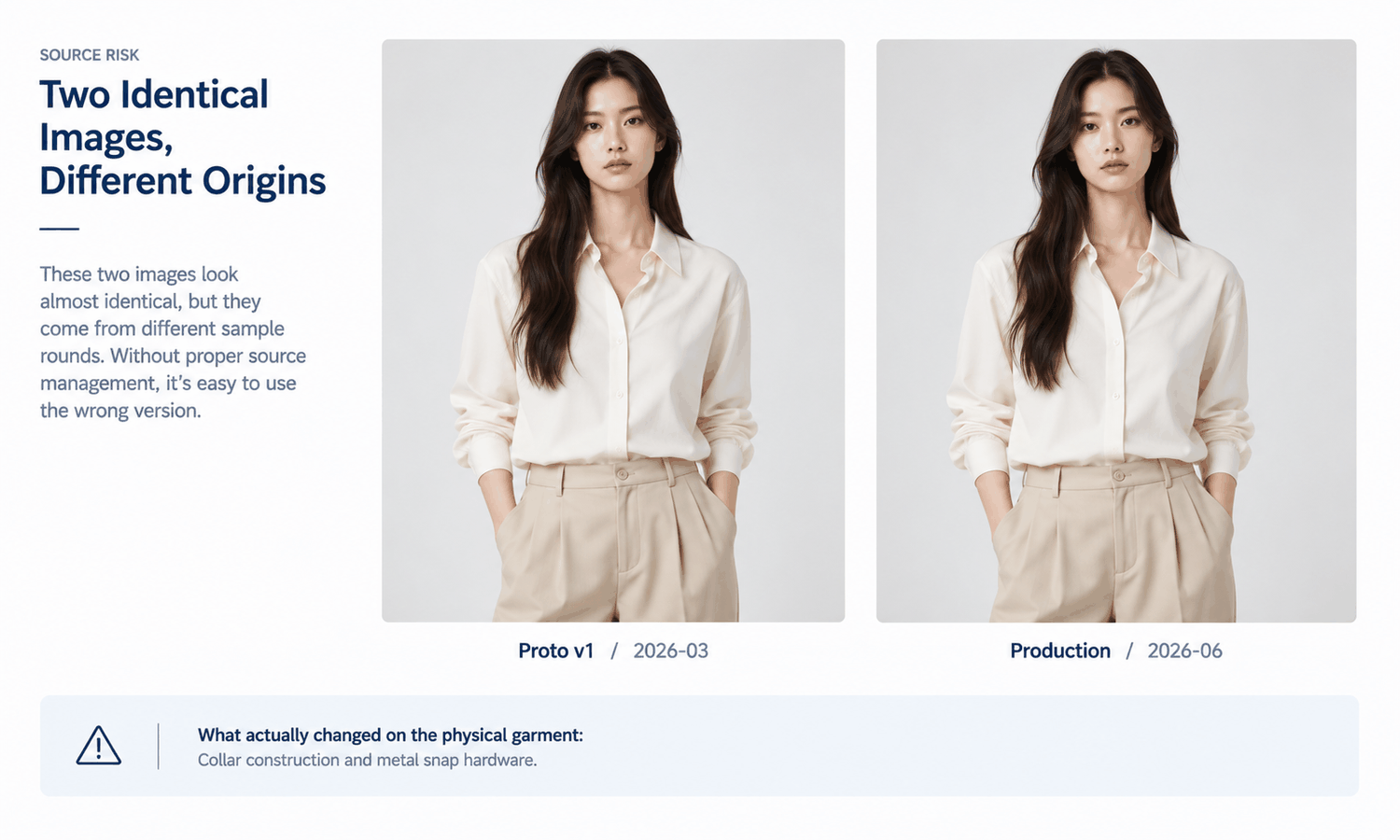
The hazard sits underneath. An image produced from a proto sample looks exactly like an image produced from a production sample, and once it is in a folder nothing distinguishes them. The delay has been converted from a visible absence into an invisible discrepancy.
What can honestly be promised, by asset type
| Asset | Can it be committed before the production sample? | What the client should be told |
|---|---|---|
| Internal range review visuals | Yes | Based on the current sample, subject to change |
| Wholesale deck imagery | Usually, with a version note | Reflects the sample as of a stated date |
| Product page listing set | Only if the style is confirmed unchanged | Must match what ships |
| Colorway variants | Yes, once the base style is confirmed | Color rendering pending physical approval |
| Detail crops | No | Requires the physical product and a camera |
| Campaign hero imagery | No | Needs the real garment and art direction |
The first two rows are where generation genuinely rescues a timeline. The middle rows need a condition attached. The last two are unchanged by any of this and promising them early creates a problem that surfaces at the worst moment.
Reading this table aloud in a client call is more useful than it sounds, because it converts a vague reassurance into a specific set of commitments the client can plan around.
Assets that outlive the version they depict
The failure mode is not a bad image. It is a good image of a garment that subsequently changed.
A proto sample gets photographed, imagery is generated, the client is happy, and three weeks later the factory adjusts a collar or substitutes a trim. The imagery is now wrong in a way nobody will notice until a customer receives the product, because the assets have already been distributed, approved, and scheduled.
This is a genuinely new risk. It did not exist when imagery could only follow the production sample, and it arrives precisely because the constraint that used to enforce accuracy has been removed.
Account managers are the people who discover it, usually in the form of a client asking why the delivered goods differ from the pictures.
Worth noticing that the question arrives long after anyone involved remembers the sequence. The person who generated the imagery has moved on to the next drop, the sample round is a distant detail, and the account manager is left reconstructing a timeline under pressure to explain something that was nobody's mistake. Preventing that reconstruction is most of what the next section is for.
Version the imagery to the sample it came from
The fix is unglamorous and it works. Every generated asset carries the identity of the sample it was derived from, in the filename, not in a document.
That means a style code, a sample stage, and a date. An asset named for a proto sample is self-evidently provisional wherever it travels, and an asset named for an approved production sample is self-evidently final. Neither requires anyone to read a covering note, which is what makes it survive being forwarded.
Then, when a sample changes, you can find every affected asset in seconds rather than reconstructing which images came from which round. Keep them in a shared library rather than in a thread — a personal or enterprise library plus the generation history turns "which round did this come from" into a search rather than an investigation. That single capability is worth the naming discipline on its own.
Agree the format with whoever produces the assets rather than imposing it afterward. A convention introduced at delivery gets applied inconsistently and abandoned within two drops; one agreed before the first batch costs nothing and holds, because it was never extra work.
Where the change is a material rather than a shape — a substituted fabric or a revised colorway — the affected assets can often be regenerated from the same base rather than rebuilt, which is the cheapest form of correction available. See fabric, color and style substitution.
What to say to the client, precisely
Vague reassurance is what causes the problem. Precision costs nothing and protects both sides.
Three sentences cover almost every case. The imagery reflects the sample received on a stated date. Any change to the garment after that date will require the affected assets to be reissued. Fit, sizing and fabric hand are not represented in these images and remain subject to the physical sample.
Say it once when the imagery is delivered and put it in writing in the same message. A client who has heard this is a client who will accept a reissue calmly later, because it was described as a normal step rather than as a failure.
The tone matters as much as the content. Delivered as a warning, the three sentences read as hedging and invite doubt about the whole delivery. Delivered as a statement of what the assets are, they read as competence. Same information, and the difference decides whether the client feels informed or nervous.
When to hold rather than generate
Producing something is not always the right response to a delay, and account managers are frequently the only people positioned to say so.
Hold when the style is still under revision, since imagery produced mid-revision generates rework for everyone. Hold when the client's use is customer-facing and the sample is not final, because a listing that has to be corrected after launch costs more than a late listing. Hold when the asset in question is a detail crop or a campaign hero, which need the real product regardless.
Generate when the use is internal, when the base style is confirmed and only the color or material is pending, or when a wholesale conversation would otherwise stall entirely. The middle case is the most common and the most valuable, since shape confirmation typically arrives well before material confirmation, and the imagery that depends only on shape can proceed in that window. The AI Virtual Try-On module in Lightchain AI (apparel AI) produces on-model imagery from an existing sample photograph, subject to the same input conditions as anywhere else — a clean, evenly lit garment shot on a suitable base — see AI Virtual Try-On, and the judgment about whether that sample is a good enough basis stays with you.
What generation cannot rescue
Some consequences of a late sample are unaffected, and promising otherwise is where account management goes wrong.
The output is a visual asset. It does not predict fit, determine sizing, model how a fabric behaves in motion, or forecast returns. A client waiting on a sample to resolve a fit question is still waiting on that sample.
Nor does it shorten the production path. Nothing here brings a delivery date forward; it changes what can be shown while the date holds. Presenting imagery as progress on a delayed order invites a misunderstanding that becomes visible when the goods do not arrive any earlier, and it damages the credibility of every subsequent update from the same source.
And where a logo, wordmark or printed text appears, every asset needs comparison against the source, since reconstructed text is often almost right. Almost right is the version that reaches a client.
Questions account managers ask
Can I promise imagery on the original date if the sample slips? For internal and wholesale deck use, usually yes. For listing assets, only if the style is confirmed unchanged, since those have to match what ships.
How do I explain that images exist but the product is late? State plainly that imagery is derived from the sample received to date and that the delivery schedule is unchanged. The risk is a client hearing that the order has caught up when it has not.
What if the sample changes after imagery is approved? Reissue the affected assets, which is why versioning to the sample matters. With filenames carrying the sample stage and date, identifying them takes seconds rather than an afternoon of guesswork.
Should I show proto-sample imagery to a retail buyer? With a stated date and a change caveat, often yes, since it keeps a conversation alive that would otherwise stall. Without those, it creates an expectation the production goods may not meet.
Does this help with a fit complaint? No. Fit, sizing and fabric hand sit outside what the imagery represents, and a fit question waits for the physical sample regardless of how good the pictures are.
Who decides whether to generate or hold? Whoever carries the client relationship, in consultation with whoever owns the product. The decision is about representation risk rather than production capacity, which puts it on the account side.
What the late sample now costs
Less time and more attention. The schedule can absorb a delay that used to break it, and in exchange somebody has to track which images came from which sample and reissue them when the product moves. Version the assets to their sample in the filename, tell the client precisely what the imagery represents and what it does not, and hold rather than generate when the use is customer-facing and the style is unsettled. Handled that way, a late sample becomes a manageable event. Handled loosely, it becomes a discrepancy that surfaces after the goods ship.
Add the sample stage and date to your next asset filenames.
**Include the style code, the sample round the imagery came from, and the date it was received. Then send the three-sentence note with the delivery — what it reflects, what triggers a reissue, and what it does not represent. Both take minutes and they convert the most common client complaint in this area into a routine reissue. → **AI virtual try-on
About the author
[REPLACE — real person's name, role, relevant experience, LinkedIn URL. No team byline.]