
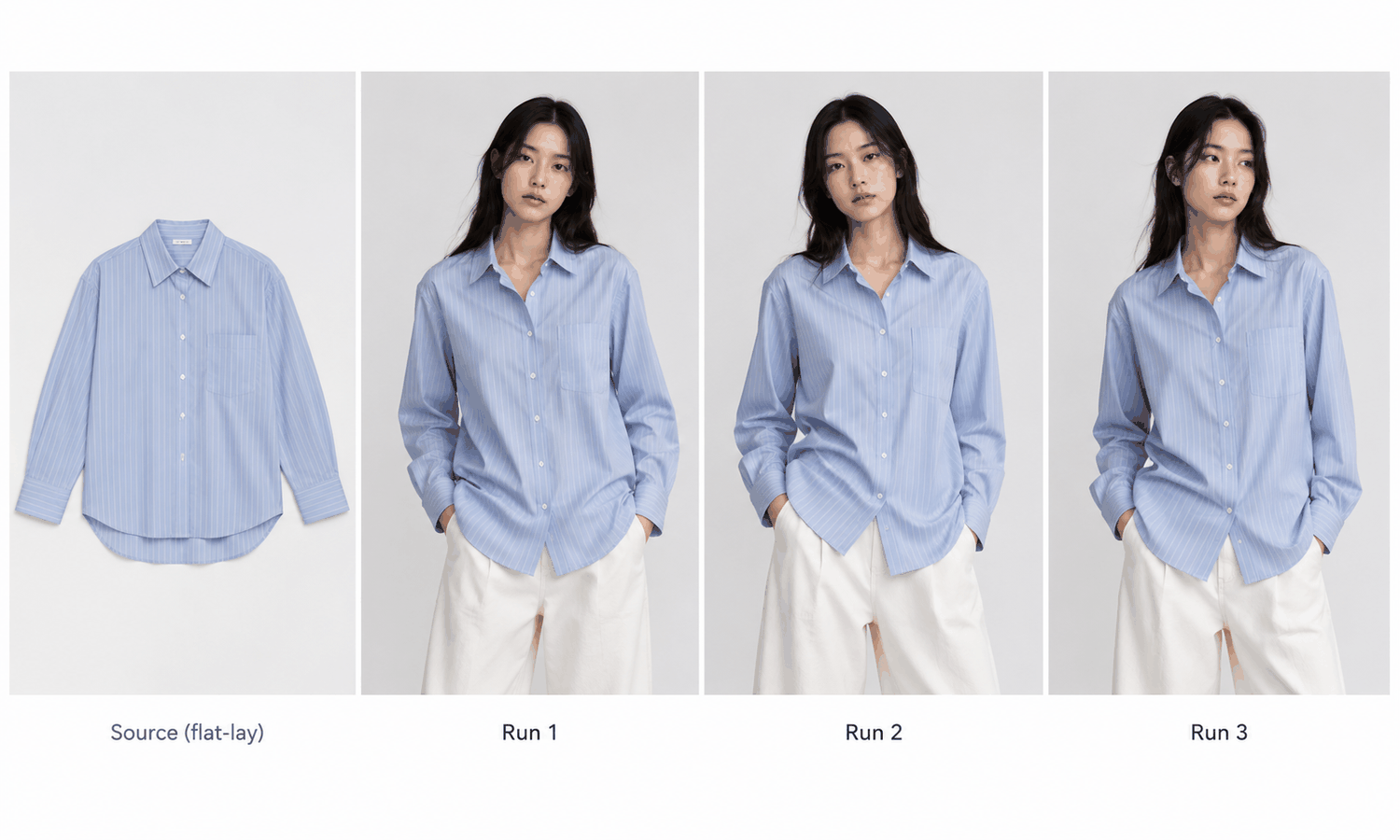
Somebody in the review asks whether the AI clothes try-on output is accurate. It is a fair question, and it is two questions wearing one coat. One is whether the picture matches the garment you put into it. The other is whether the garment will behave that way on a person. The first can be tested. The second cannot be tested by looking at a picture, no matter how good the picture gets.
Most try-on evaluations go wrong at that seam. A team assembles a set of outputs, agrees they look convincing, and records a conclusion that quietly covers both questions. Six weeks later a sample turns up and the conclusion turns out to have covered only one.
Drape, stretch, and print placement get bundled into a single accuracy question more often than any other three attributes, and they sit at three different distances from being testable at all. Sorting them is most of the work.
What a test can settle, and what it cannot
| Attribute | What a viewing test can settle | Where the real answer comes from |
|---|---|---|
| Print placement | Repeat scale, motif position, and continuity across seams, checked against the source and the spec | The same test, because the answer is present in the input |
| Drape | Whether the fall stays stable across runs, and whether it reads as plausible to somebody who handles cloth | A physical sample, since the input never contained drape to begin with |
| Stretch | Nothing | The measurement chart, the graded pattern, and a fit session on a body |
The pattern behind the table is simple enough to apply to any attribute you add later: ask whether the answer exists in the input. A flat lay contains the print. It does not contain the drape, because a garment lying flat is not draping. It contains nothing whatsoever about stretch, because stretch only exists under load.
Anything absent from the input is being constructed rather than reproduced, and a construction cannot be checked against a source that never held it. That single distinction is the test design. Everything below is bookkeeping.
Build the test on garments you already know
Ground truth has to be physical. Pick six styles you have already sampled and already photographed the conventional way, so that for each one there is a garment somebody in the building can pick up and a reference image that was made with a camera.
Choose them to cover your difficult categories rather than your easy ones. Complex prints, lace and open work, sheer and transparent fabrics, and layered styling are documented weak cases for this kind of generation, and a test built from plain jersey will produce a flattering average that tells you nothing about the styles where you would actually have needed the answer.
-
Fix the source photo standard: same lighting setup, same background, same distance, for all six
-
Fix the output side too — one model direction, one pose, one scene, one output size, held constant in Model Studio so the garment is the only thing changing
-
Run each style three times with no changes at all, because run-to-run variation is a finding rather than noise
-
Have the comparison done by whoever approves images in production, not by whoever proposed the test
Working with the source file and the output in the same place matters more than it sounds. Much of what makes these tests collapse is administrative: three weeks later nobody can say which output came from which input at which setting. In Lightchain AI (apparel AI) the uploaded source and the generation history sit together, which is enough to keep the trail intact without anybody maintaining a spreadsheet about it.
Print placement: the one attribute with a right answer
Print is where a test earns its keep, because a correct answer exists in two places at once. It exists in the source photograph, and it exists in the specification as a measurement. Three checks cover most of it: whether the repeat is at the intended scale, whether the motif sits where it should relative to center front and the seams, and whether the pattern stays continuous across panels and around the body.
All three are comparisons rather than judgments, which means two people will reach the same verdict, which is what makes them worth recording. Scale is the one that turns into money later, since a repeat is a measurement and an image only ever shows a ratio. Run that comparison at the resolution the asset will be published at — output can be set to 2K or 4K, so the ratio being checked is the one a customer will see. That makes the comparison honest; it does not put the measurement into an image that never contained one.
The same pass covers a rule that has no exceptions. Logos, printed text, care labels, and small hardware get compared against the source image on every single output. Reconstructed detail lands almost right — a letterform slightly off, a stitch count wrong, a zipper pull the wrong shape — and almost right survives review in a way that obviously wrong does not.
One thing the print pass must not absorb is color. Screen color is not a physical reference, exact code matching is not something to promise, and the gap between a monitor and a roll of cloth stays open regardless of display quality. Colorways get settled by strike-offs against an agreed standard, and values must never be read off a generated asset and passed downstream. Judging a colorway direction is a separate activity with a separate resolution path; a print test scores placement and continuity and stops there.
Drape: consistency is the only measurable part
Feed in a flat lay and there is no drape in the input. What appears as fall in the output is assembled from what the model has learned about garments of that shape and surface, which means the phrase correct drape has no operational definition in this test. There is nothing to compare it with.
Two things remain measurable, and they are worth more than the question you cannot answer. The first is stability. Run the identical input three times through AI Virtual Try-On and look at whether the fall changes between runs. A category that comes back different every time is a category where single outputs should not be carrying decisions, and that is a usable finding even though it says nothing about the fabric.
The second is plausibility, judged by somebody who has handled the cloth. Give a technical designer or a sample room lead five seconds per image and take a verdict with no explanation attached. It is a subjective measure and should be written down as one, but it catches the outputs that a marketer would approve and a maker would not.
What the drape pass cannot do is tell you anything about the fabric itself. A heavier weight and a lighter one can be made to look identical in a still image, and a fall that reads as convincing is evidence about the picture rather than about the cloth.
Stretch is not an image question
The limit here is a property of the method rather than a gap waiting for a better version. The output is a visual asset. It does not predict fit, determine sizing, model how a fabric behaves in motion, or forecast returns. Those come from measurements, a graded pattern, a physical sample, and your own data.
Stretch is expressed under load, on a body, over time. A still image shows one state and no behavior, so there is no version of a viewing test that reaches it. A garment can look correct across every output in the set and still be several centimeters short through the sweep, and nothing in the set would have shown that.
So the honest structure of a try-on test excludes stretch entirely rather than scoring it badly. Route it where it belongs: the measurement chart, the graded pattern, and a sample on a fit model. Designing a scoring row for stretch, even one that mostly fails, teaches the people reading the results that this is a question images might eventually answer. It is not.
Recording results without inventing a score
The pull toward an overall accuracy percentage is strong and should be resisted. Averaging attributes that differ in how testable they are produces a number with no meaning, and that number will outlive the test — it gets quoted in a deck nine months later by somebody who never saw the method.
Record a verdict per style per attribute instead, with the category noted alongside. Three levels are enough.
-
Pass: goes to channel through the normal review
-
Borderline: usable internally, or usable externally after a targeted correction to the failing region rather than a full rerun — the region is rebuilt against the source in Partial Redraw, so a borderline verdict costs one region and leaves the rest of the set comparable
-
Fail: this category goes to conventional photography, which is a result rather than a defeat
What comes out is a map of where the workflow is usable, broken down by garment category, which is the thing you needed and not a grade. Keep the outputs and the source files. Retained generation history in Lightchain AI turns a later rerun into a comparison rather than a fresh test, and the same six styles should go through again after any product update, since a general improvement means nothing until you know whether it reached your categories.
Do not publish the map as a benchmark. It used your garments, your photo standard, and your reviewers, and it answers your question honestly while generalizing to nothing.
Frequently asked questions
How many styles do we need for the test to be worth anything?
Six is enough to expose category boundaries if the six are chosen for difficulty rather than convenience. Adding more of the same easy category does not add information; adding one sheer, one heavy knit, or one placement print does. If a category matters to your business, it needs its own entry rather than a representative from something similar.
Who should judge drape?
Somebody who handles physical garments — a technical designer, a sample room lead, a pattern maker. The judgment being asked for is whether the fall is consistent with a real garment of that construction, and that recognition comes from touching cloth rather than from reviewing images. Record their verdict as subjective, because it is.
The outputs look better than our actual product photography. Is that a pass?
It is a pass on conformity only if the details still match the source, and it is a warning on everything else. Imagery that outperforms the physical product creates a gap the customer discovers later, and that gap is a merchandising problem rather than a generation problem. Score conformity and raise the flattery separately.
Can we run this test across two different tools?
For an internal decision, yes, provided the garments, source photos, controls, and reviewers are identical on both sides. Keep the results internal: a comparison you can publish needs a stated methodology, a defined evaluation set, and a date, and an informal run does not meet that standard.
A whole category failed. What do we do with it?
Send it to conventional photography and record the reason next to the category so the decision does not get relitigated every season. A failed category is information about where the line sits, and moving that line is a question for a later rerun rather than for more attempts now.
How often should we repeat the test?
After any product update that plausibly touches your categories, and otherwise once a season. Keep the same six styles and the same controls, because the value of the second run comes entirely from being comparable to the first. A test redesigned between runs produces two unrelated snapshots.
In closing
The useful version of an accuracy test is narrower than the question that prompted it. It measures whether an output conforms to the garment that went in, category by category, and it says nothing about how that garment will behave on a body. Print placement has a right answer and should be checked against one. Drape has no source to check against, so measure stability and ask somebody who handles cloth. Stretch belongs to the measurement chart and the fit session, and leaving it out of the scoring is the most accurate thing the test can do about it.
Start here
Pick the six styles this week rather than designing the perfect protocol. Choose them from what is already sampled and already photographed, weight the selection toward the categories that worry you, and hold the model, pose, and output size constant so the garment is the only variable. Three runs each, verdicts recorded per attribute, no overall score. The whole thing fits in an afternoon, and the map it produces will settle arguments that have been running for months.
**Start with the on-model workflow → **https://www.lightchainai.com/global/solutions/aiVirtualTryOn