
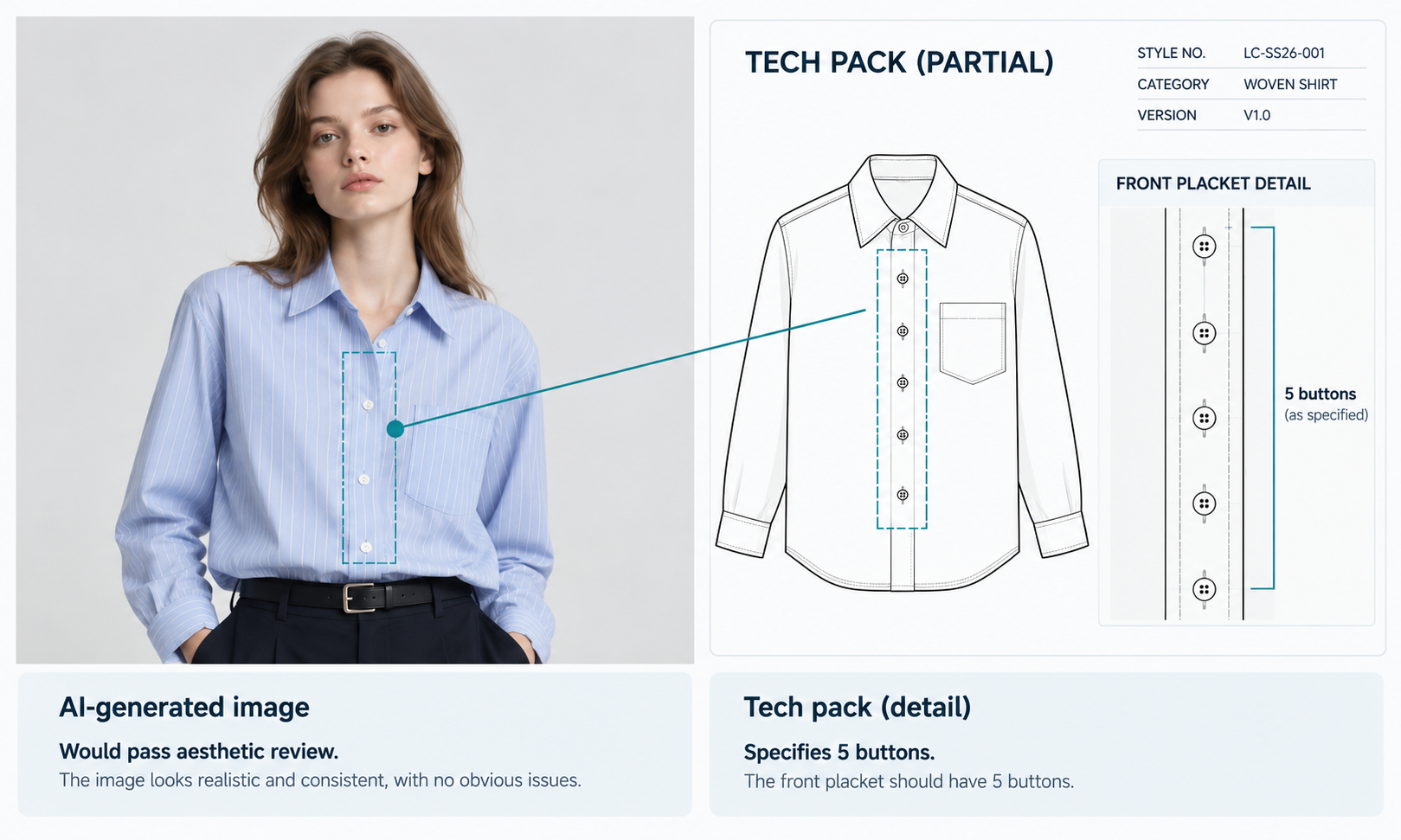
Rework in this workflow arrives in two forms, and only one of them gets caught by the people currently doing the reviewing.
The first is the obvious kind: an image that looks wrong. Odd edges, a hem that floats, lighting that disagrees with itself. Anybody can see these, they get rejected quickly, and they cost an attempt.
The second is an image that looks entirely convincing and depicts a garment that is not the one being sold. That one passes every review it encounters, reaches a product page, and generates a return, a complaint, or a correction weeks later. It is the expensive kind, and a technical designer is the only person in the building reliably able to catch it.
Conformity errors pass aesthetic review
A merchandiser looking at a generated image is asking whether it is a good image. That is the right question for them to ask and it does not detect a two-button closure where the specification says three.
The reason is not carelessness. Conformity errors are invisible without the specification in hand, and nobody reviewing forty assets in an afternoon is holding forty tech packs. The image is internally coherent, professionally lit, and wrong in a way that requires a different kind of knowledge to see.
This is why adding more general review does not reduce this category of rework. Doubling the number of people asking whether an image looks good produces a more thorough answer to a question that was never the problem.
The cost of finding one late
Worth being concrete about why this category justifies a dedicated check, because the argument otherwise sounds like extra process.
An aesthetic reject costs an attempt and ten minutes. A conformity error found after publication costs a corrected listing, a reissued asset set, and often a conversation with a customer who received something different from the picture. The two are not the same order of expense, and only the second one damages anything beyond a schedule.
There is also a compounding effect. Conformity errors propagate through every variant derived from the same base, so a single unnoticed closure error becomes forty wrong images rather than one — which is the argument for where the check belongs rather than merely whether it should exist.
Where conformity errors originate
Three sources account for nearly all of them, and each has a different fix.
The source photograph shows a garment that is not the final one. A proto sample was photographed, the design changed, and the imagery carries the older version. This is a version-control problem rather than a generation problem.
The reconstruction alters proportion. Placing a garment on a body of different dimensions from the source requires the system to reinterpret the silhouette, and that reinterpretation can shift a waist seam or a hem relative to where the pattern puts it.
Details are constructed rather than transferred. Anything the source did not resolve clearly — a closure, a pocket detail, topstitching, a small trim — is generated to look plausible, and plausible is not the same as specified.
Only the first is preventable by process. The other two require someone to look, which is the argument for the check.
The distinction matters when a team tries to solve this with better tooling. Version control fixes the first source and does nothing for the other two, so a team that tightens its sample tracking and expects conformity errors to disappear will be disappointed by roughly two thirds.
What a technical designer should check
The instinct is to check everything, and that would make the technical designer a bottleneck within a week. The efficient version is narrow.
| Check | Why it matters | Time |
|---|---|---|
| Closure type and count | Constructed frequently, specified precisely | Seconds |
| Seam and panel positions | Reconstruction shifts these under proportion change | Seconds |
| Pocket presence, type and placement | High-visibility spec item, often approximated | Seconds |
| Trim and hardware form | Generated to look right rather than to match | Seconds |
| Hem and sleeve length relative to the spec | Proportion changes show here first | Seconds |
| Print or panel placement across seams | Rarely correct unless the source resolved it | Seconds |
Six looks, under two minutes for a familiar style, and against the specification rather than against an impression of the garment. The last part is what distinguishes this from a general review: the reference is the document, not the memory.
Where to insert the check without creating a bottleneck
Do not put a technical designer in the path of every asset. Put them in the path of every style.
One asset per style, checked properly, catches the conformity errors that would otherwise propagate through all of that style's variants. A colorway set derived from an approved base inherits its conformity, so checking the base and spot-checking the derivatives is both cheaper and more effective than checking each one shallowly.
Sequence it before the batch expands. Checking the anchor image before forty variants are generated turns one correction into one correction; checking afterward turns it into forty.
This has a scheduling implication worth agreeing in advance. The check has to happen between anchor approval and batch generation, which is a gap that does not currently exist in most workflows and needs to be created deliberately. A day of lead time on the anchor is usually enough, and it is much cheaper than the alternative.
Where the flagged issue is a material or color rather than a construction detail, the correction is often a regeneration from the same base rather than a rebuild — see fabric, color and style substitution.
Feed the finding back upstream
A check that only rejects assets is a filter. A check that changes what arrives is worth considerably more.
Record which errors recur. If closures are consistently constructed wrongly on a particular style type, the fix is a better source photograph of that detail rather than a repeated correction. If proportion shifts appear whenever a garment is placed on a taller body, the base image selection is the lever.
Most of what a technical designer finds in the first month is fixable at the source, and a short weekly note back to whoever shoots and whoever generates removes more rework than any amount of downstream diligence. Keep the note to three lines and send it whether or not anything was found, since a report that only appears when something is wrong gets read as criticism rather than as information. The AI Virtual Try-On module in Lightchain AI (apparel AI) works from an approved source image, which is where most of these corrections actually land — see AI virtual try-on.
What the check cannot do
Conformity review confirms that the depicted garment matches the specification. It does not extend to anything else, and treating it as broader creates a different problem.
The output remains a visual asset. It does not predict fit, determine sizing, model how a fabric behaves in motion, or forecast returns. A technical designer confirming that a seam is in the right place has not confirmed that the garment fits, and that distinction needs to survive into whatever sign-off language the team uses.
Nor does the check validate the specification itself. If the tech pack is wrong, an image conforming to it is also wrong, and imagery review is not a proxy for pattern review. Occasionally the check surfaces a genuine specification error, which is a useful accident rather than a purpose.
And anything containing a logo, wordmark or printed text still needs comparison against the source on every asset, since reconstructed text is frequently almost correct.
Questions technical designers ask
Why is this our job rather than the studio's? Because conformity requires the specification, and nobody else in the review chain is holding it. The studio can judge image quality; only someone with the tech pack can judge whether the depicted garment is the specified one.
How much time should this take per style? Under two minutes for a familiar style, using the six checks against the document rather than from memory. If it is taking longer, the check has expanded into a general review.
Should we check every asset? One per style, before the batch expands, then spot-check the derivatives. Variants inherit the conformity of the base they came from, which is what makes the anchor check efficient.
What if the error is in the source photograph? Then it is a version-control issue and it will recur. Flag it to whoever manages sample rounds rather than correcting the asset, because correcting the output leaves the cause in place.
Does approving an image imply approving the garment? No, and the sign-off language should say so. Confirming that an image matches a specification is a narrower statement than confirming a garment is correct, and conflating the two creates exposure nobody intended.
What is the most common error? Constructed details — closures, pockets, trims — that look plausible and do not match. These are generated rather than transferred whenever the source did not resolve them clearly.
Where the rework actually comes from
Not from images that look wrong, which get caught for free, but from images that look right and depict something else. That category is invisible to aesthetic review and visible in seconds to anyone holding the specification. Six checks, one asset per style, before the batch expands, with the recurring findings sent back to the source rather than corrected repeatedly downstream. A technical designer inserted at that single point removes a class of rework that no amount of additional general review will touch.
Check the anchor image against the tech pack before the batch expands.
**Take one asset per style, open the specification beside it, and look at closures, seams, pockets, trims, lengths and print placement. Under two minutes each, and it prevents the same error appearing across every variant derived from that base. Note which errors recur and send that list to whoever shoots the sources. → **AI virtual try-on
About the author
[REPLACE — real person's name, role, relevant experience, LinkedIn URL. No team byline.]