
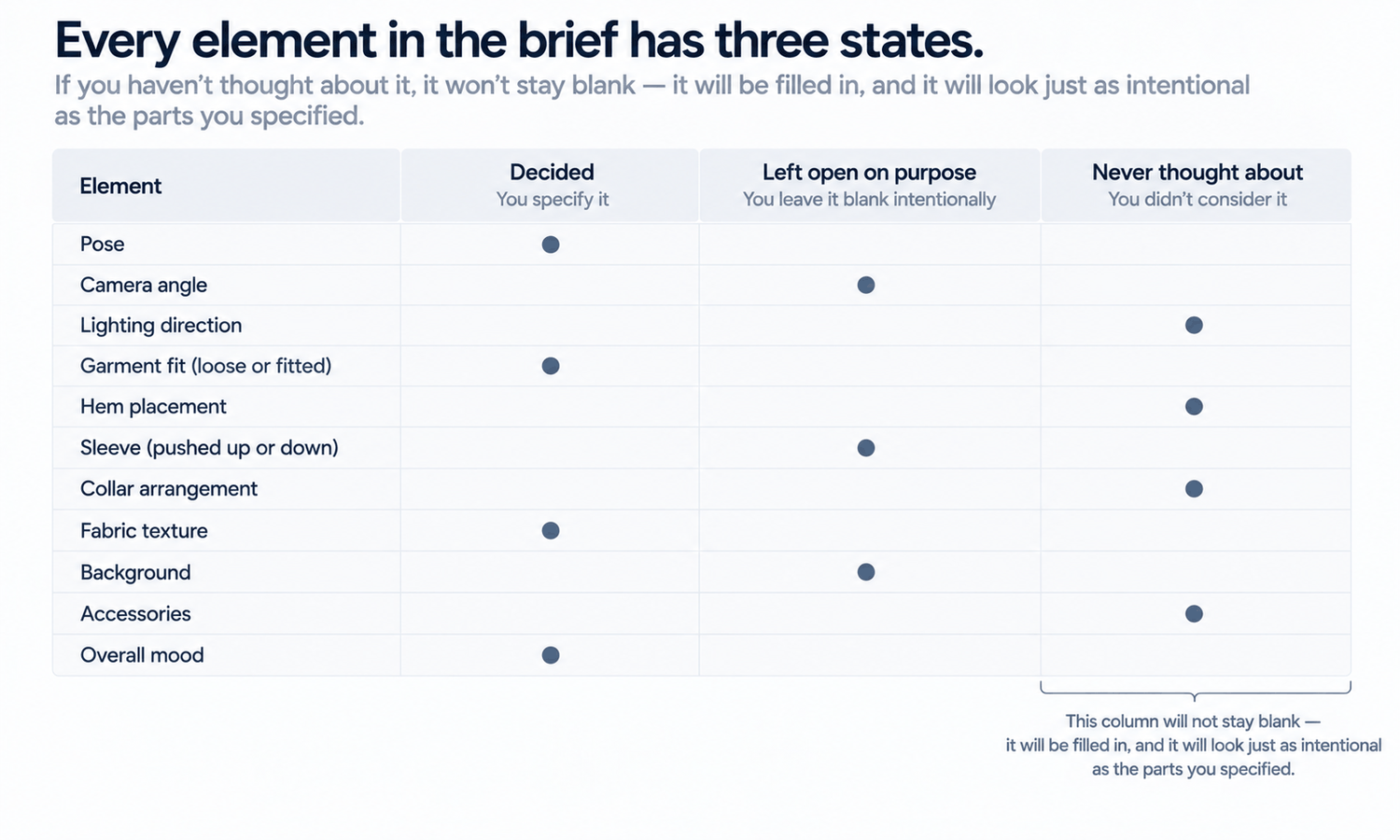
A design brief given to a person relies on judgment to fill the gaps. You describe the direction, they ask a question or make a sensible call, and the parts you did not mention come back roughly the way you would have chosen.
A brief given to a generation run works differently in one specific way. There is no judgment filling the gaps. There is something filling them, and it fills them with whatever is plausible for garments of that kind, which is often reasonable and is never a decision anybody made.
That is the whole difference. What you leave out of the brief does not stay open. It gets decided, invisibly, and arrives in the result looking exactly as intentional as the parts you specified.
Omissions do not stay open, they get filled
The practical consequence is that a brief cannot be judged by what it says. It has to be judged by what it does not say, because the unspecified parts are where the surprises live.
Somebody searching for an ai clothes swap free option is usually working quickly, and the quick version of a brief is a sentence and a photograph. That produces results, and it produces them with a large number of decisions taken on your behalf: the pose, the lighting direction, the way a hem sits, whether a sleeve is pushed up, how a collar is arranged. Any one of those can be the thing a client objects to, and none of them was a choice you would remember making.
So the useful move is not a longer brief. It is a brief that distinguishes three states for every element that matters: decided, deliberately open, and not thought about. The third category is the one to shrink.
The source photograph is most of the brief
| What you want to control | Carried by the source photograph | Carried by the words |
|---|---|---|
| The garment itself: cut, proportion, construction as visible | Almost entirely | Nothing. Words cannot describe a garment into existence |
| Prints, logos, labels, and small hardware | Entirely, and only if they are legible at a checkable size | You can flag which ones matter, which changes review rather than output |
| Fabric character and how a surface reads | Most of it | A little, and less than people expect |
| Pose, model direction, scene, and framing | Not at all | This is where instructions actually decide something |
| Which details are load-bearing for this run | Not at all | Entirely, and leaving it unsaid is the most common omission |
Reading the table, the pattern is that words adjust and the photograph determines. People coming from a design background tend to invert this, writing a careful paragraph and using whatever garment photograph was to hand, which is roughly like specifying a print run in detail and supplying a smudged original.
Practically, that means the effort belongs upstream. A garment shot complete, unobstructed, evenly lit, at a consistent distance, against a plain background, carries more of your intent than any amount of description will. If the piece has a detail that matters, it needs to be legible in the source at a size where somebody could check it afterwards.
That last point is not only about quality. Logos, printed text, care labels, and small hardware get compared against the source image on every single output, without exception, and a source that cannot support that comparison makes the check impossible rather than merely difficult. Reconstructed detail lands almost right — a letterform slightly off, a stitch count wrong, a zipper pull the wrong shape — and almost right is what survives a quick look.
What to close before you run anything
Five things are worth deciding in advance, because each one is otherwise decided for you.
-
What the output is for: an internal look, a client presentation, a product page. The intended use sets the accuracy bar and it is the field people most often skip
-
Which details are load-bearing, named individually. A placement print, a logo, a specific closure — anything a viewer would notice being wrong needs to be called out, because generic instructions do not protect a specific detail
-
The fixed elements: one model direction, one pose, one scene, held constant across a set in Model Studio so the outputs can sit next to each other
-
The variant budget, and what will decide between the variants. Two options with a stated basis beats eight with none, and the eight cost review time from whoever has the least of it
-
What happens to a near miss: whether a failing region gets a targeted correction or the whole thing is rerun, since rerunning one item inside a set is how a set stops matching itself
The first field does more work than it looks. A brief for an internal mood check and a brief for a product page are the same words with completely different tolerances, and writing the intended use at the top changes how everything under it gets reviewed.
What to leave open, deliberately
A brief that closes everything is not better. It is slower to write, it produces fewer usable options, and it removes the exploration that made the approach worth using.
The distinction that matters is between deliberately open and never considered. Writing down what you do not care about takes one line and has an effect out of proportion to its length: it tells whoever reviews the output which differences are worth raising and which are noise. A note saying the background and the pose are unimportant on this run means nobody spends twenty minutes on either.
Colorway and fabric direction** is the field most usefully left open early and closed late. Exploring several directions before committing is where a lightweight workflow earns its place, and the survivors get narrowed by a physical decision rather than by a screen. Leaving it open on purpose is a brief decision; leaving it open by accident produces a set nobody can compare.**
What no brief can specify
The output is a visual asset. It does not predict fit, determine sizing, model how a fabric behaves in motion, or forecast returns. Those come from measurements, a graded pattern, a physical sample, and your own data. No instruction in a brief changes that, and a brief written as though it might is the origin of a specific kind of disappointment.
Two things follow. A brief cannot ask for a garment to be shown fitting correctly, because fit is not a property of the image and asking for it produces an appearance rather than an answer. And a brief cannot specify a shade in any binding sense: screen color is not a physical reference, exact code matching is not something to promise, and the gap between a monitor and a roll of cloth stays open regardless of display quality. Colorways get settled by strike-offs against an agreed standard, so a colorway named in a brief is a direction to explore rather than a target to hit.
Scope is worth writing into the brief template itself. Footwear is not covered by this class of workflow, and that is structural rather than a gap waiting to close. Lace and open work, sheer fabrics, complex prints, and heavily layered looks are documented weak spots, so a brief in those categories should carry lowered expectations or route to photography instead.
Write it once and reuse it
A brief written from scratch each time gets shorter every week until it is a sentence again. The version that survives is a short template with defaults.
Set the fixed elements once per collection rather than per style: the model direction, the scene, the accuracy bar, and the standing note about which details always get checked. Then a per-style brief only records deviations from that default, which makes it three lines long and makes the deviations visible rather than buried in repetition.
In Lightchain AI (apparel AI) the uploaded source stays beside the on-model outputs it produced, which matters here because a brief is only auditable if somebody can later see which source and which settings it was applied to. Whether the work runs through Lightchain AI or a browser tab, keep the brief with the source and the outputs rather than in a separate document, since a brief nobody can locate is a brief that gets rewritten from memory.
Frequently asked questions
Is there a free version of this kind of tool?
Terms change, so read the current listing rather than relying on any article including this one. What does not change is that writing the brief and checking the result cost the same regardless of what generation costs, and those are usually the larger share of the work. Budget the attention rather than only the fee.
How long should a brief be?
Long enough to close the five fields and short enough to be written every time, which in practice is under ten lines for a first brief and about three for subsequent styles in the same collection. A brief that takes fifteen minutes will be skipped on a busy day. Skipping it is worse than a short one.
Our results are inconsistent. Is that a brief problem?
Check the source photographs first, since inconsistency usually enters at capture rather than in the words. If the sources share a position, distance, background, and light, then look at whether the fixed elements were actually held constant across the set. Inconsistent briefs are a real cause and a less common one.
Should the brief name the tool or the settings?
Name the settings if you can record them, because a defect shared across several outputs has one cause and finding it requires knowing what they shared. The tool matters less than the settings profile. If settings cannot be recorded, note that explicitly, so nobody later assumes a record exists.
Who should write the brief?
Whoever holds the intent, at the moment they hold it, rather than whoever runs the generation. Intent does not survive being relayed, and a brief reconstructed by a second person is a guess presented with confidence. If those are different people, the writer should be the one who will be dissatisfied with a wrong result.
What if we genuinely do not know a field yet?
Write it as open rather than leaving it blank, and say what will settle it. A blank reads as an oversight to whoever reviews the output, and an explicit open reads as a question with an owner. This matters most for the intended use, since a run with no stated purpose gets reviewed against whichever standard the reviewer assumed.
In closing
A brief for a generation run is not a description of what you want. It is a list of decisions you are making rather than leaving to be made for you, and its quality is measured by how few elements fall into the category of never considered. The source photograph carries more of it than the words do, so the effort belongs at the capture rather than in the phrasing. Close the five fields, name what you deliberately do not care about, and keep the whole thing short enough to write every time.
Start here
Take the last output you were unhappy with and work out which element you objected to. Then check whether that element appeared anywhere in the brief. It almost never does, and the point of the exercise is not the individual case but the pattern: the same two or three fields go unspecified every time, and those are the ones that belong in your template. Do it for three recent outputs rather than one, since a single case looks like bad luck and three look like a habit.
**Start with the on-model workflow → **https://www.lightchainai.com/global/solutions/aiVirtualTryOn