
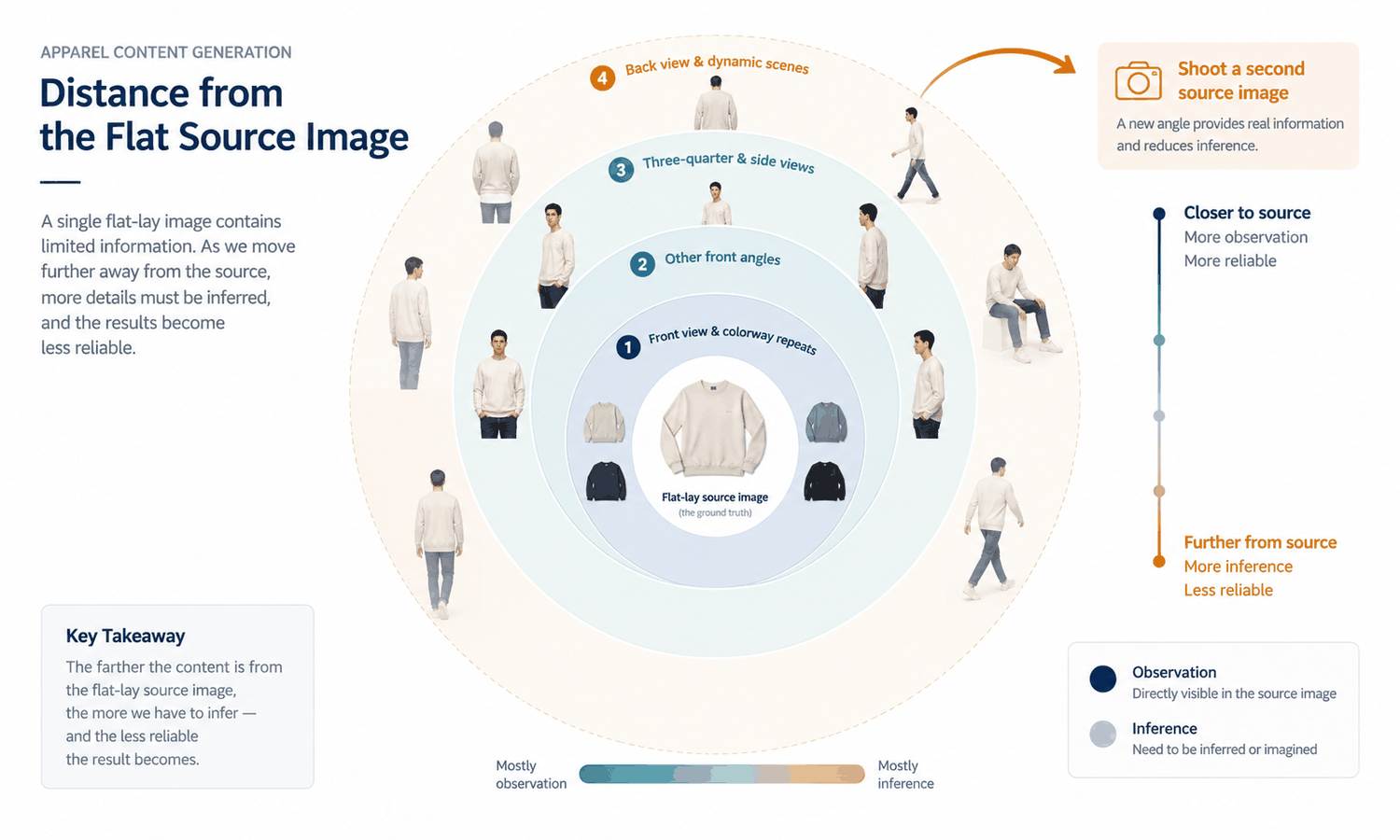
One flat-lay can produce a set of on-model images, and the sentence is worth reading carefully. It can produce a set — not an unlimited one, and not a set whose every member is equally trustworthy.
The useful way to think about it is distance. Each image you generate sits some distance from the source photograph, measured in how much the software had to invent rather than observe. Close-in variations usually resolve on the first attempt and rarely need a second look. Distant ones consume attempts, need more checking, and eventually stop being worth producing. Knowing where that line sits for your product is what separates a campaign from a folder of near-misses.
What one flat-lay actually contains
A flat-lay is a garment photographed lying down. It records the shape when unworn, the color under one lighting condition, the print or weave at whatever resolution the shot allows, and the construction details visible from above.
It records nothing about how the piece behaves on a body. It does not show where the shoulder sits, how the hem falls when someone moves, or what the back looks like. All of that has to be generated when the garment appears on a model — the angle and the view can be set deliberately, but what fills those views is produced rather than recorded, and that is where variance enters.
This is not an argument against the method. It is the reason a good flat-lay is worth more than an average one: everything downstream is built from what that single frame observed.
The practical version is a short shooting note. Lay the garment so the silhouette is unambiguous, light it evenly so the weave is visible, keep the edges clear of the background, and shoot at a resolution comfortable for the largest destination. Keep the file in a format the upload accepts — WebP, JPG, PNG or AVIF — and within the size limit. Four instructions and one file check, applied once, and the reliability of every derived image rises.
The set you can build, and how far each part sits from the source
| Variation | How much is inferred | Practical reliability |
|---|---|---|
| Front on-model, neutral pose | Least — closest to the observed shape | High, usually first attempt |
| Alternate front angles | Small extrapolation from observed detail | High |
| Colorway repeats | Color changes, structure stays | High, the strongest case |
| Three-quarter and side views | Moderate inference at the edges | Workable, needs checking |
| Back views | Substantial inference, nothing observed | Variable, check every one |
| Different body types | Silhouette must be reinterpreted | Variable by garment |
| Movement and scene shots | Drape behavior is invented | Weakest, treat as illustrative |
Read the table as a budget rather than a menu. The top four rows are where most campaigns should live, and the bottom rows are worth producing deliberately rather than by default because someone wanted more images.
Back views deserve a specific warning. Nothing in a front flat-lay observes the back of a garment, so a generated back view is a plausible construction rather than a record — including one produced by an angle control, since the control changes where you are looking from, not what was photographed. On a plain style that is usually acceptable; on anything with a seam, panel, or closure at the back it needs checking against the actual product every time.
Distance from the source drives the cost
The generation step is not meaningfully more expensive for a distant variation than a close one. Everything around it is.
Close variations resolve on the first attempt and pass review quickly. Distant ones take several attempts, and each output needs a slower look because the reviewer is checking invention rather than reproduction. In practice a back view or a movement shot can consume more total time than five front variations, which inverts the intuition that more images equals more value.
Track it once and the pattern becomes obvious. Log attempts and review minutes by variation type across one range, and the budget writes itself.
The finding is usually uncomfortable for whoever proposed the largest asset set. A brief asking for twelve images per style tends to contain three that carry the listing and nine that were included because the number sounded thorough, and the nine consume most of the schedule. Cutting the brief is a legitimate response to the data.
Where a second input beats a tenth variation
There is a crossover point, and most teams pass it without noticing.
If you find yourself repeatedly attempting back views, movement shots, or a substantially different body type from a single front flat-lay, the cheaper move is usually to capture a second source — a back flat-lay, or a single clean on-model reference of that garment. One more photograph converts a series of expensive inferences into a series of cheap observations.
The signal to watch for is retries clustering on one variation type. Retries spread evenly across a batch mean the input is weak overall; retries concentrated on back views mean you are asking one frame to describe something it never saw.
For a range where the same silhouette recurs across styles, a small library of reference captures pays back quickly, since each one raises the reliability ceiling for every garment sharing that shape.
Organize that library by silhouette rather than by season. Seasons expire and shapes do not, and a reference filed under last autumn will not be found by the person working on a similar shape two years later, which is the moment it would have been worth most.
Build the set in the right order
Approve the anchor before producing anything else. The anchor is the front on-model image that everything else will be consistent with, and generating a full set before anyone signs off on it is the most common way a batch gets rebuilt.
Then work outward in order of distance. Front angles and colorways next, three-quarter views after that, and the inference-heavy variations last — by which point the deadline pressure will have clarified whether they are actually needed.
Reviewing at the size the asset will be seen keeps this honest. A back view that looks uncertain at full screen may be entirely adequate in a listing grid, and a colorway that looks fine at full screen may be visibly wrong at the size a customer sees. Where a check fails on one region rather than the whole frame, rebuilding that region against a reference is faster than another full generation. The AI Virtual Try-On module in Lightchain AI (apparel AI) produces the on-model set from that single approved source — see AI Virtual Try-On.
What the set cannot claim
Everything above concerns whether an image is usable. Several things sit outside that entirely.
The output is a visual asset. It does not predict fit, it does not determine sizing, it does not model how the fabric behaves in motion, and it does not forecast returns. Those come from measurements, a graded pattern, a physical sample, and your own returns data.
Movement shots deserve a second mention here, because they are the most likely to be misread. A generated image of a garment mid-movement shows a plausible drape, not the drape. Anyone using it to judge how a fabric will hang is reading a rendering as an observation. The same applies to a video generated from the still: motion can be produced from a photograph, and what it shows is an interpretation rather than a record, with frame-to-frame consistency a known weak point.
Say this when the set is delivered rather than assuming it is understood. The images look like photographs, and people treat photographs as evidence.
The risk grows as the set travels. An anchor image reviewed carefully by the team that made it ends up in a wholesale deck, then in a supplier thread, then in a buyer's folder, and each hop strips a little more context. A single line in the file name or the delivery message survives those hops better than any conversation.
Consistency is the deliverable
Individual images are not what a campaign needs. What it needs is forty assets that look like they belong together, and this is the one thing a single-source set does better than a multi-day shoot.
Every image derived from one approved anchor inherits the same lighting, the same model, and the same treatment. That coherence is difficult and expensive to achieve with a camera across several sessions, and it is close to automatic here.
Protect it by resisting mid-batch changes. Swapping the anchor halfway through, or regenerating a few images with a different setting because they looked slightly better, produces a set that fails as a set while every member passes individually. When something does have to change, change it through the same model and scene settings rather than editing one image into agreement — see Scale E-commerce for how that coherence carries across a catalog.
Questions apparel teams ask
How many images can one flat-lay realistically produce?
Enough for a listing set and a colorway range, and fewer than the tool will let you generate. The limit is not technical, it is how far each variation sits from what the source actually observed.
Are generated back views usable?
On plain styles, often. On anything with back seams, panels, closures or distinctive construction, check every one against the product, since nothing in a front flat-lay observed that side — a back view is produced from the garment, not photographed from it.
Should the flat-lay be shot specifically for this?
It helps considerably. Even lighting, clear garment edges, and enough resolution for the destination size raise the reliability of everything derived from it, and a flat-lay shot for archiving rarely meets those conditions.
What about movement or lifestyle shots?
Treat them as illustrative rather than descriptive. The drape shown is invented, which is acceptable for mood and unsuitable for anything where a customer is judging how the fabric hangs.
Can we mix generated and photographed images in one set?
Yes, and the risk is consistency rather than legitimacy. Match the generated set to the photographed anchor rather than the reverse, and review the whole set together at destination size.
When should we shoot instead?
When the same variation type keeps failing, when material truth is the point of the image, or when the campaign needs art direction rather than coverage. Those three cover most of the cases where generation is the wrong tool.
What the flat-lay actually buys
A coherent set, built outward from one observed frame, with reliability that decreases as each variation moves further from what was actually photographed. Approve the anchor first, work in order of distance, watch for retries clustering on one variation type, and take a second capture when they do. The output is imagery and behaves like imagery — it will not answer a question about fit, and it will produce forty assets that match each other better than three days of shooting would.
Approve one anchor image before generating anything else.
Produce the front on-model image from your flat-lay, get it signed off at the size it will actually be seen, and only then work outward through angles, colorways, and the inference-heavy variations in that order. Log which variation types generate retries as you go. When retries concentrate on one type, take a second photograph rather than a tenth attempt — one more capture usually costs less than the attempts it replaces. → AI virtual try-on