
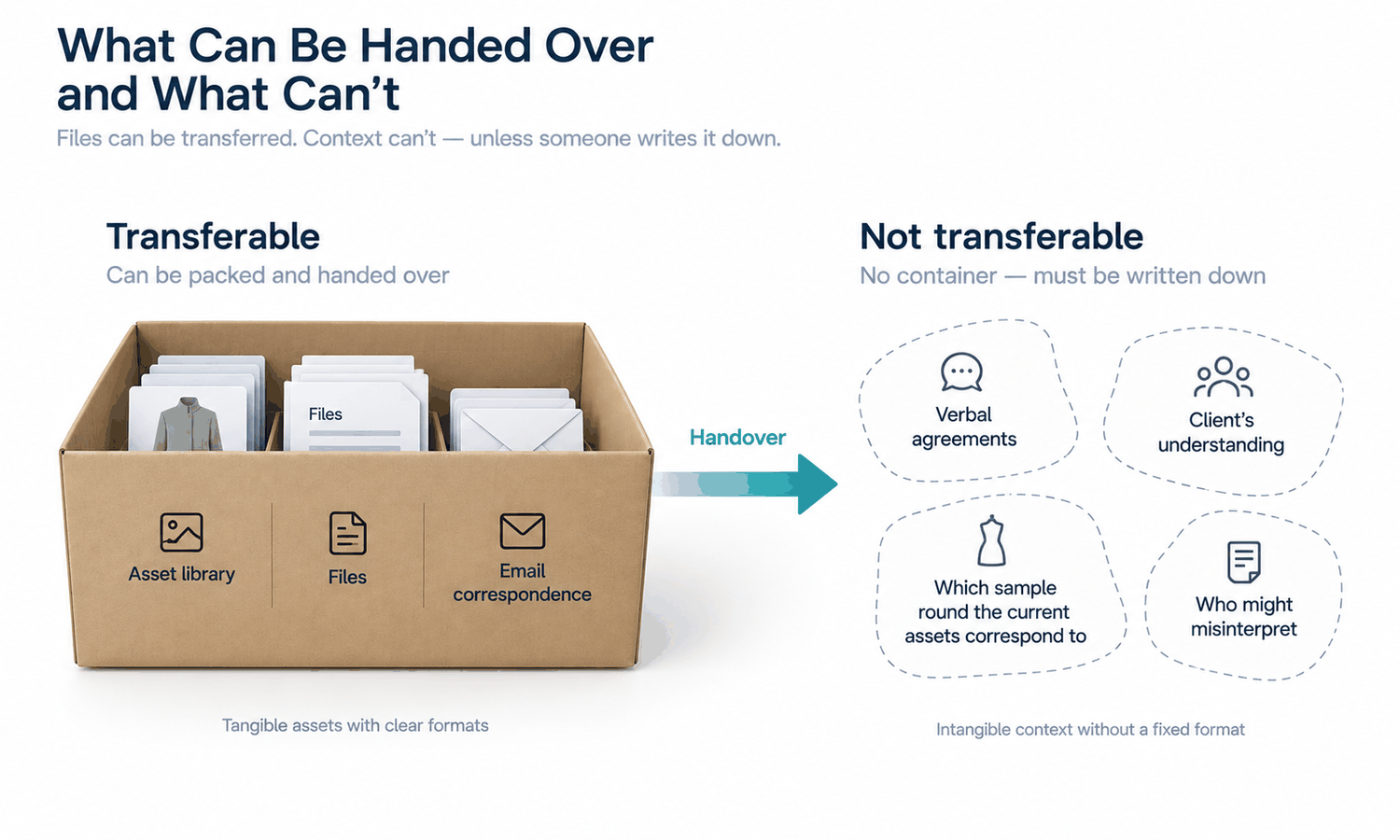
Accounts change hands. Someone leaves, a territory gets reassigned, a maternity cover starts on a Monday with eleven clients and no context. What transfers in that moment is not the asset library — it is the set of agreements, exceptions and half-remembered conversations that make the library usable.
Generated imagery has made that handover harder in a specific way. There are more assets, produced faster, under conditions that were never written down, and the person receiving the account cannot tell by looking which of them are safe to send.
The library transfers, the reasoning does not
Files are easy to hand over. A folder is a folder.
What does not transfer is why a particular client only ever receives imagery after their sample round closes, or that another one asked eighteen months ago never to be shown generated visuals in a wholesale context, or that a third has a buyer who reads any on-model image as a fit representation and has to be told otherwise every season.
Those are the conditions under which the assets are usable, and they live in one person's head until that person leaves. The new account manager then either discovers them by making the mistake, or governs so cautiously that the account slows down.
Both failures are attributed to the successor. A client whose standing request was broken concludes that the new person is careless; a client whose account has stalled concludes that the new person is slow. Neither conclusion reaches the actual cause, which is that nothing was written down.
Five things that belong in the file
| Item | Why it cannot be inferred | Length |
|---|---|---|
| What imagery this client has been told it represents | Determines what can be sent without a caveat | One line |
| Any standing restriction | Frequently a verbal agreement with no record | One line each |
| Which sample round current assets came from | Determines whether a reissue is pending | One line per active style |
| Who on the client side reads images as specification | Prevents a predictable misreading | One line |
| Open items from the last reissue | Otherwise they resurface as a surprise | One line each |
Five categories, most of them a line long. The file is not a document to be written; it is a short list maintained continuously, which is the only version that survives an unplanned departure.
The third row is the one that ages fastest. An asset set is only meaningful relative to the sample it was derived from, and a successor who does not know which round is looking at pictures with no provenance.
Standing restrictions are the highest-value item
Every account accumulates conditions that were agreed once and never recorded. No generated imagery in the seasonal presentation. Always send the original photograph alongside. This buyer wants the physical swatch before any colorway discussion.
These are usually reasonable requests made by clients with a reason, and breaking one is a relationship event rather than a process error. The client will assume the agreement was ignored rather than forgotten, and there is no way to demonstrate otherwise.
Write each one with a date and, where known, the reason. The reason matters because a successor who understands why a restriction exists can renegotiate it sensibly, while one who only knows the rule can either follow it forever or break it blindly.
Dates matter for a related reason. A restriction agreed when generated imagery was unfamiliar to the client may no longer reflect their position, and a dated entry invites that conversation while an undated one reads as permanent.
What the incoming person needs on day one
Not the full history. Three questions answered.
Which of this client's active styles have imagery that will need reissuing when the next sample round lands. Which conversations are open. And what this client believes the imagery represents, stated in the words the client would use rather than in the words your team uses internally.
Those three cover the first two weeks. Everything else can be picked up in the ordinary course of the account, and a handover document attempting completeness will not be read on a Monday morning with eleven clients waiting.
Say what the imagery represents, in the client's words
This one deserves separating because it is where the misunderstandings concentrate.
Internally a team knows the output is a visual asset — it does not predict fit, determine sizing, model how a fabric behaves in motion, or forecast returns. A client may hold a different and unexamined version of the same idea, and the account manager is the only person who knows which version.
Record what has actually been said to them. If a client was told the imagery reflects the current sample and may be reissued, that is the operative statement and the successor should keep making it. If nobody ever said anything, that is worth recording too, because it means the conversation has not happened and someone will eventually have it under pressure.
An empty entry is therefore more useful than no entry. A successor reading nothing at all cannot distinguish between an account where the ground rules are settled and one where they have never been raised, and those two accounts need completely different handling in the first month.
Where the pending question is a material or colorway rather than a construction, a reissue is usually a regeneration from the approved base rather than a new production round — see fabric, color and style substitution.
Keep it where the account lives
A handover file kept separately from the account record is a handover file that will be out of date at the moment it is needed.
Put the five items wherever the client's other information sits, and update them as part of ordinary account work rather than as a departure task. The version written during a notice period is the least reliable one available, because it is composed from memory under time pressure by someone whose attention has already moved on.
Reviewing it once a quarter takes minutes and keeps it true. That review is also the point at which restrictions get renegotiated, since a condition agreed two years ago may no longer reflect what the client wants.
Tie the review to something that already happens rather than creating a new recurring task. The end of a selling season, or the meeting where next season's assets get planned, works better than a calendar reminder, which is the first thing to be dismissed in a busy week.
What the file does not do
It transfers context and not judgment, which is the same limit any documentation has.
A successor holding the file still needs to decide what to send, when to hold, and how to phrase a caveat. Those decisions depend on reading a relationship, and no list produces that. What the file does is prevent the avoidable errors — the broken agreement, the unlabeled proto-sample imagery, the reissue nobody knew was pending. Those three account for most of the incidents that damage an account during a transition, and none of them require judgment to avoid.
Nor does it substitute for the underlying discipline. If assets are not versioned to their sample rounds in the first place, a handover file cannot record what nobody recorded. The Model Studio and AI Virtual Try-On modules in Lightchain AI (apparel AI) produce assets from an approved source image, and keeping them in a shared library with the generation history turns "which source" from a reconstruction into a lookup — see AI Virtual Try-On.
Questions account managers ask
How long should a handover file be? Short enough to read before the first client call. Five categories, most entries one line, maintained continuously rather than written at departure.
What is the single most important item? Standing restrictions, because breaking one reads to the client as disregard rather than as a gap in the handover, and the damage is to the relationship rather than to a deliverable.
Should the file record what we told the client, or what is true? Both, and separately. What was said governs the client's expectations; what is true governs what you can safely promise next. Where they differ, that difference is the most useful line in the file.
When should it be written? Continuously. A file composed during a notice period is assembled from memory by someone already disengaging, which is the least reliable version available.
Does this apply to internal handovers between teams? Yes, and it is often worse there, because internal recipients assume shared context that does not exist. The same five items apply.
What if the previous manager left nothing? Rebuild it from the client rather than from the files. Asking a client what they were told is a reasonable early conversation and produces a more accurate record than reconstructing from a folder.
What is actually being handed over
Not assets. The conditions under which those assets can be used with this particular client — what they were told, what they asked for, which sample round the current set reflects, and what remains open. Five short entries, kept with the account record and updated as part of ordinary work, cover almost all of it. The successor still has to read the relationship, and they should not also have to rediscover an agreement made eighteen months ago by someone who has left.
Write the standing restrictions for your three largest accounts today.
**One line each, with a date and the reason where you know it. Then add which sample round the current imagery came from for every active style. That is under an hour for three accounts, and it is the part of the handover that cannot be reconstructed by anyone else after you have gone. → **AI Virtual Try-On
About the author
[REPLACE — real person's name, role, relevant experience, LinkedIn URL. No team byline.]