
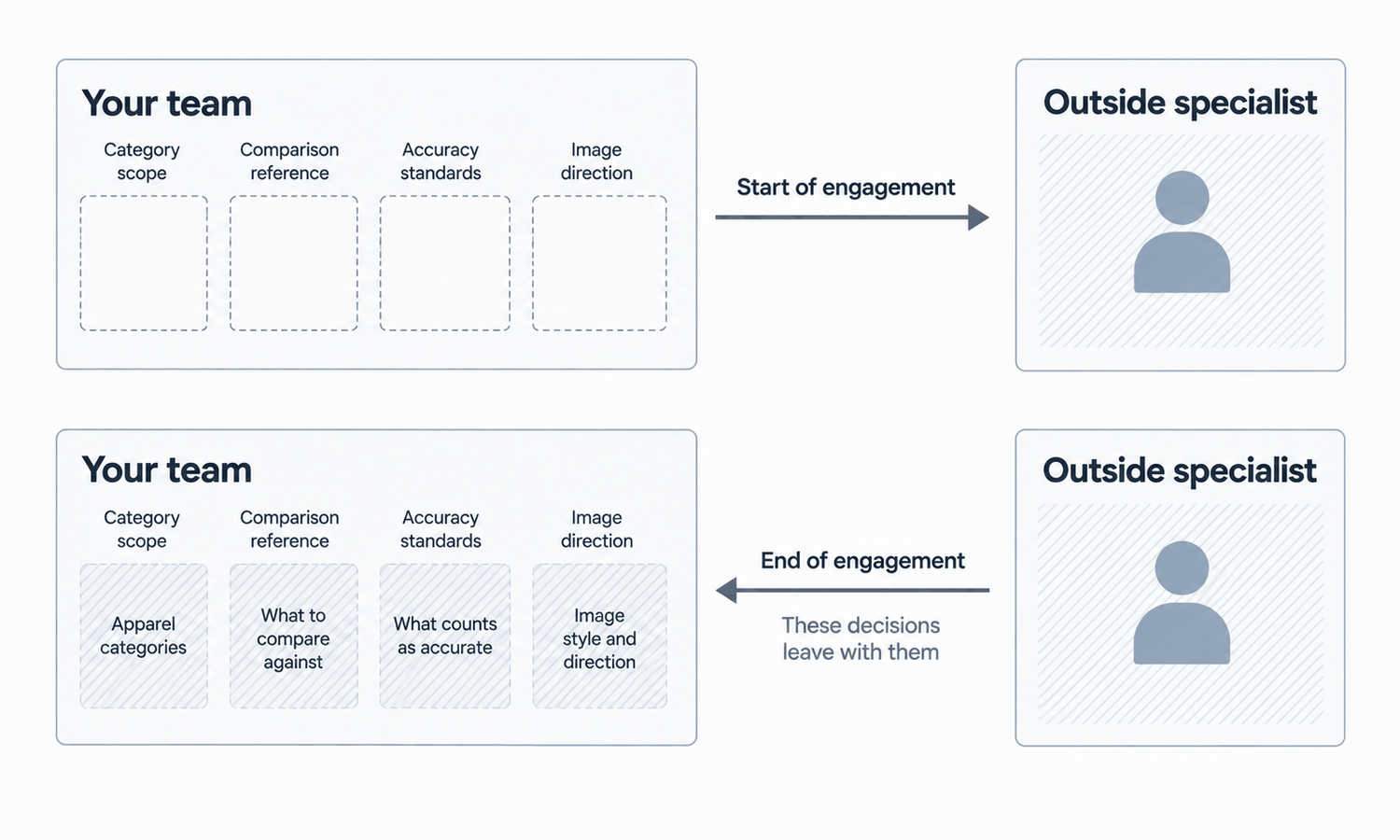
Teams reach for outside help at the moment they feel stuck, and stuck is a feeling rather than a diagnosis. It covers at least four different situations, and an outside specialist is useful in two of them.
The two where it works are knowledge problems: something needs to be done well that nobody in the building has done before. The two where it fails are a capacity problem, which is a different kind of hire, and a decision problem, which is the most common and the least visible.
Working out which one you have takes about twenty minutes and saves a great deal more than that.
Stuck usually means an unmade decision
The specific way this goes wrong is worth describing, because it does not feel like a mistake while it is happening.
A team is producing ai clothes changer online output, the results are inconsistent, and nobody can say why. Somebody suggests bringing in a specialist. The specialist arrives, finds no written capture standard, no agreed category scope, and no named owner for the comparison against source, and does the reasonable thing: they make sensible choices and get on with the work.
Those choices are now your standard. Nobody decided to hand over the definition of correct, and yet it has been handed over, to somebody who does not have your garments, does not carry your reorders, and will leave. That is the failure mode, and it is invisible until the engagement ends and the standard leaves with them.
Four problems, one phone call
| What it feels like | What the problem actually is | Does an outside specialist help |
|---|---|---|
| Our results are inconsistent and nobody can say why | Usually a capture problem: no repeatable setup, no written standard | Yes. This is a knowledge gap and the skill transfers into something you keep |
| We cannot trace anything back once it is published | A provenance and pipeline problem | Yes, but only after you have written down which fields matter |
| Everything takes longer than it should and we keep reopening the same arguments | A decision problem: scope, ownership, and the accuracy bar were never set | No. Nobody outside can make these, and an engagement will make them by default |
| We have more work than people | A capacity problem | A different kind of arrangement, and a specialist is the wrong shape for it |
| We are not sure our imagery looks like us | A direction problem | Briefly, and it is the thing least safe to hand over permanently |
The row worth dwelling on is the third. It looks like every other row from inside the team, since the symptom in all four cases is that things are not working. The distinguishing question is whether somebody could write down the right answer if they had a quiet afternoon. If yes, it is a decision problem and no external party can help. If no, it is a knowledge problem and one can.
Where a specialist genuinely pays: the capture standard
The highest-value outside help in this area is usually photographic rather than technological, which surprises people who came to the problem through software.
Every generated image is a derivation from a source photograph, and the capture is the only stage whose defects cannot be corrected downstream. Getting a repeatable setup right is a real skill, it is not one most apparel teams have, and it is learnable in a short engagement rather than requiring a permanent hire. Somebody who does this well will leave you with a marked floor, a light you can reproduce, reference photographs of the setup, and a written card — and every on-model output afterwards inherits that work.
The second genuine knowledge gap is provenance and pipeline: whether an image on a live page can be traced back to the source that produced it, and whether identity fields survive the crossing into your commerce system. That is a specialist question and worth buying, with one condition attached. Buy it after you have written down which fields matter, not before, or you will receive an architecture built around somebody else's assumption about what you needed to keep.
If any of the work heads toward a factory, a technical designer rather than a generalist is the right specialist, since converting a look into a line drawing or tech-sheet draft in the Design & Production Workbench produces drafts that need construction judgment to review.
Where they cannot help, and should not be asked to
Four decisions have to be made inside the building, and an engagement started before they are made will make them by default.
-
Which categories are in scope and which go to photography, since that is a commercial judgment about your range rather than a technical one, and it constrains what any catalog-scale program can be scoped to cover
-
Who owns the comparison against source, by name, and whether that person has access to the source files
-
What the accuracy bar is for each use: an internal look, a client presentation, and a product page carry different tolerances
-
What the brand's imagery is supposed to look like, which is the thing you are least able to outsource and most likely to be offered
The comparison is the one that quietly transfers. Logos, printed text, care labels, and small hardware get compared against the source image on every single output, without exception, and an external party performing that check is fine provided the accountability stays with you and the evidence comes back. What is not fine is nobody noticing that the check moved, which is the usual outcome when a specialist arrives into an undefined process.
Reconstructed detail lands almost right — a letterform slightly off, a stitch count wrong, a zipper pull the wrong shape — and almost right passes an unfamiliar reviewer even more easily than a familiar one, because they do not know the product.
What no specialist can supply
The output is a visual asset. It does not predict fit, determine sizing, model how a fabric behaves in motion, or forecast returns. Those come from measurements, a graded pattern, a physical sample, and your own data. No expertise changes that, because the limit is in what the asset is rather than in who is operating it.
So a size chart cannot be produced by an engagement, and fit guidance on a page has to trace back to the measurement chart and the fit session regardless of who wrote the page. No engagement should be scoped against a return-rate or conversion outcome either, since both sit at the end of a chain running through sizing, price, assortment, and traffic, and a specialist offering one is offering something outside what the work controls.
Color has the same shape. Screen color is not a physical reference, exact code matching is not something to promise, and the gap between a monitor and a roll of cloth stays open regardless of display quality. Colorways get settled by strike-offs against an agreed standard, which stays a physical step whoever is running the workflow.
Footwear is not covered by this class of workflow at all, and that is structural rather than a matter of skill. Lace and open work, sheer fabrics, complex prints, and heavily layered looks are documented weak spots, so an engagement scoped to make those categories work is scoped against a category verdict rather than a capability gap.
Brief for the exit, not the engagement
The test of this kind of help is what you hold afterwards. An engagement that ends with better images and no written standard has produced a dependency rather than a capability.
So write the deliverables as artifacts rather than as outcomes. A capture standard with reference photographs. A settings profile, recorded and versioned. A named acceptance basis. A list of category verdicts with reasons. Those four are things a team keeps, and they are what makes a second engagement unnecessary or at least much shorter.
State the exit condition at the start: the engagement ends when somebody inside the team can run a full cycle without asking. That is a testable condition rather than a feeling, and it changes what the specialist optimizes for. Working in Lightchain AI (apparel AI) or anywhere else, the specific thing to verify before they leave is whether an output can still be traced to its source without them, since that trace is what every later diagnosis depends on. Where the uploaded source stays beside what AI Virtual Try-On produced from it, that verification is a two-minute exercise rather than an audit.
Whether the work continues through Lightchain AI or a camera, the standard is the artifact and the images are the byproduct. Teams that get this the wrong way round buy the same engagement twice.
Frequently asked questions
How do we tell a knowledge problem from a decision problem?
Ask whether somebody in the team could write the correct answer down given a quiet afternoon. Capture setup and pipeline provenance usually fail that test, which makes them knowledge problems. Category scope and who owns the check usually pass it, which makes bringing in help the wrong response.
Should we hire a photographer or a technologist?
A photographer, in most cases, and earlier than teams expect. The capture is the stage that determines everything downstream and the one where outside skill transfers cleanly into something you keep. Pipeline expertise is worth buying second, after you have specified what needs to be preserved.
What if we cannot make the decisions ourselves?
Then the engagement should be scoped to help you make them rather than to produce images, and that is a different brief with a different deliverable. Facilitating a decision is legitimate outside help. Absorbing the decision by default is not, and the difference is whether it gets written down with your name on it.
How long should an engagement run?
Until the exit condition is met rather than for a fixed period, which usually means shorter than a retainer and longer than a workshop. Define the condition as somebody inside running a full cycle unaided. Open-ended arrangements tend to optimize for continuation.
Can a specialist own the comparison check permanently?
They can perform it; the accountability should not move, since the consequence arrives at your customer. Require the comparison evidence to come back rather than just approved files. That split keeps the labor where the capacity is and the responsibility where the exposure is.
We already have an agency. Is a specialist different?
Usually yes: an agency absorbs volume and a specialist closes a knowledge gap, and they are worth briefing differently. Asking a volume partner to define your standard is the most common version of the failure described above. Decide which of the two you are buying before writing the brief.
In closing
Outside help is the right answer to a knowledge gap and the wrong answer to an unmade decision, and the two feel identical from inside a team that is stuck. Capture setup and pipeline provenance are genuine knowledge gaps worth buying. Category scope, who owns the comparison, the accuracy bar, and what your imagery should look like are yours, and an engagement that starts before they exist will settle them by accident. Brief for the artifacts you keep, state an exit condition, and check that the trace from output back to source still works once the specialist has gone.
Start here
Before contacting anybody, write down the four decisions on a single page: categories in scope, who owns the comparison, the accuracy bar per use, and what your imagery should look like. If you can fill all four, you have a knowledge problem and a specialist will help. If you cannot fill two of them, the gap is internal, and an engagement started now will fill them for you in a way you did not choose.
**Start with the on-model workflow → **https://www.lightchainai.com/global/solutions/aiVirtualTryOn