
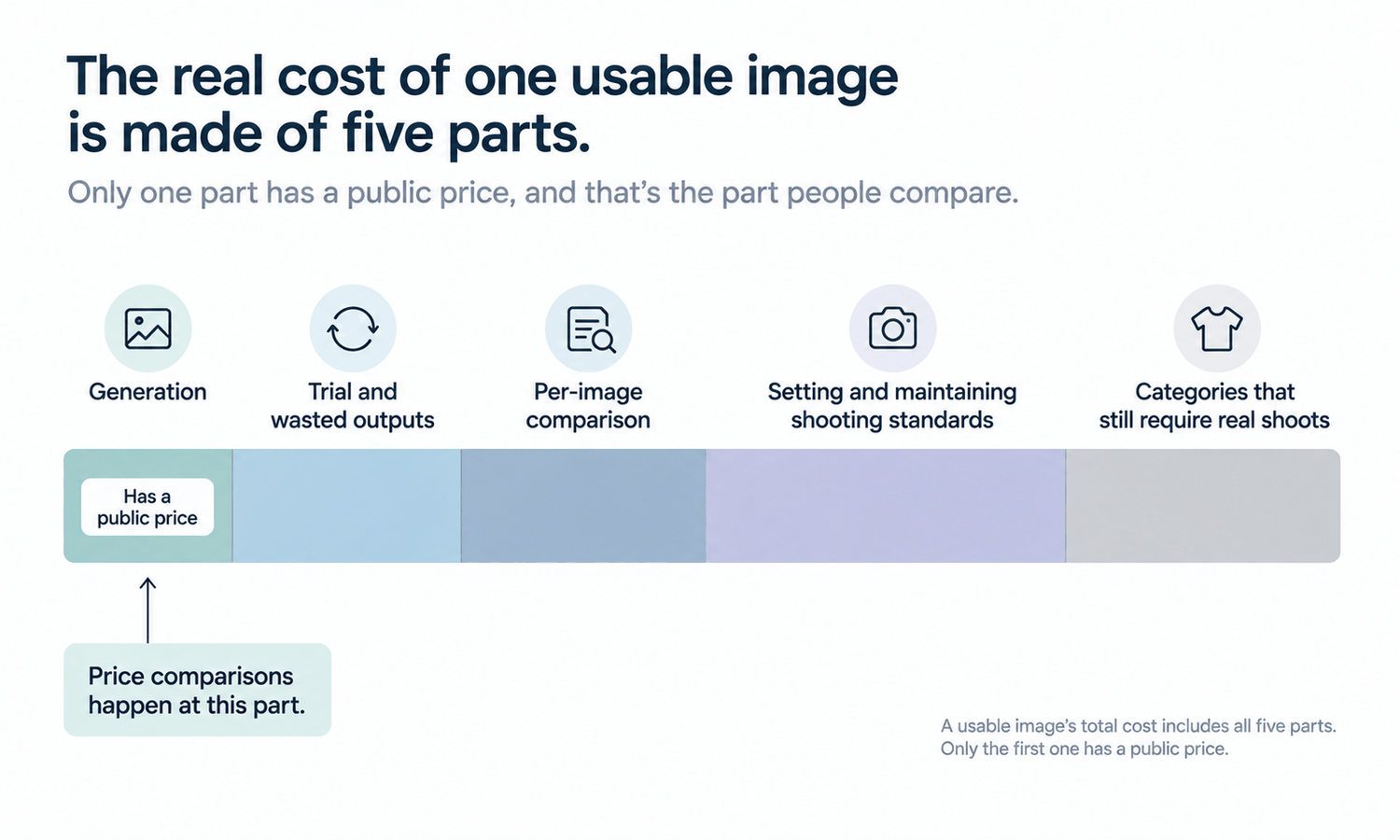
Ask what an ai clothes changer tool costs and you get a rate card. Rate cards are easy to compare, which is most of why they get compared, and they describe the smallest number in the decision.
The number that decides the budget is cost per accepted image, and it is not on any pricing page because it is set by your garments rather than by anybody's tariff. Two tools with identical list prices can differ several-fold once your categories are involved, and a team that picked on the rate card will find that out in month three.
This is not an argument against looking at pricing. It is an argument for knowing what fraction of the cost pricing represents.
The list price is the smallest number in the decision
Consider what has to happen for one usable image to exist. A garment gets photographed to a standard somebody had to define. Somebody writes a brief. A run happens, and some number of attempts produce one output that gets accepted. That output gets compared against its source, which takes a person and some minutes. Then it gets identified, filed, and published.
Generation, the step where an on-model output actually gets made, is one link in that sequence and the only one with a published price. Every other step consumes hours belonging to people who are already busy, and those hours are the part that scales badly.
That is why the useful question changes shape. Not what does an image cost, but what does an accepted, checked, published image cost, and how much does that number move between the categories you actually sell.
What the cost is actually made of
| Cost component | What it depends on | Is it on a pricing page |
|---|---|---|
| Generation itself | The published tier and how many attempts you run | Partly. The rate is, the attempt count is not |
| Attempts per accepted output | Your categories, your source photographs, and your acceptance bar | No. This is the number that decides the budget |
| The comparison against source, on every output | How quickly somebody can put an output next to its input | No, and it is the largest recurring labor cost |
| Building and holding a capture standard | What your photography looks like today | No. It is paid once and then held, and it reduces every other row |
| Categories that have to go to photography anyway | Your fabric mix rather than any tool | No, and pretending otherwise is where budgets overrun |
Reading the third column, only one row is answerable from a pricing page. The rest depend on your range, your photography, and how your team is organized, which means the same tool genuinely costs different amounts at two different brands.
That has a practical consequence for how to evaluate. A demonstration and a rate card together tell you about one row. Getting the others requires running your own styles, which is the same test worth running for quality reasons anyway.
The unit that matters: cost per accepted image
An accepted image is one that passed the comparison against its source and went somewhere. Everything else is an attempt, including outputs that looked good and lost to a change of direction.
So the calculation is your total spend divided by your accepted outputs, and the interesting part is the attempts sitting in the numerator. A category where three attempts produce one acceptance costs three times a category where one does, at the same list price, and the difference is a property of your garments rather than of the tool.
-
Record attempts per accepted output by category rather than as an average, since the average hides the categories that will actually determine your budget
-
Count review minutes alongside attempts, because a category needing more attempts usually needs more checking too
-
Include the styles you find difficult rather than the ones that work, since the difficult ones are where the cost concentrates
-
Recalculate after any change to your capture standard, as a better source usually moves this number more than any setting does
-
Treat a documented weak spot as outside the calculation rather than as an expensive row: lace, sheers, complex prints, and heavily layered looks belong with photography
Where a single region fails and the rest of the frame is sound, a targeted correction to that region counts as a smaller unit of cost than a rerun, and tracking that separately is worth the small effort because it changes what a partial failure means.
The published pricing, and what it does not tell you
For the platform's own figures: point packages start at $9.90 for 600 points, described by the company as roughly 20 images, with further tiers published alongside. Those are list figures and should be read from the current pricing page before they enter a plan, since terms change and an article is a poor source for a number that moves.
What that estimate cannot give you is the number from the previous section. Point consumption varies by feature and by settings, so a colorway pass and a full on-model generation are not the same line item. And the published estimate counts images produced, while your budget depends on images accepted, which is always the smaller figure.
The honest way to use a rate card is as a floor. It tells you what the cheapest possible version of this costs if every attempt succeeded and nobody spent any time reviewing, which is a scenario that has never happened. Your actual number is somewhere above it, and only your own test says where.
What no pricing page can buy you
Some things are outside the transaction entirely, and it is worth being explicit because a comparison conducted on features will otherwise imply they are purchasable.
The output is a visual asset. It does not predict fit, determine sizing, model how a fabric behaves in motion, or forecast returns. Those come from measurements, a graded pattern, a physical sample, and your own data. No tier, no plan, and no vendor arrangement changes that, because it is a property of what the asset is.
So a size chart cannot be bought as a feature, and any fit guidance on a page has to trace back to a measurement chart and a fit session. No spend can be committed against a return-rate or conversion outcome either, since both sit at the end of a chain running through sizing, price, assortment, and traffic.
Color sits in the same category. Screen color is not a physical reference, exact code matching is not something to promise, and the gap between a monitor and a roll of cloth stays open regardless of display quality. Colorways get settled by strike-offs against an agreed standard, which is a physical process with its own cost that no plan removes.
Footwear is not covered by this class of workflow at any price, and that is structural rather than a gap waiting to close.
How to reach your own verdict
The comparison worth running is between your current cost of producing an image and your cost with this in the workflow, on your own styles. Anything else is a comparison of tariffs.
Pick one style from each category that matters, prepare the sources to a single standard so the test measures the workflow rather than your photography, and run each three times unchanged. Record attempts per accepted output and review minutes per accepted output. That gives you two numbers per category, which is more decision-relevant information than any rate card contains.
In Lightchain AI (apparel AI) the uploaded source stays beside the outputs AI Virtual Try-On derived from it, which matters for this specifically: attempts are only countable if somebody can see which outputs came from which input. Where that link does not exist, the count has to be maintained by hand, and a count maintained by hand tends to stop after two weeks.
Then decide on the two numbers rather than on the price. Whether the work runs through Lightchain AI or a camera, the categories where attempts stay low are where this pays, and the categories where they do not are where it does not, regardless of what any tier costs.
Frequently asked questions
Is a cheaper plan a false economy?
Not necessarily, and the plan is rarely the decisive variable either way. If attempts per accepted image are low in your categories, most plans work out similar; if they are high, no plan rescues it. Decide the categories first and the tier second.
How many styles do we need to test to get a usable number?
One per category that matters to the business, with three runs each, which is usually four to six styles in total. Testing more of the same easy category adds volume rather than information. The number you want is per category rather than overall.
Should we compare several tools on cost?
For an internal decision, yes, provided the garments, source photographs, preparation, and reviewer are identical across every option, and provided you measure attempts and review time rather than list price. Keep it internal, since a published comparison needs a stated method and a defined evaluation set that an informal run does not have.
Where does the biggest saving actually come from?
Usually from the capture standard rather than from anything on a pricing page, because a consistent source reduces attempts across every category at once. That work costs an afternoon and a season of discipline rather than money. Teams that fix it first find the tool decision matters less than they expected.
What is the cost of getting this wrong?
Mostly review hours spent on outputs nobody uses, which does not appear on any invoice and shows up as a team that feels busier without producing more. Track attempts per accepted output for a month and the figure becomes visible. It is the cheapest diagnostic available.
Do we need to redo this calculation later?
Recalculate after a change to your capture standard or after a product update, since both can move attempts per accepted image. A schedule-based recalculation on an unchanged setup returns the same answer at a cost. Keep the original test set so the second run is a comparison rather than a fresh opinion.
In closing
Pricing is the visible part of a decision that is mostly invisible. What a usable image costs is set by how many attempts your categories take, how many minutes the comparison takes, and how consistent your source photography is, and none of those three appear on a rate card. Read the published figures as a floor, then run four to six of your own styles and record two numbers per category. Those numbers are the comparison, and they are specific to you in a way no tariff can be.
Start here
Before looking at any pricing page, count something you already have: for your last twenty published images, how many outputs were generated in total. The ratio between those two figures is your attempts per accepted image, it costs nothing to work out, and it will tell you more about your budget than any published rate. Most teams have never calculated it and are surprised by both directions.
**Start with the on-model workflow → **https://www.lightchainai.com/global/solutions/aiVirtualTryOn