
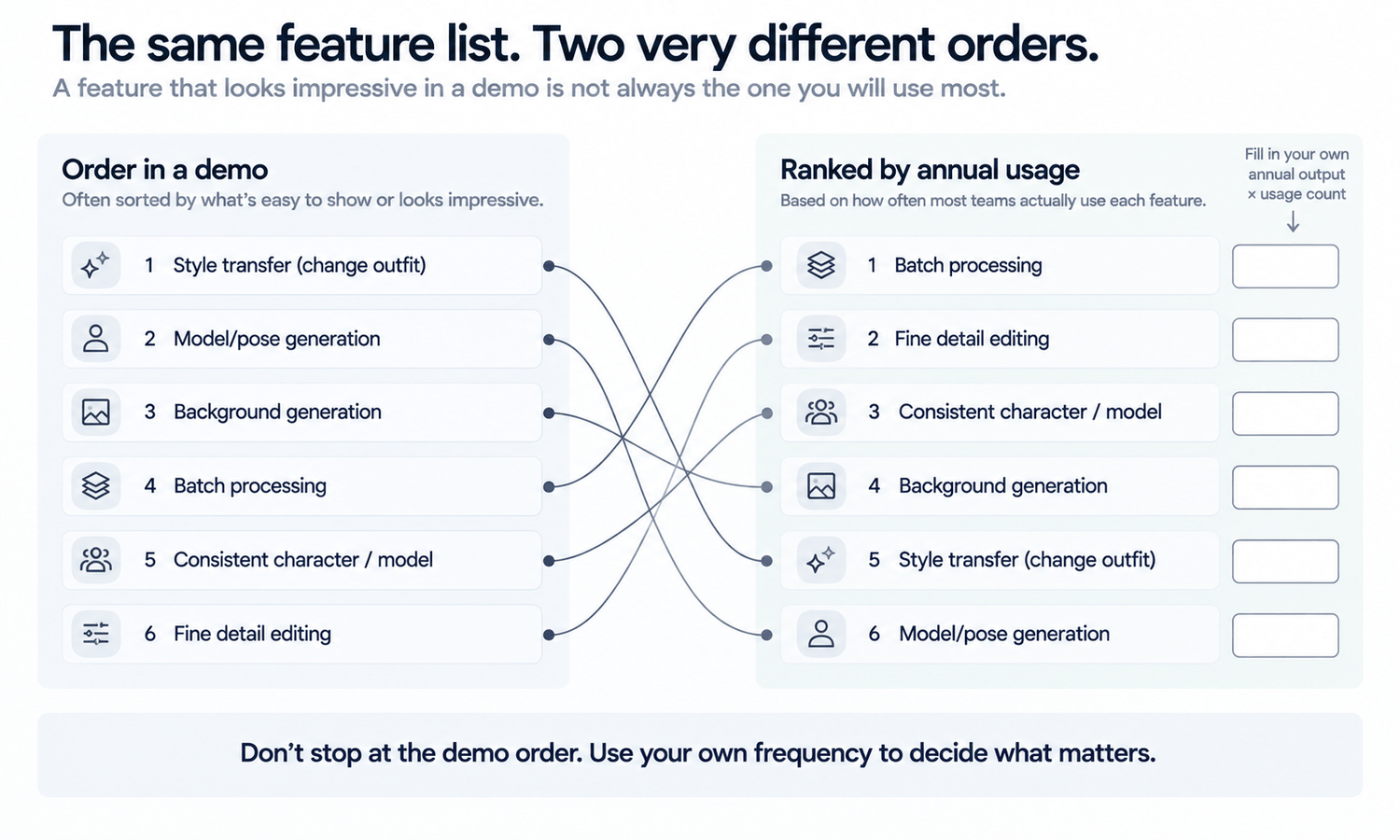
A feature list tells you what a tool can do. It does not tell you how often you will do it, and that second number is what decides whether a workflow is comfortable or exhausting.
Buyers evaluate at a frequency of one. Somebody demonstrates a capability, it works, it goes on the list. Operations then runs at a frequency of hundreds, where a capability used once a season contributes almost nothing and two seconds of friction per image contributes an hour a week.
That mismatch is why a tool can pass an evaluation and be resented by month three. The correction is arithmetic rather than judgment: multiply every feature by how often it will actually be used.
Multiply by frequency
| Feature | How often you use it | What decides whether it matters |
|---|---|---|
| Getting from an output back to the source it came from | Every output, forever | Seconds. At volume this is the largest recurring cost in the workflow |
| Correcting one region instead of rerunning | Every partial failure, which is most batches | Whether a near miss costs a cycle or a moment |
| Recording and reapplying a settings profile | Every batch | Whether a defect found later can be traced to what the batch shared |
| Reprocessing a batch when a defect is shared | Rarely, and decisively when it happens | Whether a shared defect is one fix or several hundred |
| Model direction, scene, and format variants | A handful of times per season | Whether it exists. Friction here never accumulates |
| Colorway and fabric exploration | Once per range decision | Whether it exists, and whether the outputs are labeled as candidates |
The third column is the whole point. Nothing in it is a capability question, and all of it is decided by capabilities.
Anything searching for an ai free clothes changer is starting at low or no cost, which makes this more acute rather than less: when generation is cheap, the per-image friction is the entire cost, and it is the part nobody demonstrates.
The per-image features nobody demonstrates
These are used on every single output, which makes seconds matter and makes them invisible in a demo, since a demo has one output.
The comparison against source is the clearest case. Logos, printed text, care labels, and small hardware get compared against the source image on every single on-model output, without exception, and reconstructed detail lands almost right — a letterform slightly off, a stitch count wrong, a zipper pull the wrong shape. Whether that check takes two seconds or two minutes is not a quality question about the tool; it is the difference between a check that survives a busy week and one that decays into a general look.
Ask how you get from an output to the source it came from. If the answer involves a filename convention, a shared drive, or somebody's memory, the multiplication has already given you the answer.
The arithmetic is worth doing rather than describing. Take the number of images you publish in a year, multiply by the seconds that operation takes in your setup, and divide into working days. Two different answers to the same question — one where the source is adjacent and one where it has to be located — commonly differ by a factor large enough that no other line on the feature list matters as much. Nothing about that calculation depends on output quality, which is why it never appears in an evaluation built around output quality.
The second per-image feature is regional correction. When one area is wrong and the rest is sound, being able to fix that area with a targeted correction rather than rerunning removes an entire cycle rather than shortening one, and it keeps the rest of a set aligned. Partial failures are most of what a real batch produces, so this is a per-image capability rather than an edge case.
The per-batch features that decide whether volume is possible
Used once per run rather than once per image, and still frequent enough that friction compounds.
Three matter. Whether a settings profile can be recorded and reapplied, since a batch that cannot be reproduced identically cannot be diagnosed later. Whether identity fields travel with the files rather than being re-entered, since anything re-typed is wrong on some percentage of items. And whether a batch can be reprocessed when a defect turns out to be shared, which is the operation that makes correlated failure survivable.
That last one is worth pressing on in an evaluation, because it is the difference between a defect being one fix and being two hundred. Ask for a demonstration rather than a description, on a batch rather than an image.
The reason these three sit together is that they are the ones correlated failure depends on. Outputs sharing a source and a settings profile fail together, which is bad news for detection and good news for repair — but only if the settings were recorded, the files can be identified, and the batch can be reprocessed. Miss any one of the three and a shared defect becomes a manual sweep. That is a scenario worth walking through in an evaluation rather than discovering in a season.
The per-collection features that get evaluated instead
These are real, they are worth having, and they are used a handful of times per season.
Model direction and scene control, format and channel variants, colorway and fabric exploration at the point a range is being decided — each of these does genuine work, and each is used at a frequency where a few seconds of friction never accumulates into anything.
The mistake is not valuing them. It is weighting them as heavily as the per-image features when they will be used two orders of magnitude less often, which is exactly what a demonstration encourages, since a demonstration shows each feature once.
What no feature supplies
Some things are outside a feature list entirely, and a buyer's guide that omits them invites a question the product cannot answer.
The output is a visual asset. It does not predict fit, determine sizing, model how a fabric behaves in motion, or forecast returns. Those come from measurements, a graded pattern, a physical sample, and your own data. No tier and no capability changes that, because the limit is in what the asset is.
So a size chart is not a feature, and fit language on a page has to trace back to the measurement chart and the fit session. And no purchase should be scoped against a return-rate or conversion outcome, since both sit at the end of a chain running through sizing, price, assortment, and traffic.
Color is not a feature either. Screen color is not a physical reference, exact code matching is not something to promise, and the gap between a monitor and a roll of cloth stays open regardless of display quality. Colorways get settled by strike-offs against an agreed standard, which is a physical step no software removes.
Footwear is not covered by this class of workflow, and lace and open work, sheer fabrics, complex prints, and heavily layered looks are documented weak spots. Those are category verdicts rather than gaps a feature closes.
Running the multiplication before buying
The exercise takes an afternoon and reorders most shortlists.
-
Write your annual output volume, then write how many times each feature on the list would be used against it
-
Time the two per-image operations on your own styles: getting from an output to its source, and correcting one region
-
Ask for a batch-level demonstration of reprocessing a shared defect, on more than one image
-
Score per-image friction in seconds and per-collection capability in whether it exists, since those are different units and averaging them hides the decision
-
Check terms from the current listing rather than from any article, including this one, since pricing and entry conditions change
In Lightchain AI (apparel AI) the uploaded source stays beside every AI Virtual Try-On output derived from it, which is the specific property that makes the first timed operation short. Across a catalog at scale that difference compounds into the largest recurring cost in the workflow. Whether the work runs through Lightchain AI or a camera, the features that decide the outcome are the ones nobody thinks to demonstrate.
Frequently asked questions
Is there a free version of this kind of tool?
Terms change, so read the current listing rather than relying on any article. What does not change is that per-image friction costs the same whatever generation costs, and at low cost it becomes the dominant expense rather than a secondary one.
Which feature should we weight most heavily?
Whichever one you will perform on every output, which in practice is getting from an output to its source. It is used more than anything else on the list and demonstrated less than anything else, which is a poor combination for a buyer.
How do we time per-image operations fairly?
On your own styles, with the person who will actually do it, in a normal week rather than in a scheduled session. A timing taken during an evaluation is a favorable case, and the interesting number is the one from an ordinary Thursday.
Are the per-collection features not worth paying for?
They are, and they should be valued at the frequency they will be used. The error is weighting a twice-a-season capability equally with an every-image one, which is what a feature list encourages by listing them side by side.
What if a tool is strong on per-image and weak on per-collection?
That is usually the better trade at volume, since per-collection gaps can be worked around a few times a season and per-image friction cannot be worked around at all. Check which of your constraints is actually binding before deciding.
Can we defer this and evaluate on output quality first?
Output quality is worth checking and takes an afternoon. The frequency exercise takes a similar afternoon and predicts more about month six, so there is little to gain by ordering them that way rather than doing both.
In closing
Feature lists are written at a frequency of one and operated at a frequency of hundreds, and the gap between those two is where a tool becomes comfortable or exhausting. Multiply each capability by how often you will use it: seconds on a per-image operation compound into hours, a per-batch capability decides whether a shared defect is one fix or many, and a per-collection capability is worth having at the frequency it is used. The features that decide the outcome are the ones a demonstration has no way to show.
Start here
Take the feature list you have been given and write a number next to each line: how many times per year would we do this. The list reorders itself, usually dramatically, and the items that move to the top are the ones nobody demonstrated. Then time those two or three operations on your own styles, with the person who will own them, before looking at anything else on the list.
**Start with the on-model workflow → **https://www.lightchainai.com/global/solutions/aiVirtualTryOn