
A wholesale brand's images are collateral. A buyer sees the sample, the sales rep answers questions, and a picture that oversells gets corrected by a garment in a showroom before anybody's money moves.
A direct-to-consumer brand has none of that. The image is the entire pre-purchase experience, and it is also the document a customer will hold you to afterwards. When somebody opens a parcel and decides the thing inside is not what they bought, the page is the evidence they are comparing against.
That changes which decisions about an ai clothe changer workflow are reversible. A campaign image can be swapped on a Tuesday. A product page image that several hundred people have already purchased against is a different kind of object, and the decisions that produced it are correspondingly harder to unwind.
In DTC the image is the product description of record
Treating product imagery as marketing output is the assumption underneath most of the expensive mistakes here. Marketing output is judged on whether it performs. A product description is judged on whether it is accurate, and accuracy has a different failure mode: it does not show up as weak engagement, it shows up as a parcel coming back.
The practical consequence is that once a catalog is populated, changing your mind about how the images were made means redoing the catalog rather than adjusting a setting. Six decisions carry that weight, and they are all available to make now, cheaply, before anything exists.
The six decisions, and what it costs to change each one later
| Decision | When it locks | What reversing it costs |
|---|---|---|
| The source photo standard | The first time a batch is captured and published | Reshooting every style captured under the old standard, since nothing generated from it can be corrected downstream |
| Who approves, and against what | Culturally, within about two weeks of starting | A habit change rather than a policy change, which is why it is worth deciding in writing on day one |
| What the product page claims about fit, size, and color | The first time a customer buys against it | Contact with customers who already bought, and a catalog-wide copy pass |
| Where masters live and how channel versions derive | When the second channel is added | Rebuilding the relationship between masters and derivatives across everything published so far |
| Which categories are in scope | Loosely, and revisable each season | Little, provided the failed categories were recorded with a reason |
| Variant count per style | Nothing locks; it is a weekly choice | Nothing, which is why it should not absorb the attention the rows above deserve |
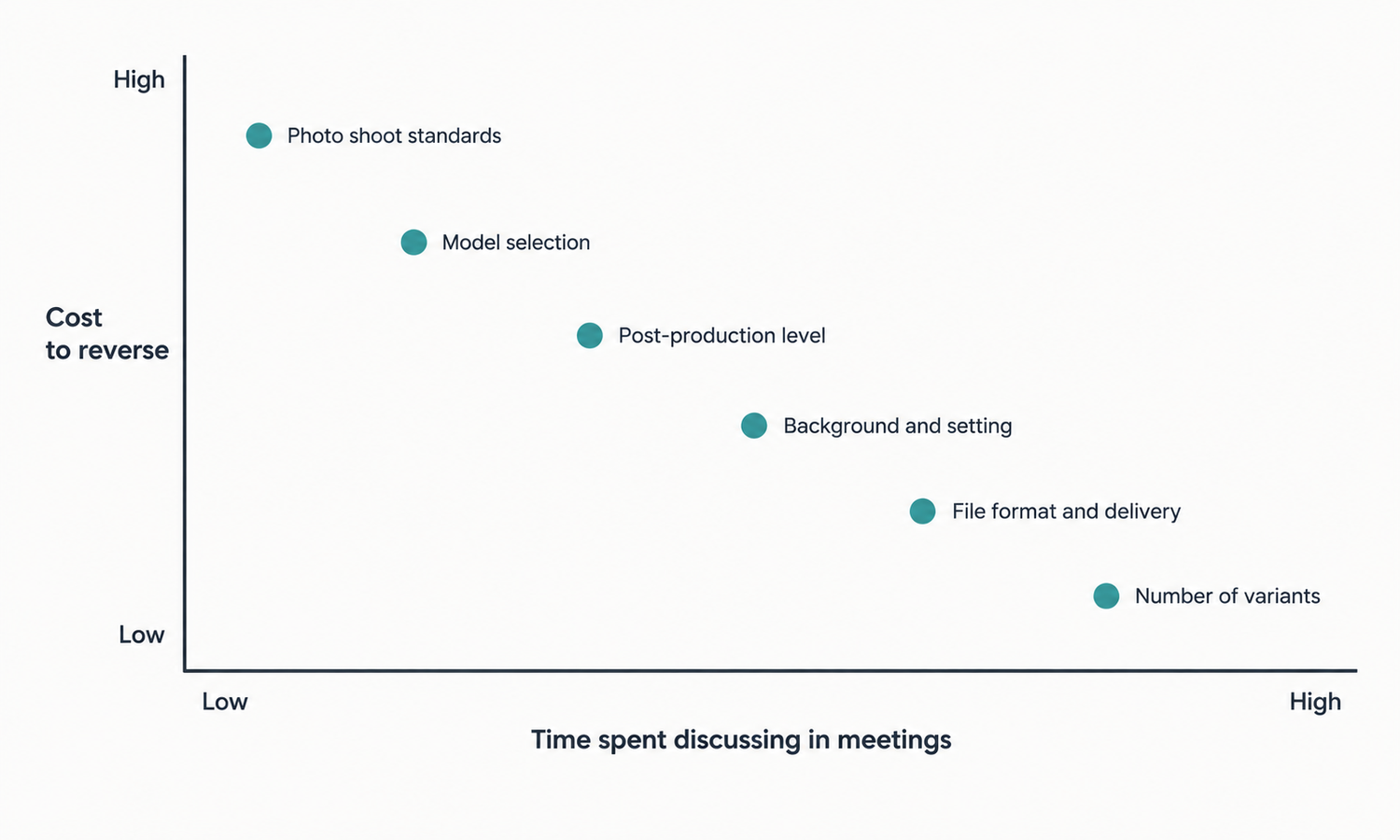
The pattern is that the expensive rows are the boring ones. Nobody has an opinion about background distance, and everybody has an opinion about which pose looks better, so meetings fill with the second while the first gets settled by whoever happened to be shooting that week.
Decide the source standard first, and then freeze it
The source photographs are the only description of each garment the rest of the workflow will ever have. Everything generated is a derivation from them, which means inconsistency entering here cannot be corrected downstream and stays invisible until a customer scrolls a collection page and something feels off without being nameable.
-
One position, one distance, one background, one light, written down with reference photographs rather than described in words
-
Every piece shot complete and unobstructed, since a later styling decision has not been made yet
-
One shoulder line and one center-front axis, so pieces that appear together on a collection page share a geometry
-
A scale reference in frame, because relative proportion between styles is what a grid exposes
-
Hardware and printed detail captured close enough to be checked later, not only close enough to read
Freeze it for a season. The instinct to keep improving the setup is what produces a catalog that reads as three different brands, and improving mid-season costs more than any gain it delivers. Working in Lightchain AI (apparel AI) or anywhere else, holding the capture beside the outputs it produced is what lets a badly shot piece be traced to everything derived from it rather than discovered by accident.
Decide who approves, and against what
In wholesale, an error gets caught by a buyer who has the sample. In DTC there is nobody between the file and the customer, so the last reviewer inside your company is the last reviewer there is.
That makes the split between two kinds of review a structural decision rather than a process nicety. The conformity check asks whether the output matches its source, has a right answer, and can never be sampled. The judgment pass asks whether the image is good and can be sampled or delegated. Merging them means the judgment pass absorbs the time and the conformity check quietly stops happening, which is the sequence that puts a wrong garment on a product page.
Inside the conformity check, one rule holds without exception. Logos, printed text, care labels, and small hardware get compared against the source image on every single output. Reconstructed detail lands almost right — a letterform slightly off, a stitch count wrong, a zipper pull the wrong shape — and in DTC the person who finds it is holding the garment and composing an email. When a single region fails and the rest of the frame is sound, a targeted correction to that region is smaller than a rerun and keeps the rest of the catalog comparable.
Decide the model and scene policy at the same time, since a catalog is read as a set. One model direction and one scene per category in Model Studio, changed between seasons rather than within one.
What you must not decide to claim
Some decisions look like choices and are not. The output is a visual asset. It does not predict fit, determine sizing, model how a fabric behaves in motion, or forecast returns. Those come from measurements, a graded pattern, a physical sample, and your own data.
Three things follow for a product page. A size guide cannot be assembled from imagery, however much of it there is, because a size guide is a measurement document and one built from pictures is a sizing claim with nothing behind it. Fit language on a page has to trace back to the measurement chart and the fit session rather than to how a garment looks in a generated image. And no asset can be presented internally or externally as the reason a return rate or a conversion figure moved, since both sit at the end of a chain running through sizing, price, assortment, and traffic.
Color is the one customers argue with most. Screen color is not a physical reference, exact code matching is not something to promise, and the gap between a monitor and a roll of cloth stays open regardless of display quality. Colorways get settled by strike-offs against an agreed standard, and values must never be read off a generated asset and published as a product attribute.
Decide the storefront question separately from the catalog question
Two different projects get bundled together because they share a name. Producing catalog assets is an operations project with a review queue and a source standard. Offering shoppers something interactive on the storefront is a customer-experience project with different risks, a different owner, and a different failure mode.
Running both at once is tempting and costs you the ability to interpret anything that happens afterwards. If the catalog imagery changed in the same month a storefront feature launched, neither can be evaluated, and you will spend a season arguing about which one did what.
-
Sequence them: get the catalog production stable first, since the storefront experience depends on the same assets being accurate
-
Give them separate owners, because one is a production problem and the other is a merchandising and support problem
-
Decide in advance what the storefront feature is allowed to say, which is the same boundary as everything above and gets tested harder because a shopper is reading it
-
Budget them separately, since credit consumption for catalog production and for a storefront feature scale with completely different things
On cost, the platform publishes credit packages starting at $9.90 for 600 credits, described by the company as roughly 20 images, and a Shopify-side option exists as Lightchain AI Virtual Try-On for Shopify with its own published tiers. Both should be checked against current listings before they enter a plan, and neither figure tells you your cost per published product page, which depends on how many attempts each accepted image took.
Frequently asked questions
What is the single decision to get right before anything else?
The source photo standard, because it is the only one whose consequences cannot be corrected downstream. Every other decision on the list can be revised with effort proportional to how much catalog exists. This one requires reshooting whatever was shot before you changed your mind.
We already have a catalog shot inconsistently. Where do we start?
Start with the styles that carry the most traffic and the ones that appear together on collection pages, since inconsistency is most visible in a grid. Reshoot those to a single standard and let the long tail wait. A partial catalog at one standard beats a complete one at four.
Should we say on the product page that images are generated?
Decide it once as a policy rather than per product, and if you disclose, do it in the same place every time so it reads as a standard rather than a caveat. Whatever you choose, the more consequential commitment is that the image accurately represents the garment that ships. Disclosure without accuracy does not help you.
Who should own the conformity check in a small DTC team?
Somebody other than the person who made the image, even if that means the founder checks the designer's work or the reverse. The check is comparison against a source, so it does not require the taste that produced the image, and separating it is what stops it from being absorbed into an appreciative look at your own output.
How many product images per style should we plan for?
Decide the number before generating rather than discovering it, and set it per style rather than globally so a hero style can carry more than a basic one. Every extra image adds a conformity check and a page-load consideration, and adds nothing until somebody has chosen between them.
Can we start with the storefront feature and do the catalog later?
You can, and the risk is that an interactive experience built on inconsistent source assets makes the inconsistency more visible rather than less. The storefront draws attention to the garments; the catalog decides what there is to see. Sequencing the other way is usually cheaper.
In closing
The decisions that matter in a DTC workflow are made before anything is generated, and most of them are not about the software. Write the source standard and freeze it. Separate the conformity check from the judgment pass and give them different owners. Keep fit, sizing, and color claims tied to measurement and strike-offs rather than to imagery. Sequence the catalog project ahead of the storefront one so each can be judged. None of that requires a tool decision, and all of it decides what the tool can be worth.
Start here
Before generating anything, write two pages. The first is the capture standard, with reference photographs rather than adjectives, and a date you will not revisit it before. The second is a one-line answer to each of the six decisions in the table above, including the ones you would rather leave open. The value is in having a written position to disagree with later, since the alternative is discovering three months in that four people held four different positions and the catalog shows all of them.
**Start with catalog-scale asset work → **https://www.lightchainai.com/global/solutions/scaleECommerce