
The first test decides what a print team believes about this for the next year, which makes the choice of style more consequential than the test itself.
Most teams pick their simplest print — a small tossed repeat on a plain shape — because it is likely to work and a good first result is easier to report. That choice produces confidence and no information. The print that should go first is the one whose failure would be most expensive to discover in six months.
Pick by consequence, not by ease
Consequence in print work has a specific shape: it follows repetition. A print that appears on twelve styles carries twelve times the exposure of one that appears on a single dress, and any error in how it is handled propagates across all of them.
Choose your highest-repeat print for the first test. Not the newest, not the most visually interesting — the one your range leans on most heavily. If it behaves, a large share of your imagery is derisked in one afternoon. If it does not, you have found that out while the season can still absorb it.
A second candidate, if you have capacity for two, is whichever print carries an engineered element. Placement prints and border designs fail differently from all-over repeats, and knowing which failure mode you are dealing with shapes everything afterward.
Resist testing both in the same session. Two prints run together produce a comparison rather than a finding, and the comparison is between two things that were never going to behave the same way. Sequence them, and let the first one establish the method before the second one stresses it.
Test the three properties the source cannot supply
A print test is not a general image test. Three properties are invisible in the source photograph and get reconstructed, and those are what the test exists to examine.
Scale is first. Does the repeat read at the size it physically is, against the body shown. This is the property most likely to be subtly wrong and least likely to be noticed by anyone reviewing casually.
Placement is second. Where does the repeat fall relative to the seams, the center front, the shoulder. On an all-over print this is loose; on anything engineered it is the whole design.
Orientation is third and quickest to check. Directional prints rotated are simply a different fabric, and the check takes seconds once someone thinks to make it.
Everything else — color, texture, motif fidelity — is a general imaging question and will be answered incidentally. Do not let it dominate the test.
Saying that in advance matters, because a print team looking at a generated garment will notice color first. Color is the thing they are trained on and it is the thing this test is least able to settle, so an agreement to set it aside for the duration keeps the session pointed at the questions it can answer.
What to hold constant
| Variable | Fix it by | Why |
|---|---|---|
| The source photograph | Use one flat-lay, not several | Different sources produce different results for reasons unrelated to print |
| The garment | One style, one size, one colorway | Variation elsewhere makes the print finding unreadable |
| The operator | One person runs everything | Skill differences exceed most other effects |
| The viewing size | Judge at the destination size only | Scale errors are size-dependent by definition |
| The reference | A stated repeat measurement, written before | Otherwise the judgment is against an impression |
The last row does the most work. Write down what the repeat physically measures and how many times it should appear across a stated chest width before generating anything, then compare the output against that. A test without a stated reference produces a discussion about whether it looks right, which is the conversation the test was supposed to replace.
Pass criteria a print team can actually use
Express the criteria as observations rather than as impressions, so that a second person reaches the same verdict.
The repeat appears the stated number of times across the stated width, within a tolerance you have named. The motif orientation matches the specification. Where the print is engineered, the named alignment points fall where the specification puts them. No motif is dissolved into texture at the destination size.
Four checks, each answerable yes or no. Record them per attempt rather than per session, since a session that took six attempts to reach a pass has told you something different from one that passed immediately.
Have someone who did not run the session apply the criteria. An operator judging their own output against criteria they watched being met will pass work that a fresh reader would query, which is not a comment on anyone's integrity — it is what happens when the person judging has seen the attempts that came before.
Read the failures by type
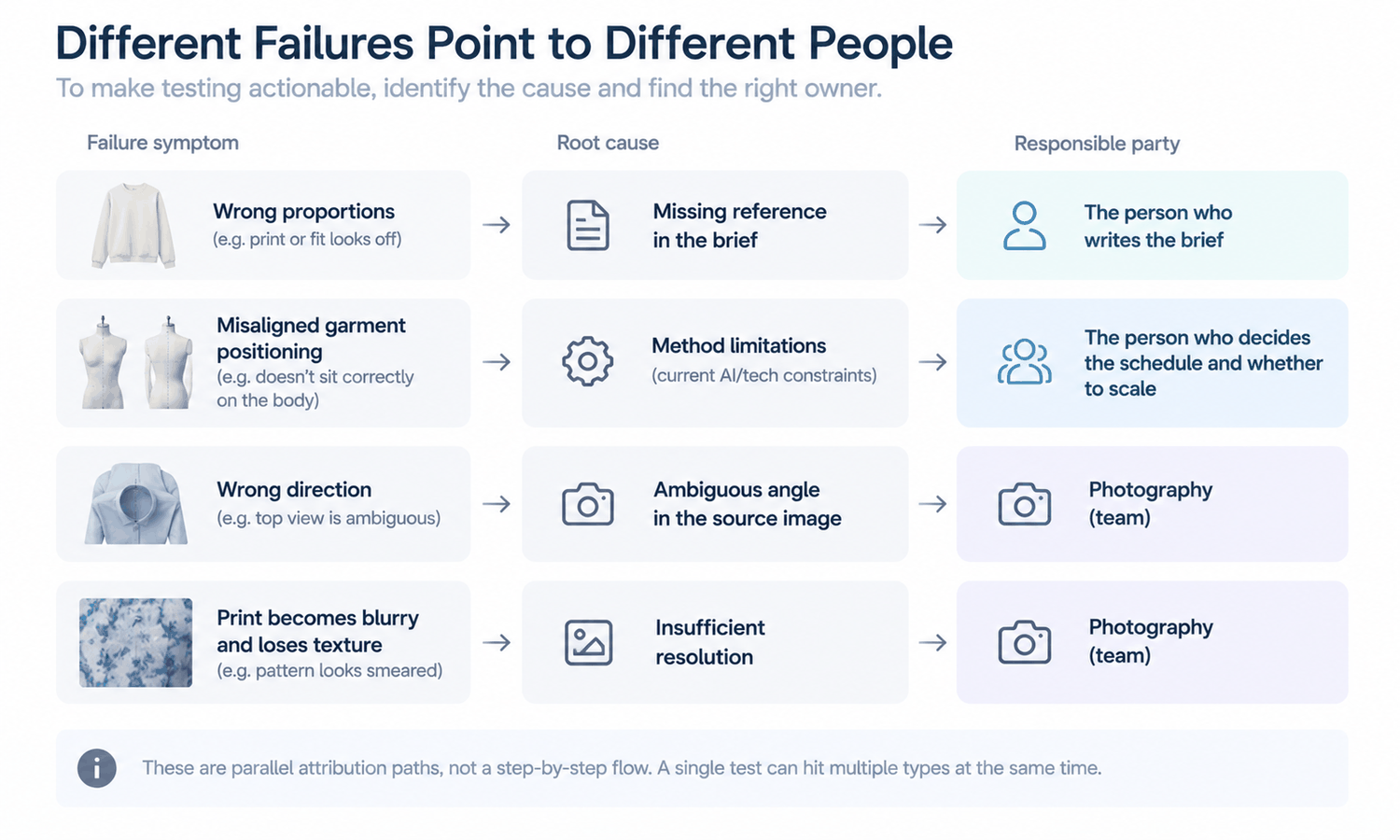
The point of a controlled test is that a failure points somewhere specific.
A scale failure usually points at the absence of a stated reference rather than at the tool, and it resolves once the brief carries a measurement. A placement failure on an engineered print points at the method rather than the brief — reconstruction produces continuity more readily than alignment, and that is a limit rather than an instruction gap. Where only the alignment is wrong in an otherwise sound asset, rebuilding that region against a reference is the correction, not another full run. An orientation failure points at an ambiguous source, since a flat-lay viewed from above often does not establish direction, and a repeat that dissolves into texture is fixed at the source or by a higher output setting, not by a better instruction.
Motif dissolution points at resolution, which is a photography decision made before any of this and fixable only there.
Four failure types, four different owners. A test that produces a verdict without a type has not saved anyone any work.
The ownership point is what makes the test worth running rather than simply forming an opinion. A verdict of it does not handle prints well cannot be acted on by anybody. A verdict that scale failed because no reference was stated lands on the person who writes briefs, and gets fixed the same week.
What one style will not tell you
The scope of the finding is narrower than teams tend to assume, and stating it protects the result.
One print on one style tells you how that print behaves on that shape. It does not establish behavior across silhouettes, since placement interacts with the cut. It does not establish consistency across a set, because consistency is a property of a sequence rather than of an asset. And it says nothing about how the print will look on the actual fabric, which remains a strike-off question.
The output is a visual asset throughout. It does not predict fit, determine sizing, model how a fabric behaves in motion, or forecast returns. Screen color is not a physical reference, and a colorway that reads correctly in the test still needs a strike-off and an agreed standard before anyone commits.
Turning one test into a standing rule
The value of the first test is the rule it produces, not the images.
If scale passed once a stated reference was in the brief, the rule is that every print carries a repeat measurement from now on. If engineered placement failed, the rule is that engineered prints are photographed conventionally or checked individually rather than batched. If orientation was ambiguous, the rule is that every directional print states which edge is up.
Two or three rules is the realistic output of a first test, and that is enough. A team that emerges with a page of rules has been documenting preferences rather than findings, and the page will not be read.
Write those rules against the print rather than against the style, and file them with the artwork in a shared library rather than in a season folder, so they get reused. Prints outlive styles, and a rule attached to a season expires with it — see Design with Purpose for the operations those rules govern, and AI Virtual Try-On for the on-model output the rules apply to.
Questions print teams ask
Why not start with an easy print? Because an easy print produces confidence rather than information. The highest-repeat print carries the most exposure, and derisking it is worth more than a comfortable first result.
How many attempts should a pass take? Record it rather than target it. A pass on the first attempt and a pass on the sixth mean different things about the workflow, and the count is part of the finding.
What tolerance should we allow on scale? Name one before the test rather than adopting an external figure, since acceptable variance depends on the print, the garment and the viewing size. The discipline is in stating it, not in the number.
Does a pass mean we can batch this print? On that silhouette, yes. Placement interacts with the cut, so a different shape needs its own check before batching.
Can we approve the colorway from the test? No. Screen color is not a physical reference, and the strike-off governs regardless of how correct the test output looked.
What should the test leave behind? A rule attached to the print, not a folder of images. The images expire with the season and the rule applies to every garment that print reaches.
What the first test is really for
Establishing which of four things you are dealing with — a brief gap, a method limit, an ambiguous source, or a resolution problem — because each has a different owner and a different fix. Choose the print your range depends on most, hold everything else constant, state the repeat measurement before you start, and judge against it at the destination size. One afternoon, one style, and the output is a rule filed with the artwork rather than a set of pictures nobody will look at again.
Run your highest-repeat print through one style this week.
**Write the repeat measurement and the expected count across a stated width first, then generate on a single style, size and colorway with one operator. Check scale, orientation, engineered alignment and motif legibility at the destination size, record the attempt count, and turn whatever failed into a rule filed with the artwork. → **Design with Purpose
About the author
[REPLACE — real person's name, role, relevant experience, LinkedIn URL. No team byline.]